Approaches
Instrument approach types, minima, and the practical differences between published IFR arrival procedures.
Quick Reference
Key points
Short-answer refresher for returning pilots before diving into the full page.
Quick Reference
Key points
Short-answer refresher for returning pilots before diving into the full page.
- Read plates in order: top strip and notes, then plan view, then profile view, then minima and missed approach.
- One RNAV plate can publish LPV, LNAV/VNAV, LP, and LNAV; brief the exact minima line you can use and whether it ends at a DA or an MDA.
- Have the missed approach and decision point fully briefed before the FAF so the approach is one continuous plan, not a late improvisation.
Standards & References
FAA doctrinal and ACS cross-reference
Use this box to line the topic up with the FAA’s primary instrument handbooks, the most relevant ACS task areas, and the knowledge, skill, and risk elements that usually drive checkride evaluation.
- IFH Ch. 9, IFR Flight: approach briefing, stabilized instrument-approach execution, DA/MDA decisions, and missed-approach transition.
- IPH Ch. 4, Approaches: chart interpretation, minima selection, approach families, circling, and missed approach procedures.
- VI.A Nonprecision Approach.
- VI.B Precision Approach.
- VI.D Circling Approach.
Checkride Focus
How this topic is typically evaluated
Use this block as the ACS-ready summary: what task areas this page supports, what the applicant should know, what the applicant should be able to do, and what risks must be managed without prompting.
Checkride Summary
On the practical test, the examiner is looking for the correct minima strategy, a stable approach flown according to the available guidance, and an immediate transition to the missed if the runway or stability standard is not there.
Knowledge
- Identify the approach family, guidance type, and whether the procedure is flown to a DA or an MDA.
- Select the correct minima line, aircraft category, and missed-approach trigger for the specific approach being flown.
- Explain RNAV downgrade logic, including what changes if LPV or LNAV/VNAV is not available.
Skills
- Brief and set up the approach from the correct transition or vectors-to-final entry.
- Maintain lateral and vertical path discipline to DA or MDA without chasing the needles.
- Execute the missed approach immediately when visual references are not acquired or the approach becomes unstable.
Risk Management
- Using the wrong minima line or wrong approach category for the airplane and speed flown.
- Treating advisory glidepath information as approved descent guidance.
- Missing an RNAV downgrade, circling-risk increase, or unstable approach cue while trying to salvage the landing.
On This Page
Approach Families
An instrument approach procedure gets an aircraft from the en route or terminal environment to a point from which a landing can be made or a missed approach can be flown. The main differences between approach types are the kind of guidance they provide, the minima they use, the equipment or approvals required, and how precisely they align the airplane with the runway.
In practice, published approaches fall into three broad families: precision approaches, which provide both lateral and vertical guidance to a decision altitude; approaches with vertical guidance, often called APV, which also use a decision altitude but are not classified as precision; and nonprecision approaches, which provide lateral guidance only and normally use an MDA.
Many modern RNAV (GPS) procedures publish multiple minima lines on the same chart. That means one approach can support several different levels of capability, such as LPV, LNAV/VNAV, LP, or LNAV, depending on aircraft equipment and approvals.
The phrase "what kind of approach is this?" matters because it tells the pilot what to brief and how to fly it. A precision or APV procedure usually supports a stabilized descent to a DA, while a nonprecision procedure may require more careful step-down management, timing, or a continuous descent final approach technique to avoid diving at the end.
Approach Chart Anatomy
Before comparing approach types, it helps to know what parts of the plate actually matter. Every approach chart includes the same core decision points even when the navigation system changes.
- IAF / IF / FAF: The initial, intermediate, and final approach fixes tell the pilot where the procedure is organized and where final descent begins.
- Final approach course: The inbound course flown to the runway or runway environment.
- Glideslope or glidepath intercept altitude: The altitude where descent on the vertical path begins for ILS, LPV, or LNAV/VNAV operations.
- Step-down fixes: Mandatory descent checkpoints on many nonprecision approaches.
- MAP: The missed approach point, reached by distance, timing, waypoint, or facility passage depending on the procedure.
- Minima block: The part of the chart that shows which line applies to the aircraft and equipment.
- Missed approach instructions: The immediate climb, track, and hold actions required if the runway environment is not visible at the decision point.
A good instrument approach brief turns that plate into a sequence: where do I join, what guidance am I using, when do I descend, what minima apply, and what exactly do I do if I go missed?
Reading Approach Plates
An approach plate is easiest to understand when it is read in a deliberate order rather than scanned randomly. The FAA Instrument Procedures Handbook, AIM 5-4-5, Instrument Approach Procedure (IAP) Charts, and the published Terminal Procedures Publication all assume the pilot can move from the plate title and notes, to the plan view, to the profile view, to the minima and missed approach without losing the overall sequence of the procedure.
The practical goal is not to memorize every symbol on first look. The goal is to answer the operational questions in the order they matter: what procedure is this, how do I get established, what path do I fly, what restrictions control me, what minima apply, and what do I do if I cannot land?
Top Strip and Notes
Start at the top of the plate. Confirm the exact procedure title, runway, and navigation source. On RNAV procedures, that means checking whether the plate is RNAV (GPS), RNP, or another PBN-based design; on localizer or ILS procedures, that means confirming the facility and frequency. The top strip also contains important notes such as required equipment, local altimeter limitations, radar requirements, DME requirements, nonstandard takeoff or alternate minimum notes, and in some cases temperature restrictions. Those notes are not background reading. Under FAA guidance in AIM 5-4-5, Instrument Approach Procedure (IAP) Charts, they can change whether the procedure is legal or practical to fly in the aircraft actually being used.
The airport sketch area and communications information should also be scanned early. Even though those items are not part of the final approach path itself, they help the pilot visualize runway environment, lighting, tower frequencies, and how the approach fits into the airport layout. If the notes or plan view show a DME requirement or arc feeder, brief that segment as its own task before the approach workload spikes. The execution side of that handoff is covered in DME Arcs.
Plan, Profile, and Minima
The plan view answers lateral questions: where the IAFs are, what feeder routes or transitions exist, how procedure turns or holds are oriented, where step-down fixes sit laterally, and what the missed approach routing looks like from above. This is the view that helps the pilot understand whether the approach is entered by vectors, a full transition, or a course-reversal segment.
The profile view answers vertical questions. It shows crossing altitudes, glideslope or glidepath intercept altitude, step-down fix altitudes, final approach fix identification, and how the missed approach begins vertically. Many approach errors come from understanding the plan view but not the vertical picture. The profile view is where the pilot confirms exactly when descent is authorized and what altitude must be protected at each segment. The FAA Instrument Flying Handbook emphasizes that a stabilized approach begins with that vertical plan already understood before the aircraft reaches the final segment.
The minima block is read last, but it is never optional. The pilot must select the correct line based on aircraft category, approach capability, and the actual guidance available. This is where many RNAV misunderstandings happen: the avionics may load one final course, but the usable minima may be LPV, LNAV/VNAV, LP, or LNAV depending on equipment status and what service is available. The plate must also be checked for approach-lighting notes, visibility requirements, and circling minima if straight-in landing is not expected.
Practical Reading Flow
A disciplined plate-reading flow usually works best in this order:
- Confirm the procedure title, runway, and navigation source.
- Read every note that affects legality, equipment, altimetry, or limitations.
- Study the plan view to understand how the approach is joined and whether course reversal is involved.
- Study the profile view to identify where descent begins, what altitudes control each segment, and how the missed approach starts.
- Check the minima block for the exact line that applies to the aircraft and current guidance.
- Finish by briefing the missed approach as a separate maneuver, not an afterthought.
In practice, a pilot should be able to point to each of these on the plate before starting the approach: initial fix or vector join, FAF, final course, descent path or MDA strategy, MAP, selected minima line, and first missed approach action. If any of those cannot be found quickly, the plate has not been read deeply enough yet.
Procedure Turns
A procedure turn is a published course-reversal maneuver used to position the aircraft on the inbound course when the approach design does not assume radar vectors, a straight-in transition, or another specific reversal method. In practical terms, a procedure turn answers the question: how do I get turned around and lined up with the final approach course while staying inside protected airspace?
The FAA Instrument Procedures Handbook treats the procedure turn as part of the procedure design, not as an improvisation area. That is why the pilot should think of it as a published segment with limits, not as a generic place to maneuver until things look right.
Purpose and Recognition
On the plate, a procedure turn is identified in the plan view by the barb or by other charted course-reversal depictions, and it is supported by the profile view showing where descent and segment altitudes apply. Its purpose is to reverse direction and establish the aircraft inbound on the intermediate or final approach course in a predictable way. If a pilot sees a course reversal on the chart, the next briefing question is whether the procedure turn is expected, optional, or not authorized for the clearance actually received. AIM 5-4-9, Procedure Turn and Hold-in-lieu of Procedure Turn is the controlling FAA explanation for that distinction.
Procedure turns are most common when arriving at an approach from a direction that does not naturally feed the final approach course. They are less about fancy maneuvering and more about protected geometry. The AIM and FAA approach design guidance assume the aircraft will remain within the published side and distance limits of the maneuver. When the reversal is a hold or HILPT, the protected-side logic in Holding Entry Geometry is the part worth briefing before the fix.
When Not Flown
A procedure turn is generally not flown when the aircraft is being radar vectored to final, when the approach chart says NoPT for the route or transition being used, when the aircraft is established in a published holding pattern in lieu of procedure turn, or when the pilot is cleared for a straight-in segment that bypasses the reversal. This is where reading the plan view and notes matters. A procedure turn that is required from one arrival path may be prohibited from another.
This is also where many briefing errors happen. Pilots sometimes see a procedure turn on the chart and assume it is always part of the approach. It is not. Whether it is flown depends on how the aircraft joins the procedure. The charted path, the published NoPT notation, and the actual ATC clearance have to agree before the maneuver is started, which is why AIM 5-4-6, Approach Clearance and AIM 5-4-9 are worth reading together.
Technique and Limits
The technique should be disciplined and compact. The pilot flies outbound on the published course, remains on the depicted side of the maneuver, reverses direction using the charted course-reversal geometry, and returns inbound established on the approach course. The key is not to invent a prettier shape but to stay inside the protected area that the chart assumes. The Instrument Flying Handbook emphasizes that a procedure turn should be briefed as a complete segment: outbound course, altitude, reversal direction, inbound intercept, and where descent beyond that segment becomes authorized.
Altitude discipline is central. Unless the chart authorizes descent earlier, the pilot remains at the published altitude for that segment until established where further descent is allowed. Lateral protection does not automatically mean descent protection. That distinction matters on nonprecision procedures where the temptation to descend early can be strong once the airplane looks lined up inbound.
A practical procedure-turn brief should answer five questions:
- Am I actually expected or authorized to fly the procedure turn on this clearance?
- What outbound course and altitude apply before the reversal?
- Which side of the course is protected for the maneuver?
- At what point will I be established inbound and able to continue the approach?
- If the airplane gets high, fast, or poorly positioned, do I still remain within the published maneuver limits?
That last question matters because the real risk of a poorly flown procedure turn is not cosmetic. It is leaving protected airspace, descending at the wrong point, or arriving inbound unstable. A careful, briefed, slightly conservative reversal is usually better than a rushed attempt to make the approach look efficient.
Aircraft Categories
Approach minima are not just based on the procedure. They are also based on the aircraft category, which is tied to reference speed. Faster aircraft need more protected space, especially for circling, and therefore often have higher minima.
- Category A: less than 91 knots
- Category B: 91 knots or more, but less than 121 knots
- Category C: 121 knots or more, but less than 141 knots
- Category D: 141 knots or more, but less than 166 knots
- Category E: 166 knots or more
The practical implication is straightforward: the pilot must use the minima appropriate to the speed actually flown. This matters most on circling procedures, where category differences can materially change obstacle clearance and runway maneuvering margin.
Precision Approaches
ILS
Guidance: lateral guidance from a localizer and vertical guidance from a glideslope. Minima: decision altitude. Use: the most common precision approach in civil U.S. operations.
ILS is usually the benchmark for an IFR approach because it offers accurate runway alignment and a stabilized descent path. When the glideslope is unavailable, the same runway may still support a localizer-only approach with higher minima.
Practical considerations: localizer sensitivity increases as the aircraft nears the runway, so small CDI deflections near the threshold represent large corrections. Pilots should also verify the correct localizer frequency, inbound course, and glideslope intercept altitude before descent because an ILS is simple only when it is thoroughly briefed.
GLS
Guidance: precision-like lateral and vertical guidance from a GBAS station at the airport. Minima: decision altitude. Use: limited to airports and aircraft equipped for GBAS operations.
GLS provides ILS-like functionality using satellite-based corrections from the airport. It can support multiple final approach paths without installing separate localizer and glideslope facilities for each runway end.
Practical considerations: GLS is operationally attractive where available because it can support flexible path design and multiple runway-end procedures, but it is only useful if both the airport infrastructure and the aircraft avionics support it.
PAR
Guidance: radar azimuth and elevation guidance provided verbally by a controller. Minima: decision altitude. Use: commonly associated with military or specialized radar facilities.
In a PAR approach, the controller talks the pilot down final, giving heading and glidepath corrections. It is a precision approach because both lateral and vertical guidance are supplied, even though that guidance comes from the controller rather than a cockpit display.
Practical considerations: PAR demands disciplined listening and immediate correction. It is less about interpreting a display and more about precise compliance with the controller's instructions.
Approaches With Vertical Guidance
LPV
Guidance: WAAS-based lateral and vertical guidance on an RNAV (GPS) approach. Minima: decision altitude. Use: common at airports without ILS, provided WAAS capability is available.
LPV is not a precision approach by classification, but operationally it behaves much like one because it gives a stabilized glidepath to a DA. For many GA aircraft, LPV provides the most capable satellite-based straight-in minima available.
Practical considerations: LPV often gives the most runway-friendly minima a non-ILS airport has, but it depends on WAAS availability and correct database currency. A pilot briefing an LPV should also note what fallback minima remain if vertical guidance is lost.
LNAV/VNAV
Guidance: lateral guidance plus approved vertical guidance, usually from WAAS or baro-VNAV. Minima: decision altitude. Use: available only when the aircraft and procedure support the required vertical path source.
LNAV/VNAV gives a glidepath-like descent but usually with slightly higher minima than LPV. Baro-VNAV operations must account for temperature and aircraft limitations, while WAAS-based systems may provide LNAV/VNAV without those same constraints.
Practical considerations: the important briefing question is not just whether LNAV/VNAV exists, but what is generating the vertical path in this airplane. Temperature limits, altimetry requirements, and system capability matter more here than on a typical LPV.
That automation distinction matters enough to study on its own. Use Automation and Avionics Management for the difference between approved VNAV, advisory VNAV, FMA cues, and what Garmin-style panels usually show before the FAF.
RNP AR
Guidance: tightly controlled RNAV path guidance using required navigation performance with authorization required. Minima: procedure dependent. Use: special aircraft, crew, and operator approval.
RNP AR approaches are designed for demanding environments, often where terrain, airspace, or runway alignment require very accurate path control. They are not for general use unless the aircraft and operator hold the necessary authorization.
Practical considerations: these procedures are intentionally restrictive. If a pilot is authorized to use them, the briefing must include not just the plate but the operator's approval limits and any required equipment, monitoring, or contingency actions.
Nonprecision Approaches
LNAV
Guidance: lateral RNAV guidance only. Minima: MDA. Use: widely available on RNAV (GPS) approaches as the basic line of minima.
LNAV remains one of the most common satellite-based nonprecision minima lines. Without approved vertical guidance, descent planning and discipline matter more because the pilot levels at or above the MDA until the runway environment is in sight and the landing can be completed safely.
Practical considerations: LNAV is where a strong nonprecision technique matters. Pilots need a clear plan for step-down compliance, MDA management, and where the missed approach point is actually defined.
LP
Guidance: WAAS-enhanced lateral guidance only. Minima: MDA. Use: available on some RNAV (GPS) procedures where LPV is not published or not available.
LP gives tighter lateral sensitivity than basic LNAV but still no approved vertical guidance. It often appears where terrain or obstacle considerations allow improved lateral containment but not a full LPV glidepath.
Practical considerations: LP can feel more precise laterally than LNAV, but it does not remove the need for disciplined descent management because it still lacks approved vertical guidance.
Localizer
Guidance: localizer lateral guidance only. Minima: normally MDA. Use: often published with an ILS when the glideslope is unusable or when localizer-only service is provided.
Because localizer sensitivity increases as the aircraft nears the runway, localizer approaches demand accurate tracking. They are usually more precise laterally than VOR or NDB approaches and often provide lower minima than other nonprecision procedures.
Practical considerations: localizer-only approaches can tempt pilots to fly them like an ILS. They are not. Without usable vertical guidance, descent technique still must be managed as a nonprecision procedure.
VOR
Guidance: lateral guidance from a VOR radial. Minima: MDA. Use: legacy but still common enough to understand, especially during training and backup planning.
VOR approaches rely on ground-based navigation and are generally less precise than localizer-based procedures. As the FAA continues to reduce parts of the VOR network, their long-term role is narrowing, but many pilots still encounter them in charts and training material.
Practical considerations: VOR approaches require careful station identification, radial awareness, and wind correction. They are useful backup knowledge precisely because they demand the pilot understand underlying course geometry rather than just follow magenta-line guidance.
NDB
Guidance: lateral bearing guidance from an automatic direction finder tracking a non-directional beacon. Minima: MDA. Use: increasingly rare and more susceptible to error sources.
NDB approaches are sensitive to lightning, coastal refraction, bank effects, and station passage issues. They are important historically and still worth understanding, but many pilots will see them less often than RNAV, ILS, or localizer procedures.
Practical considerations: NDB procedures are a reminder that not all instrument guidance is equally stable. Relative bearing interpretation, drift, and susceptibility to environmental error make them more demanding than modern GPS-based procedures. The system picture behind those errors is covered in ADF and NDB Navigation.
LDA and SDF
Guidance: localizer-type guidance that is not full standard ILS localizer service. Minima: often MDA, though some LDA procedures may publish vertical guidance. Use: specialized runway geometry or facility limitations.
An LDA is not aligned closely enough with the runway centerline to qualify as a standard localizer approach. An SDF also uses localizer-type technology but with wider course structure. Both require careful review because they may look familiar on paper while flying differently in practice.
Practical considerations: these approaches deserve extra briefing attention because their names can sound familiar while the runway alignment or lateral sensitivity differs meaningfully from a standard localizer or ILS.
ASR
Guidance: controller-provided radar azimuth guidance only. Minima: MDA. Use: where airport surveillance radar service is available.
ASR approaches are nonprecision because they do not provide vertical guidance. The controller supplies headings and may give altitude advisories, but the pilot remains responsible for altitude compliance and descent planning to published or assigned minima.
Practical considerations: as with PAR, communication discipline matters. The pilot must divide attention between instrument control, altitude management, and rapid interpretation of controller instructions.
Other IFR Arrival Clearances
Circling
What it is: a maneuver to position the airplane for landing on a runway that is not aligned with the straight-in final approach course. Minima: circling minima, usually higher than straight-in minima.
Circling is not a separate navigation system. It is a maneuver flown after reaching circling minima on a published approach. It requires careful attention to weather, runway environment, obstacle clearance, and the protected circling area for the aircraft category.
Visual and Contact
Visual approach: an IFR clearance to continue to the airport visually, usually when the airport or preceding traffic is in sight and weather permits. Contact approach: pilot-requested, requires remaining clear of clouds with at least 1 statute mile flight visibility and reasonable expectation of proceeding to the airport.
Neither of these is a published instrument approach procedure. They are IFR arrival clearances that reduce reliance on a published final segment when weather and pilot judgment allow. A contact approach in particular places substantial responsibility on the pilot for terrain and obstacle clearance.
RNAV Minima Selection
Modern RNAV (GPS) charts often publish several minima lines on one plate, and pilots need to brief which one actually applies before beginning the approach. The avionics may load the same final approach course, but the legal and operational minima depend on system capability and available guidance. For the system side of scaling, sequencing, and downgrade awareness, pair this section with GPS and RNAV Systems.
- LPV: Use when WAAS and avionics support LPV guidance and the procedure provides it.
- LNAV/VNAV: Use when approved vertical guidance is available, whether from WAAS or a qualified baro-VNAV source.
- LP: Use when the procedure supports LP but no approved vertical guidance is available.
- LNAV: Use as the lateral-only fallback line when the higher-capability lines are not available or not authorized.
This matters because a lost glidepath, a WAAS issue, or a database/equipment limitation may force the pilot to continue using a different minima line or abandon the approach entirely. One of the most important RNAV briefing questions is: if the avionics downgrade, what minima line remains valid?
Minima Comparison Table
The table below summarises the five most common IFR approach types side-by-side. Typical minima ranges are general references — published values vary widely by procedure, location, and aircraft category.
| Approach type | Lateral guidance | Vertical guidance | Limit type | Minimum equipment | Typical HAT range |
|---|---|---|---|---|---|
| ILS Cat I | Localizer (angular) | Glideslope (angular) | DA | ILS receiver, glideslope capable avionics | 200 ft (Cat I floor); many 200–300 ft |
| LPV | WAAS GPS (linear near FAF, angular on final) | WAAS glidepath | DA | WAAS-capable IFR GPS with LPV annunciation | 200–400 ft; some as low as 200 ft HAT |
| LNAV/VNAV | GPS (linear, ±0.3 nm on final) | WAAS or approved baro-VNAV | DA | WAAS GPS or baro-VNAV with approved avionics | 300–500 ft; typically 50–100 ft above LPV |
| LP | WAAS GPS (angular on final, like a localizer) | None | MDA | WAAS-capable IFR GPS with LP annunciation | 300–500 ft; used where LPV not available |
| LNAV | GPS (linear, ±0.3 nm on final) | None | MDA | IFR-approved GPS (WAAS or non-WAAS with RAIM) | 400–600 ft typical; higher on obstacle-limited procedures |
The key operational takeaway: ILS and LPV share a DA-based decision structure and similar minima ranges, but LPV requires no ground infrastructure. LNAV/VNAV adds vertical guidance above LNAV with a DA, making it meaningfully safer for the descent phase. LP and LNAV are both MDA-based, but LP uses tighter lateral scaling thanks to WAAS.
Minima and Descent
Decision altitude or height (DA/DH) is used on precision approaches and APV procedures. The airplane descends on a vertical path to the DA, and by that point the pilot either has the required visual references listed in 14 CFR § 91.175(c)(3) and can continue, or executes the missed approach.
Minimum descent altitude (MDA) is used on nonprecision approaches. The pilot may descend to but not below the MDA unless the required visual references are in sight and the landing can be made normally under 14 CFR § 91.175(c). That means nonprecision procedures often require more deliberate step-down planning or a continuous descent technique to avoid diving and leveling late.
For approach briefing and execution, the key questions are: what guidance do I have, what minima line applies to this aircraft, what kind of missed approach point is used, and when do I have to decide to land or go missed?
Another key distinction is that the decision point is different from the missed approach point on some procedures. On a precision or APV approach the decision is made at the DA on the vertical path. On many nonprecision approaches, the aircraft may reach MDA earlier and continue level until the actual MAP, which is why timing or waypoint awareness matters so much.
Weather Decision At Minima
Approach choice should always include a weather-specific trap review, not just a minima comparison. The same chart becomes a different risk picture when ceilings are deteriorating, a low inversion is producing LLWS, or convective weather is forcing late runway changes. Use Advanced IFR Weather Interpretation to read the larger forecast picture, then translate it into the final approach decision.
Scenario
Low stratus with a weak alternate
A warm-front deck is lowering faster than forecast and nearby alternates are inside the same system.
Approach effect: choose the straight-in approach with the best lighting and simplest missed, even if a different plate publishes slightly lower numbers on paper.
Scenario
Inversion and LLWS on final
PIREPs and the sounding suggest shear below 2,000 feet with smooth air above the layer.
Approach effect: brief the go-around and first missed-approach mode change before intercept, and avoid accepting a rushed rebrief or high-workload circling plan.
Scenario
Convective weather near the terminal area
Radar shows a line with narrow gaps and ATC is already changing runways and vectors.
Approach effect: do not let a last-minute runway assignment force an unbriefed approach. Delay, hold, divert, or request the approach that preserves stability and escape options.
Missed Approach
A missed approach is not an afterthought. It is part of the instrument approach procedure and should be mentally loaded before descent begins. If the runway environment is not in sight at the required point, or if the approach becomes unstable, the pilot must transition immediately to the published missed approach. AIM 5-4-21, Missed Approach is explicit that obstacle protection assumes the miss begins from the DA, DH, or MAP as published, not from a late improvised salvage below minima.
A practical missed-approach brief includes four items: power, attitude, navigation source, and initial routing. That means knowing what to pitch for, which mode or source should be active, what altitude to climb to first, and where the initial track or hold begins.
Approach choice should account for missed-approach complexity. A slightly higher-minima procedure with a simple climb and straight-ahead routing may be safer than a lower-minima procedure that demands immediate turns, terrain awareness, or rapid reconfiguration in poor weather.
Choosing and Briefing
When several approaches are available, the best choice is not always the lowest minima. Wind, runway length, lighting, aircraft equipment, WAAS availability, icing, convective weather, and missed-approach complexity all matter. A higher-minima approach with simpler execution may be the safer option.
A practical briefing should confirm the navigation source, approach type, final approach course, altitude restrictions, step-down fixes, glidepath or glideslope intercept altitude, minima line, missed approach instructions, and whether circling is expected. That is what turns a chart into an actual plan.
A strong briefing also answers what can go wrong: what happens if the glidepath fails, what minima line becomes relevant if the avionics downgrade, what approach lights or runway environment are needed to continue under § 91.175(c)(3), and what the first three actions are if the pilot goes missed. That level of briefing is what makes approach execution calmer when the workload rises.
Real-Chart Walkthroughs
These examples use current FAA d-TPP charts so the briefing stays tied to a real plate instead of a generic diagram. Because FAA chart PDF filenames change every cycle, treat the linked PDFs as working examples and confirm the latest version in the FAA Terminal Procedures Search before using any chart in actual flight.
The repeated questions are deliberate: how do I brief it, what do I set, what do I say, what do I expect by segment, and what traps are specific to this procedure type? That is the difference between recognizing an approach name and actually being ready to fly it.
ILS Example: KOSH ILS OR LOC RWY 36
Real chart: FAA PDF, ILS OR LOC RWY 36 at Wittman Regional (KOSH). Keep the FAA search results for KOSH handy so the current cycle is easy to recheck.
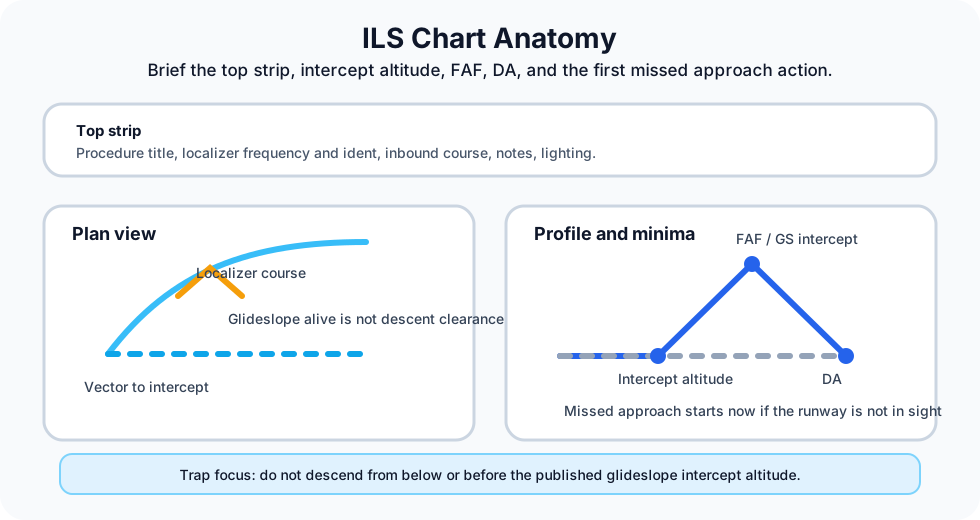
- How to brief it: verify the exact procedure title, localizer frequency and ident, inbound course, glideslope intercept altitude, FAF, DA, lighting notes, and the missed approach. Brief the localizer-only fallback as a separate plan, not as a vague backup.
- What to set in the avionics: tune and identify the localizer, set the inbound course, load the approach with the expected transition or vectors-to-final, set the intercept altitude and missed-approach altitude bugs, and preselect the published missed approach hold if the navigator supports it.
- What to say to ATC: the key call is the clearance readback, such as “Cleared ILS runway 36 approach.” If you go missed, be ready with an immediate report such as “Oshkosh Tower, Skylane 34X missed approach, published.”
- What to expect at each segment: on vectors, remain at the assigned altitude until established and at the published glideslope intercept altitude; capture the localizer first, then descend only when glideslope capture occurs from the proper altitude; at DA either continue with the required visual references or transition instantly to the miss.
- Common traps: descending when the glideslope comes alive from below the intercept altitude, chasing the localizer with large corrections inside the marker area, and failing to rebrief immediately if the glideslope drops out and the procedure becomes localizer-only.
Audio-style ATC example
Approach: “Skylane Three Four X-ray, five miles from JENKS, turn right heading three three zero, maintain two thousand five hundred until established, cleared ILS runway three six approach.”
Pilot: “Right three three zero, two thousand five hundred until established, cleared ILS runway three six, Three Four X-ray.”
Tower: “Three Four X-ray, runway three six cleared to land.”
Pilot: “Cleared to land runway three six. If not in sight at DA, Three Four X-ray will go missed on the published.”
LPV Example: KAPA RNAV (GPS) RWY 35R Flown on the LPV Line
Real chart: FAA PDF, RNAV (GPS) RWY 35R at Centennial (KAPA). The current procedure listing is available in the FAA search results for KAPA.
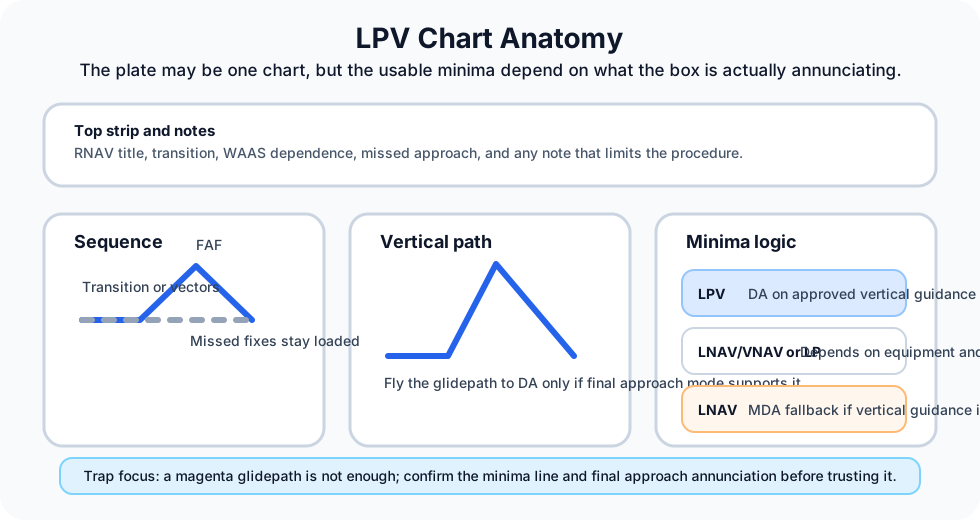
- How to brief it: brief it as an RNAV approach first, then confirm which minima line you are actually using. For an LPV briefing, the critical items are the FAF crossing altitude, the DA, WAAS availability, and what minima remain if the box downgrades before or during final.
- What to set in the avionics: load the full approach early, confirm GPS is the active navigation source, verify the correct fix sequence and missed approach are in the box, and watch for the proper approach-mode annunciation before the FAF. Set altitude bugs for the final approach fix, DA, and missed altitude so the mode logic supports the brief instead of surprising you.
- What to say to ATC: read back the actual clearance, for example “Cleared RNAV runway 35R approach.” If the procedure or runway changes late, say so plainly while still outside the final segment rather than trying to rebuild the box inside the FAF.
- What to expect at each segment: if arriving via a published transition, confirm the navigator sequences correctly through the IAF and intermediate fix; by the FAF the airplane should be fully configured, the correct minima line should be briefed, and the box should be annunciating the expected vertical guidance; then fly the glidepath to DA exactly as a decision point, not as a duck-under target.
- Common traps: assuming a magenta glidepath always means LPV is available, failing to notice a downgrade to another minima line, and chasing VNAV or autopilot modes without cross-checking the published FAF altitude and lateral path.
Audio-style ATC example
Approach: “Bonanza Eight Two Sierra, cross WIPOR at or above eight thousand, cleared RNAV runway three five right approach.”
Pilot: “Cross WIPOR at or above eight thousand, cleared RNAV runway three five right, Eight Two Sierra.”
Pilot, cockpit callout: “LPV armed, missed approach loaded, DA bugged.”
Tower: “Eight Two Sierra, runway three five right cleared to land. Report missed if you lose the runway at minimums.”
LNAV Example: KAPA RNAV (GPS) RWY 35R Flown on the LNAV Line
The same KAPA chart is a useful LNAV training case because it highlights that a single RNAV plate can demand two different mental models. On the LPV line the procedure behaves like a DA-based guided descent; on the LNAV line it becomes an MDA-based nonprecision approach and must be briefed that way.
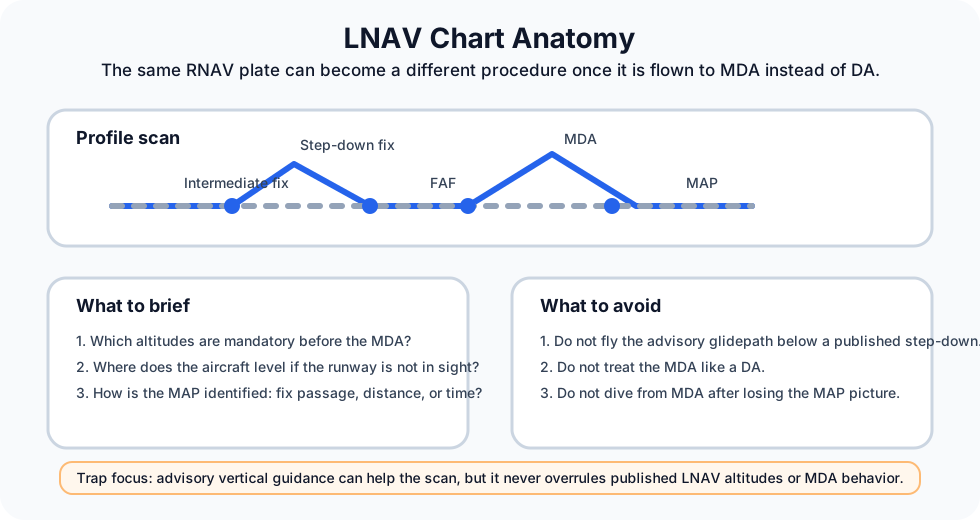
- How to brief it: brief the LNAV minima line specifically, identify every step-down or altitude checkpoint that protects descent to the MDA, and confirm exactly how the MAP is defined. The briefing question is no longer “what is my decision altitude?” but “where do I level at MDA and how will I recognize the MAP without guesswork?”
- What to set in the avionics: keep the approach loaded exactly as you would for LPV, but brief the altitude strategy differently. Set bugs for the step-down altitudes, MDA, and missed altitude. If the autopilot can fly VNAV-style advisory guidance, brief clearly that advisory path never authorizes descent below published nonprecision restrictions.
- What to say to ATC: the clearance phraseology is unchanged, but if the approach downgrades inside the terminal area the cockpit callouts should change immediately: “LPV lost, LNAV only, resetting to MDA.” That internal discipline matters more than any extra radio call.
- What to expect at each segment: descend only where the chart authorizes it, level at MDA if visual references are not yet sufficient, and stay there until the MAP. That makes LNAV time-and-distance awareness much more important than on the LPV version of the same chart.
- Common traps: flying LNAV like a pseudo-glideslope all the way to the runway, descending early because advisory vertical guidance looks stable, and treating the MDA as if it were a DA with an automatic continue-or-miss trigger.
Audio-style ATC example
Approach: “Bonanza Eight Two Sierra, verify able LNAV only, maintain eight thousand until JAKSN, cleared RNAV runway three five right approach.”
Pilot: “LNAV only, maintain eight thousand until JAKSN, cleared RNAV runway three five right, Eight Two Sierra.”
Pilot, cockpit callout: “MDA set, MAP by distance, no descent below published step-downs.”
Tower: “Eight Two Sierra, wind three three zero at one zero, runway three five right cleared to land.”
VOR Example: KOSH VOR RWY 36
Real chart: FAA PDF, VOR RWY 36 at Wittman Regional (KOSH).
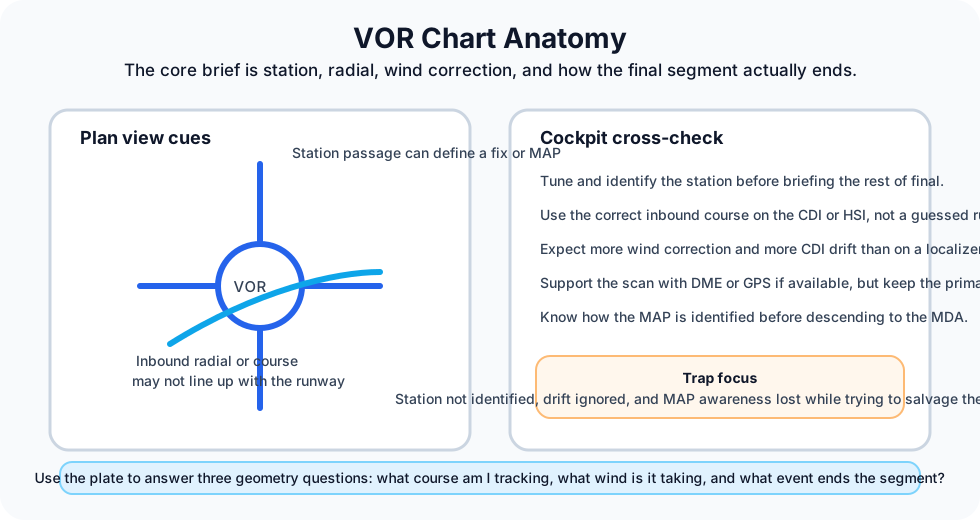
- How to brief it: identify the VOR positively, verify the inbound course and how the FAF and MAP are defined, and pay extra attention to any step-down fixes or distance information that drive the descent profile. On a VOR approach the station geometry matters more than on a localizer or RNAV plate, so the lateral picture should be briefed carefully.
- What to set in the avionics: tune, identify, and center the correct course on the CDI or HSI; if you have DME or GPS overlay information available, use it to support situational awareness, but keep the primary lateral guidance concept straight in your head before intercepting final.
- What to say to ATC: read back the approach clearance exactly. If you need a full approach or more time to identify the station, ask for it before being compressed onto final.
- What to expect at each segment: expect more wind correction and more CDI movement than on a localizer. The final segment should feel less like a rails-guided descent and more like tracking a course while managing altitude gates to the MDA and then to the MAP.
- Common traps: failing to identify the station, letting wind drift build because the CDI looks less sensitive than a localizer, and losing track of the MAP while trying to salvage a late descent from the MDA.
Audio-style ATC example
Approach: “Cherokee Six Seven Tango, cleared VOR runway three six approach, report the station inbound.”
Pilot: “Cleared VOR runway three six, will report station inbound, Six Seven Tango.”
Pilot, cockpit callout: “VOR identified, inbound course set, DME backing up the MAP.”
Tower: “Six Seven Tango, runway three six cleared to land, caution crosswind from the west.”
LOC BC Example: KOSH LOC BC RWY 18
Real chart: FAA PDF, LOC BC RWY 18 at Wittman Regional (KOSH).
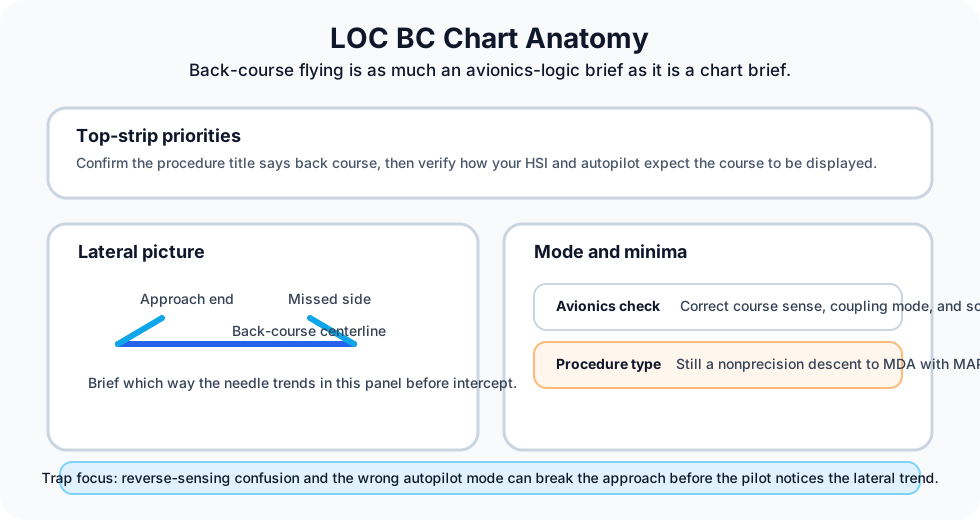
- How to brief it: brief the approach as a localizer back-course procedure, not as a normal front-course localizer. Confirm what heading and course presentation your HSI, CDI, and autopilot expect, and brief the missed approach before intercept because back-course workload rises quickly if the airplane gets displaced.
- What to set in the avionics: tune and identify the localizer, then set up the course presentation the way your specific installation requires for back-course use. This is one area where the airplane manual matters as much as the plate, because reverse-sensing protection and autopilot coupling logic differ across panels.
- What to say to ATC: read back “Cleared localizer back course runway 18 approach” so there is no ambiguity about which procedure you accepted. If you are not comfortable with the avionics setup or coupling mode, ask for another approach before joining final.
- What to expect at each segment: the workload usually spikes at intercept because the pilot must confirm both course sense and lateral trend quickly. Once established, fly small corrections and stay ahead of the MDA/MAP picture because the approach still behaves like a nonprecision procedure.
- Common traps: reverse-sensing confusion, using the wrong autopilot mode, overcontrolling close to the runway, and descending as if the procedure had normal front-course vertical guidance.
Audio-style ATC example
Approach: “Arrow Nine One Lima, turn left heading one six zero, maintain two thousand six hundred until established, cleared localizer back course runway one eight approach.”
Pilot: “Left one six zero, two thousand six hundred until established, cleared localizer back course runway one eight, Nine One Lima.”
Pilot, cockpit callout: “Back-course setup confirmed, no glidepath, MDA set.”
Tower: “Nine One Lima, runway one eight cleared to land. Report missed if the course picture does not stay stable.”
Circling Example: KASE LOC/DME-E
Real chart: FAA PDF, LOC/DME-E at Aspen (KASE). This is a good circling study plate because the straight-in mindset is not enough; runway alignment, terrain, winds, and the circling area all have to be briefed together.
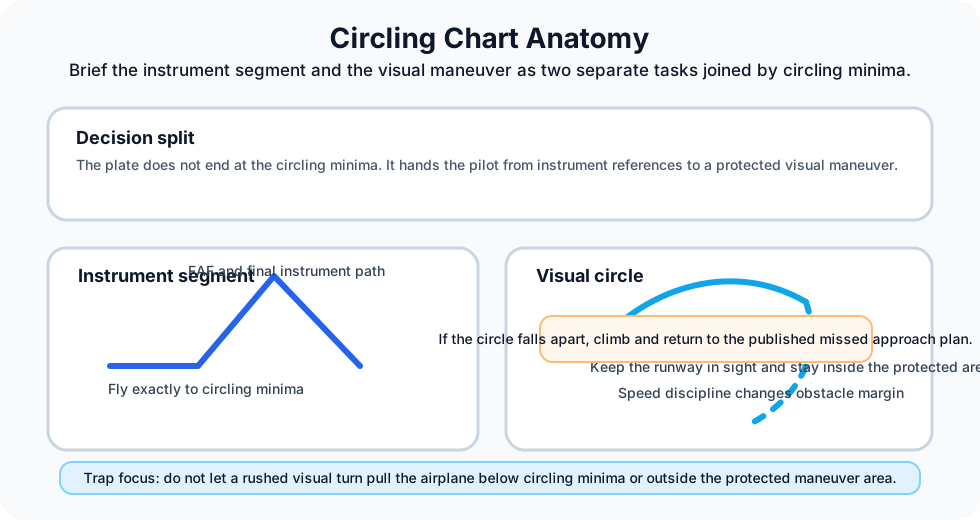
- How to brief it: brief the instrument part to the circling minima first, then brief the visual maneuver as a separate phase: likely landing runway, turning direction, wind effect, escape option, and the point at which you will abandon the circle if the picture is not stable.
- What to set in the avionics: configure the approach normally through the instrument portion, but also set altitude bugs and lateral references so the missed approach can be flown instantly if the runway is lost during the circle. In circling terrain, the missed approach is not something to reconstruct from memory after a low-altitude visual maneuver starts to unravel.
- What to say to ATC: the key readback is still the published approach clearance, but once visual in the circle the cockpit callouts should be explicit about who is keeping the runway environment in sight and what event triggers an immediate climbing turn back to the published miss.
- What to expect at each segment: fly the instrument portion exactly to the circling minima, level there until the runway environment and maneuver are genuinely in hand, then keep the airplane inside the protected circling area for its category. Circling is where speed discipline directly changes obstacle clearance margin.
- Common traps: descending below circling minima to “improve” the visual picture, widening out because the airplane is too fast, losing sight of the runway in precipitation or haze, and forgetting that a circling miss begins from an offset visual position, not from the straight-in final path shown on the plate.
Audio-style ATC example
Approach: “King Air Five Juliet Romeo, cleared LOC DME Echo approach Aspen, circle north for runway one five at pilot's discretion.”
Pilot: “Cleared LOC DME Echo Aspen, will circle north for one five, Five Juliet Romeo.”
Pilot, cockpit callout: “Circling minima set, runway in sight, staying tight north side, miss is immediate climb on the published if we lose it.”
Tower: “Five Juliet Romeo, runway one five cleared to land. Go missed immediately if the circle opens up.”
References
- FAA Instrument Procedures Handbook: primary FAA reference for instrument approach systems, chart interpretation, circling, and descent concepts.
- FAA Instrument Flying Handbook: operational IFR guidance, briefing concepts, stabilized approach practices, and missed approach execution.
- AIM 5-4-5, 5-4-6, 5-4-9, and 5-4-21: the FAA sections that govern IAP chart interpretation, approach clearances, procedure turns and HILPTs, and missed-approach execution.
- Terminal Procedures Publication: the approach plate itself is the controlling source for the specific procedure, minima, notes, and missed approach instructions actually being flown.
Go Deeper
- GPS and RNAV Systems: Approach Capability and Minima — how the navigator, integrity, and database status determine which RNAV minima remain legal.
- Automation and Avionics Management: RNAV Approach Example — FMA, source, and mode traps that sit behind the plate brief.
- Advanced IFR Weather Interpretation: Ceiling and Visibility Logic — the weather side of deciding whether minima are usable or just technically legal.
- Missed Approaches — the next segment that must already be briefed before the FAF.
- Holding Entry Geometry: Published Reversals and HILPT — how holding geometry connects to course-reversal segments on the plate.