Arrivals and STARs
How STARs, transitions, and arrival constraints organize IFR descent and handoff into the approach phase.
Quick Reference
Key points
Short-answer refresher for returning pilots before diving into the full page.
Quick Reference
Key points
Short-answer refresher for returning pilots before diving into the full page.
- A STAR only helps if you know the cleared transition, the controlling altitude and speed restrictions, and the likely handoff into the approach.
- Energy management starts on the arrival; getting high or fast here creates rushed fixes that spill straight into the approach phase.
- If runway, weather, or vectors change late, rebuild the active arrival picture from the current fix outward instead of patching the old brief.
Standards & References
FAA doctrinal and ACS cross-reference
Use this box to line the topic up with the FAA’s primary instrument handbooks, the most relevant ACS task areas, and the knowledge, skill, and risk elements that usually drive checkride evaluation.
- IFH Ch. 9, IFR Flight: descent planning, arrival setup, and transition from terminal routing to the final approach phase.
- IPH Ch. 3, Arrivals: STAR structure, transitions, descent planning, and arrival restrictions feeding the approach.
- III.B Compliance with Departure, En Route, and Arrival Procedures and Clearances.
On This Page
Overview
Instrument arrivals sit between the en route phase and the instrument approach. Their purpose is to organize traffic, lower workload for pilots and controllers, and position the aircraft for a predictable descent into terminal airspace. In practical terms, an arrival answers the question: how do I get from cruise to the approach environment in an orderly, charted way?
Not every IFR flight uses a published arrival. Some flights are vectored directly to an approach or descend via simple ATC instructions. But where traffic volume is higher or route structure is more complex, published arrivals make the descent much more standardized.
What an Arrival Does
An arrival procedure gives the pilot a planned path from the en route environment toward one or more destination airports. It may define named waypoints, transitions from different directions, altitude restrictions, and speed expectations. The main value is predictability: ATC knows roughly where the aircraft will be, and the pilot knows what descent path and workload to expect.
Conceptually, the sequence is en route to arrival to approach to landing or missed approach. That is why arrivals belong in IFR training as a separate topic rather than being buried inside the approach discussion.
STARs
A Standard Terminal Arrival Route (STAR) is a published IFR arrival used to simplify clearance delivery and manage traffic into busy terminal areas. A STAR usually includes multiple entry paths feeding toward a common arrival flow and may serve more than one runway or even more than one airport.
When ATC clears an aircraft for a STAR, the pilot is expected to fly the charted route and comply with published altitude and speed restrictions unless specifically amended. AIM 5-4-1 is also explicit that published speed restrictions remain mandatory unless changed by ATC, while many charted “expect” altitudes and speeds are only planning information until ATC issues them. A STAR does not automatically include the instrument approach clearance, but it often positions the aircraft close to where vectors or a transition to the approach will begin.
Transitions
Many STARs include named transitions that connect the en route airway or RNAV route to the main body of the arrival. The transition matters because it determines where the aircraft joins the procedure and therefore which descent and speed constraints apply first.
A pilot briefing an arrival should identify the specific transition cleared, not just the STAR name. The same STAR can look very different depending on which transition is used.
Arrival Chart Anatomy
An arrival chart should be read as a flow map rather than just a string of fixes. Key items include:
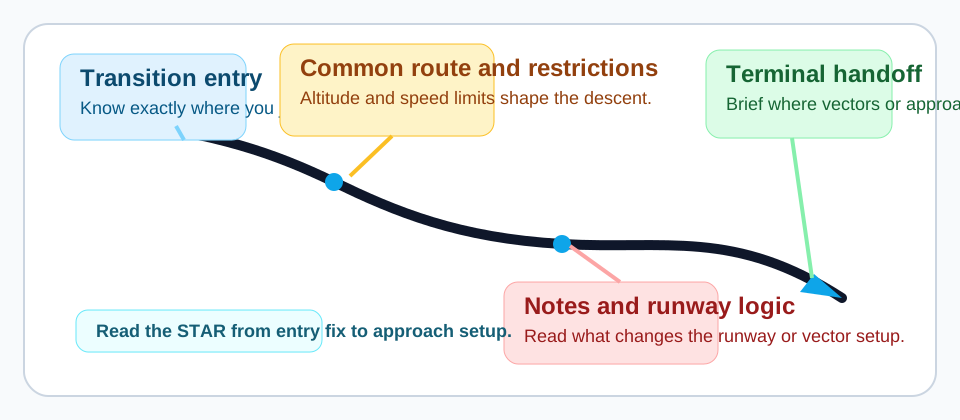
- STAR name and revision: confirms the exact procedure in use.
- Transitions: entry paths from different directions or route systems.
- Common route segment: the shared portion where traffic is funneled toward terminal airspace.
- Altitude restrictions: mandatory or expected crossing altitudes at specific waypoints.
- Speed restrictions: charted speeds used to manage spacing and flow.
- Notes: runway applicability, communication expectations, and procedure-specific operational limits.
- Bottom altitude / terminal handoff point: where vectors, further descent, or approach clearance typically begin.
That visual scan matters because a STAR is only useful if the pilot can tell which restriction is controlling now and which point is the likely handoff into the approach setup.
A strong arrival brief answers three basic questions: where do I join it, what restrictions must I meet, and how does it hand me off to the approach phase?
Altitude and Speed Constraints
Published arrivals often contain multiple altitude and speed constraints, and these are what make them operationally significant. A waypoint may require the aircraft to cross at, at or above, or at or below a specific altitude. Likewise, speed restrictions may control the sequence and spacing of traffic.
From a pilot standpoint, the important distinction is whether the restriction is mandatory and whether the airplane can realistically meet it from the current energy state. AIM 5-4-1 matters here because it separates charted planning information from actual crossing restrictions, and it defines what a descend-via clearance does and does not authorize. An arrival that seems simple on paper can become difficult if the aircraft is left high, fast, or both.
This is why arrivals reward planning ahead of the airplane. Descent and deceleration have to start early enough that compliance is smooth, not rushed. If a restriction cannot be met, ATC needs to know before the airplane reaches it.
Descent Planning
One of the biggest practical values of a STAR is descent planning. Published altitude windows let a pilot begin working backwards from a lower crossing restriction to determine where descent should start and how aggressively speed needs to come back.
Autopilot and VNAV systems can help, but the pilot still needs a mental model of the descent. A useful arrival brief includes: first expected descent point, the restrictive altitudes, likely speed changes, and whether the airplane will arrive at the terminal boundary stable or overloaded.
In high-workload IFR, the worst arrival problems are often energy-management problems. Being late on descent or fast at a constrained fix can create a chain of rushed corrections that continues all the way into the approach.
Arrival Weather Gate
The arrival is usually where a broad weather picture becomes a cockpit workload problem. That is why a STAR brief should include one explicit weather gate: what weather feature is most likely to break the arrival-to-approach flow? Use Advanced IFR Weather Interpretation to identify the system trend before top of descent, then tie it to the arrival restrictions you actually have to fly.
Scenario
Warm-front descent
The arrival descends through a deep moist layer with ceilings dropping ahead of the runway complex.
Arrival decision: expect an earlier commitment to the runway and alternate strategy. If the arrival feeds only one marginal approach, the problem started before final.
Scenario
Turbulence and inversion layer
The sounding and PIREPs show chop and shear in the exact altitude band where the STAR starts to tighten.
Arrival decision: slow down earlier, brief the likely runway sooner, and do not let descent energy management and weather surprises combine into a rushed terminal setup.
Scenario
Convective reroutes near the bottom of the STAR
Radar shows growth near the vectoring area and ATC is already issuing shortcuts and runway changes.
Arrival decision: keep the arrival charted picture in mind, but be ready to simplify. If the weather turns the STAR into improvisation, ask for delay, hold, or a cleaner reroute early.
Vectors and Amendments
ATC may assign a STAR and then amend it with shortcuts, altitude changes, speed adjustments, runway changes, or radar vectors. That means the pilot should treat the published arrival as the baseline plan, not as something guaranteed to be flown exactly as charted. AIM 5-4-1 and 5-4-6 are both relevant: if ATC vectors or clears the aircraft off the STAR, the lateral path and associated restrictions tied to that STAR are no longer the active plan unless ATC later reconnects the procedure.
Good technique is to keep the charted picture in mind even when being vectored. If a runway changes or the controller clears the aircraft direct to a later fix, the pilot should immediately reassess what restrictions remain and what approach is now most likely.
An amended arrival is still part of the arrival phase. The pilot’s job is to keep the aircraft ahead of the new clearance and avoid letting the revised plan become an improvisation problem.
RNAV vs. Conventional Arrivals
Many modern arrivals are RNAV-based and depend on waypoint sequencing rather than radials and intersections. These procedures usually provide cleaner path structure and can support more efficient traffic flows. Conventional arrivals, by contrast, may reference VORs, intersections, or radar vectors more heavily.
RNAV arrivals are often easier to fly precisely, but only if the navigation database is current and the pilot understands the active leg sequencing. Conventional arrivals can require more raw situational awareness, especially where route segments are defined by ground-based navaids rather than a clearly drawn magenta path.
The practical difference is not which one is “better,” but what the pilot has to monitor. RNAV emphasizes waypoint sequencing and automation awareness. Conventional arrivals emphasize course geometry, facility identification, and intercept logic.
Transition to the Approach
The arrival phase is complete only when the aircraft is handed off to the instrument approach. Sometimes that handoff is radar vectors to final. Sometimes it is a charted transition directly to the initial or intermediate segment of the approach. AIM 5-4-6 specifically addresses STAR-to-approach connectivity when a STAR terminates at an IAF or IF: the pilot is expected to have the approach loaded so that the arrival and approach connect cleanly. Either way, the pilot must be ready for the approach brief before the arrival is actually finished.
This is why arrivals and approaches should be briefed together at a high level. If the likely runway and approach are already known, the pilot can anticipate whether the arrival feeds naturally into the expected procedure or whether a significant reorientation, vector, or runway change is likely.
Good arrival management reduces approach workload. Poor arrival management carries excess speed, confusion, and last-minute reprogramming into the final phase of flight.
Next Concept
This is the point where the charted arrival stops being a descent-management problem and becomes an approach brief, minima, and missed-approach problem.
Real-Chart Example
For a complex STAR study case, use the FAA search results for Atlanta (KATL). The current cycle lists multi-page RNAV STARs such as CHPPR ONE, GLAVN TWO, JJEDI FOUR, and OZZZI TWO, which are useful because they force the pilot to brief transitions, common routes, and runway-flow notes instead of only one short line of fixes. For the visual study example here, use JJEDI FOUR (RNAV) as the named STAR reference.
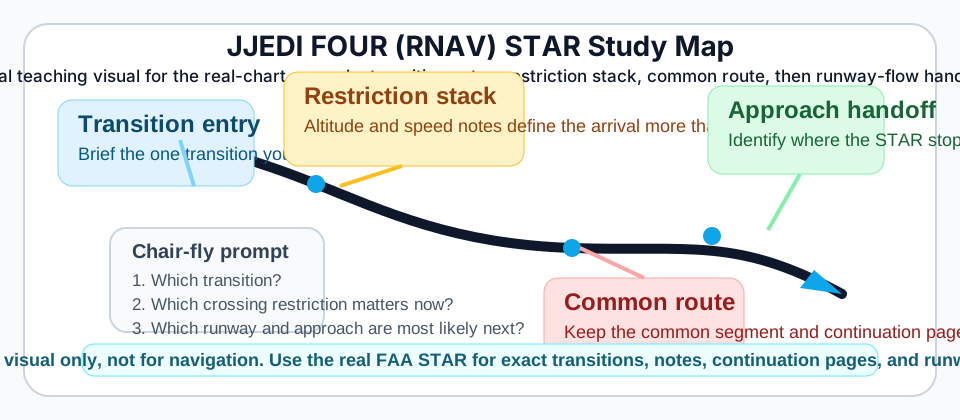
What to pull from the real STAR
- Transition entry: identify which transition you would actually brief and ignore the rest until ATC changes the plan.
- Constraint stack: find the altitude and speed restrictions that are truly controlling on your path, not just the first ones your eye lands on.
- Page discipline: on a multi-page STAR, brief the common route and the continuation page together so the runway-flow notes do not arrive late.
- Approach handoff: isolate the point where the STAR stops being a descent-management problem and starts being an approach-setup problem.
If you want a smaller mountain-terminal contrast, compare that big-hub STAR picture with the current Aspen (KASE) arrivals such as HAREI ONE (RNAV) or MMARY ONE (RNAV). The differences in complexity make the arrival-briefing priorities obvious.
Practical Briefing
A useful arrival brief is short but specific. It should include the transition, the highest-priority altitude and speed restrictions, the likely descent point, the expected runway or approach family, and any note that changes how the arrival is flown.
For practical use, the pilot should be able to answer:
- Where do I join the arrival?
- Which altitude and speed restrictions matter most?
- What is the first fix where I need to be configured or slowed?
- How does this arrival likely connect to the expected approach?
- What will I do if ATC shortens, amends, or vectors me off the procedure?
If those answers are already in mind, the arrival becomes an organized descent phase instead of a series of reactive corrections.
References
- FAA Instrument Procedures Handbook: primary FAA reference for STAR interpretation, chart reading, and terminal procedure structure.
- FAA Instrument Flying Handbook: operational IFR guidance on arrival management, descent planning, and cockpit technique.
- FAA Aeronautical Information Manual (AIM), 5-4-1: STAR routing, crossing restrictions, speed restrictions, and descend-via expectations.
- FAA Aeronautical Information Manual (AIM), 5-4-6: STAR-to-approach connectivity, approach entry expectations, and approach-clearance implications after arrival routing.
- Terminal Procedures Publication: the controlling source for any specific STAR, transition, charted note, and published restriction being flown.
Go Deeper
- Advanced IFR Weather Interpretation: Ceiling and Visibility Logic — the weather picture that can break the arrival-to-approach handoff.
- ATC System: Vectors, Amendments, and Changes — how runway changes, shortcuts, and vectors reshape the bottom of the STAR.
- Automation and Avionics Management: RNAV Approach Example — the avionics-side setup that has to be ready before the STAR finishes.
- Approaches — the next phase once the arrival hands the flight to the plate, minima, and missed brief.