GPS and RNAV Systems
How IFR-approved GPS and RNAV systems build a path, what annunciations and scaling changes mean, and where pilots most often get behind the box.
Quick Reference
Key points
Short-answer refresher for returning pilots before diving into the full page.
Quick Reference
Key points
Short-answer refresher for returning pilots before diving into the full page.
- RNAV workload spikes at phase changes, so verify source, active leg, annunciation, and CDI scaling together before trusting the magenta line.
- Database status and integrity are part of the legal navigation system, not convenience items, so stale or downgraded data changes the plan immediately.
- Brief what happens if WAAS, vertical guidance, or sequencing changes on you before the FAF turns that downgrade into a surprise.
Standards & References
FAA doctrinal and ACS cross-reference
Use this box to line the topic up with the FAA’s primary instrument handbooks, the most relevant ACS task areas, and the knowledge, skill, and risk elements that usually drive checkride evaluation.
- IFH Ch. 9, IFR Flight: RNAV/GPS source management, annunciation awareness, route changes, and cockpit workflow while flying the system.
- IFH Ch. 4, Flight Instruments: CDI/HSI interpretation as sensitivity changes between en route, terminal, and approach phases.
- IPH Ch. 2, En Route Operations: RNAV route structure, waypoint sequencing, direct-to logic, and terminal transition management.
- IPH Ch. 4, Approaches: RNAV minima selection, WAAS capability, vertical-guidance expectations, and downgrade logic.
- V.A Intercepting and Tracking Navigational Systems and DME Arcs.
- Approach-task RNAV elements: selecting the correct minima line and responding correctly to downgrades or loss of guidance.
On This Page
Overview
Modern IFR navigation is built around area navigation, or RNAV. Instead of flying only from one ground station directly to another, the aircraft can follow a defined path between waypoints using satellite position, onboard sensors, and an approved navigation database. In many GA cockpits that means an IFR-approved GPS navigator with WAAS capability, but the deeper idea is broader: the airplane is no longer tied only to ground-based geometry.
That flexibility creates new failure modes. The pilot no longer needs to identify a Morse code station every few minutes, but the pilot does need to know which leg is active, whether the database is current, what mode the navigator is in, how CDI sensitivity is changing, and what minima line remains legal if the system downgrades. IFR GPS flying is therefore less about button memorization than about mode awareness and source verification.
System Architecture
An IFR RNAV system is usually made of four practical pieces:
- Position source: GPS satellites, often enhanced by WAAS.
- Approved navigator: the box that computes the active leg and checks integrity.
- Navigation database: the coded procedure, airway, waypoint, and airport data the system is allowed to use.
- Flight display interface: CDI, HSI, PFD, or autopilot coupling that shows and flies the guidance.
The system only works as an IFR system when those pieces agree. A beautiful magenta line on the screen does not by itself prove legality or correctness. The pilot still has to verify the database currency, the loaded procedure, the active source, and the annunciations that tell whether the guidance is en route, terminal, approach, or degraded.
Sensitivity and Scaling
One of the most important differences between GPS/RNAV and older en route navigation is that lateral sensitivity changes by phase of flight. The CDI is deliberately less sensitive en route, tighter in the terminal area, and tighter again during an approach. On LPV and some other final segments, the guidance can even behave more like angular precision guidance than a constant-width en route course.
That matters operationally because a one-dot error late on an approach does not mean what a one-dot error meant fifty miles earlier. Pilots who treat the CDI as if it always represents the same lateral displacement tend to either overcorrect en route or underreact near the final approach segment.
The practical rule is simple: always notice what phase-of-flight annunciation the box is giving you before interpreting the CDI. Scaling is part of the clearance picture, not background detail.
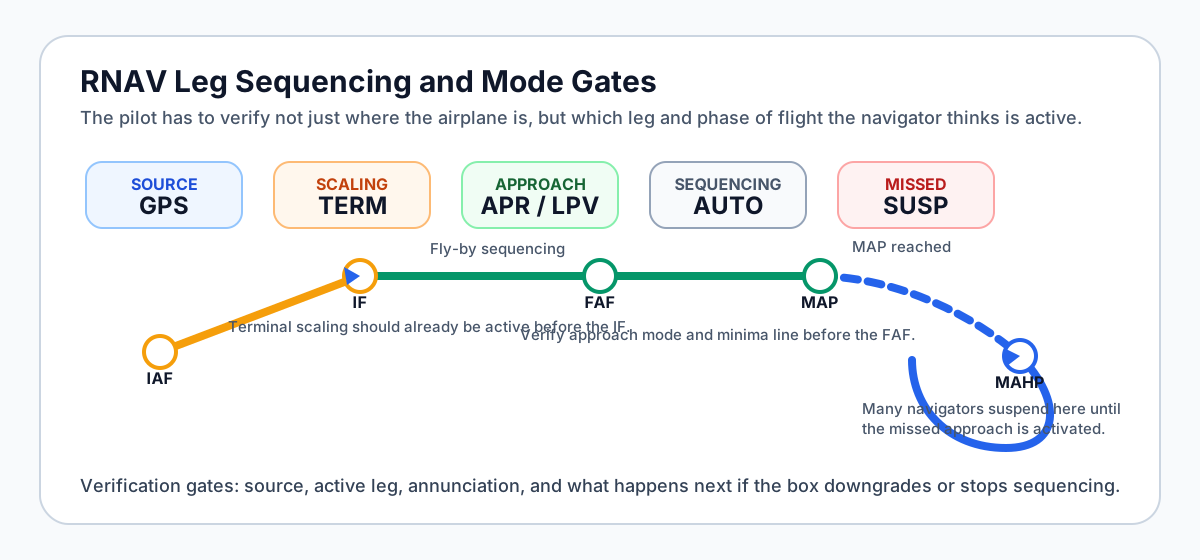
Waypoint and Leg Management
RNAV systems reduce raw navigation workload only if the pilot understands what leg the system thinks it is flying. In IFR operations, that usually means monitoring:
- fly-by versus fly-over behavior,
- automatic sequencing between fixes,
- OBS or suspend mode when sequencing is intentionally stopped,
- holds and course reversals that may require specific confirmation, and
- direct-to logic that can erase or bypass important segments if used carelessly.
This is where many IFR GPS mistakes happen. The airplane is physically under control, but the navigator is no longer flying the same plan the pilot believes it is flying. Mode confusion with a GPS is often really sequence confusion: the wrong leg, the wrong fix, or the wrong source became active without the pilot catching it soon enough.
Approach Capability and Minima
RNAV approaches are not one thing. A single RNAV (GPS) plate may publish LPV, LNAV/VNAV, LP, and LNAV minima, and each line represents a different guidance and authorization picture. The aircraft may fly the same named procedure while the legal minima and the cockpit technique change substantially.
- LPV: WAAS-based lateral and vertical guidance to a DA.
- LNAV/VNAV: approved lateral guidance with vertical guidance to a DA, depending on system capability.
- LP: WAAS-based lateral guidance only, normally flown to an MDA.
- LNAV: lateral guidance only, normally flown to an MDA.
The useful cockpit question is not "did I load the RNAV approach?" It is "which minima line is the airplane actually authorized and currently able to use?" That same issue is covered from the procedure side in Approaches. This page stays on the system side: what the navigator must be capable of, and what the pilot must notice before descending on the assumption that vertical guidance will remain available.
Downgrades and Failures
RNAV errors are often subtle because the system can remain partly usable while still no longer supporting the originally briefed minima. Common downgrade scenarios include:
- loss of WAAS capability,
- loss of vertical guidance,
- integrity alerts or loss of approach mode,
- incorrect CDI source selection, and
- database mismatch or procedure loading errors.
When that happens, the pilot must immediately separate three questions:
- Is the airplane still being navigated safely?
- What level of guidance is still available?
- Does that remaining capability still support the minima line I briefed?
If the answer to the third question is no, the pilot either downgrades to a valid line or discontinues the approach. This is a core IFH Chapter 9 workload point: the navigator can change the risk picture faster than the airplane's attitude changes, so the pilot has to catch the downgrade before the FAF becomes a commitment point.
Cockpit Technique
Good RNAV technique is built around verification gates. Before each major phase, confirm:
- source: GPS is the active navigation source when it should be,
- sequence: the correct fix and leg are active,
- annunciation: en route, terminal, approach, LPV, LNAV, or another relevant mode is actually displayed,
- altitude: the vertical profile still matches the procedure and clearance, and
- missed approach: the next mode or sequencing change after the miss is already understood.
That discipline matters more than speed. A pilot who can fly the box quickly but cannot verify the active leg is not ahead of the airplane. A pilot who slows down long enough to catch the wrong source or an unexpected suspend condition usually is.
References
- FAA Instrument Flying Handbook: RNAV/GPS systems management, source awareness, and IFR cockpit technique.
- FAA Instrument Procedures Handbook: RNAV procedure interpretation, approach minima, and PBN procedure structure.
- FAA Aeronautical Information Manual (AIM): operational GPS, WAAS, RNAV, and IFR procedure guidance.
Go Deeper
- Approaches: RNAV Minima Selection — the procedure-side view of LPV, LNAV/VNAV, LP, and LNAV line selection.
- Automation and Avionics Management: VNAV vs Advisory VNAV — what the panel cues mean before trusting vertical guidance.
- Missed Approaches — what happens when RNAV guidance downgrades or the missed must be flown from the box.
- Holding Patterns: Published Holds and HILPT — where RNAV sequencing, suspend logic, and hold execution meet.