Automation and Avionics Management
Modern IFR automation management for autopilot modes, FMA interpretation, GPS CDI scaling, VNAV versus advisory VNAV, mode confusion traps, and Garmin-style panel examples.
Quick Reference
Key points
Short-answer refresher for returning pilots before diving into the full page.
Quick Reference
Key points
Short-answer refresher for returning pilots before diving into the full page.
- Fast automation check: source, active leg, active and armed modes, then the next bug or altitude that is about to matter.
- Buttons show intent and the FMA shows truth, so read the annunciation before assuming the autopilot accepted the plan you meant.
- Most automation failures are expectation failures: wrong source, wrong leg, wrong mode, or the right mode at the wrong time.
Standards & References
FAA doctrinal and ACS cross-reference
Use this box to line the topic up with the FAA’s primary instrument handbooks, the most relevant ACS task areas, and the knowledge, skill, and risk elements that usually drive checkride evaluation.
- IFH Ch. 4, Flight Instruments: display interpretation, source selection, and instrument relationships that feed automation use.
- IFH Ch. 9, IFR Flight: navigator setup, automation monitoring, approach-mode awareness, and missed-approach cockpit flow during instrument operations.
- IFH Ch. 2, Human Factors: mode confusion, automation dependence, and workload control when the system does not behave as expected.
- Supporting only: avionics management underpins the RNAV, approach, and missed-approach execution described throughout IPH Ch. 2 through Ch. 4.
- IV.A Instrument Cockpit Check.
- III.B Compliance with Departure, En Route, and Arrival Procedures and Clearances.
- VI.A through VI.C Instrument Approaches and Missed Approach.
Checkride Focus
How this topic is typically evaluated
Use this block as the ACS-ready summary: what task areas this page supports, what the applicant should know, what the applicant should be able to do, and what risks must be managed without prompting.
Checkride Summary
Automation is checkride-relevant when the pilot uses it as disciplined cockpit management, not as magic buttonology. The evaluation is whether the pilot understands what the airplane will do next and can prove it from the annunciations.
Knowledge
- Know the basic autopilot mode families, FMA active versus armed logic, CDI scaling changes, and the difference between approved VNAV and advisory VNAV.
- Understand how Garmin-style panels typically present source, leg, and approach state without assuming every installation is identical.
- Know what reversion or downgrade cues matter most before the FAF and during a go-around or missed approach.
Skills
- Use a repeatable source-leg-mode-bug scan before high-workload phases.
- Verify the FMA and active source after every significant mode change or approach setup step.
- Manage RNAV setup, downgrade recognition, and missed-approach reversion without losing control of the airplane.
Risk Management
- Mode confusion, wrong-source tracking, and heads-down reprogramming during busy phases.
- Missing an LPV or LNAV/VNAV downgrade or treating advisory vertical guidance like an authorized glidepath.
- Assuming TOGA or go-around logic will fly the entire missed without verifying the first segment.
On This Page
Overview
Modern IFR flying is no longer just attitude control plus chart reading. In most real cockpits, the pilot is managing a navigator, a flight director, an autopilot, lateral and vertical mode logic, and a moving map that can quietly change the airplane's sensitivity and sequencing rules. That means automation management is now a core instrument skill, not an optional avionics add-on.
The FAA handbooks describe pieces of this, but they rarely turn it into one complete training block. This page does that. Use it with IFR Procedures, Approaches, and IFR Risk Management and Personal Minimums so the airplane, the box, and the procedure all stay inside one mental model.
Automation Stack
A useful way to think about the modern IFR cockpit is as a stack of four layers. If the pilot cannot say which layer is currently in charge, mode confusion is already starting.
Layer 1
Navigator
Defines the active leg, sequencing, CDI source, and often the vertical path cue.
Layer 2
Flight Director
Commands bars that show what pitch and roll the system wants right now.
Layer 3
Autopilot
Actually flies the selected lateral and vertical modes if it is engaged and trimmed to do so.
Layer 4
Pilot
Still owns clearance compliance, altitude awareness, and whether the airplane is doing what the procedure requires.
The short automation scan is: source, leg, mode, bug. What navigation source is active, what leg is active, what modes are active or armed, and what altitude or heading bug is about to matter next?
Autopilot Modes
Different installations use different button labels, but the logic is usually the same. The pilot should be able to group the modes by what they control instead of memorizing one brand-specific sequence.
| Mode Family | Typical Labels | What It Commands | Common Trap |
|---|---|---|---|
| Roll hold and heading | ROL, HDG | Basic wings-level or bug-following lateral control. | Expecting the airplane to intercept a course while it is still only obeying the heading bug. |
| Course tracking | NAV, GPSS, LOC, BC | Tracks a selected GPS leg, VOR radial, localizer, or back-course logic depending on source and installation. | Wrong source selected, stale leg in the navigator, or using front-course logic on a back-course procedure. |
| Pitch and climb or descent | PIT, VS, FLC, IAS | Commands a fixed pitch, vertical speed, or target climb or descent airspeed. | Selecting a rate or airspeed that does not fit power, trim, or altitude capture logic. |
| Altitude hold and capture | ALT, ALTS, ALT ARM | Holds the current altitude or captures the selected altitude when the climb or descent mode reaches it. | Assuming the preselector is armed when it is not, then flying through the assigned altitude. |
| Approach and glidepath | APR, GS, GP, VNAV | Arms or captures approach lateral guidance and, when available, a glideslope or glidepath. | Confusing advisory vertical guidance with approved descent guidance or expecting GP capture before the system is actually armed. |
| Go-around | TO, TOGA, GA | Commands a go-around pitch mode and often reverts lateral logic until the missed is stabilized. | Trying to reprogram the missed before confirming what the go-around mode actually did. |
The right teaching question is never just, What button did you push? It is, What lateral mode are you asking for, what vertical mode are you asking for, and what would the FMA have to show if the system obeyed you correctly?
FMA Interpretation
The flight mode annunciator is the truth source for automation. Buttons show intent. The FMA shows what the system actually accepted. If a pilot pushes APR and then looks away without checking the FMA, the airplane may still be in HDG and ALT while the pilot mentally believes it is tracking and descending.
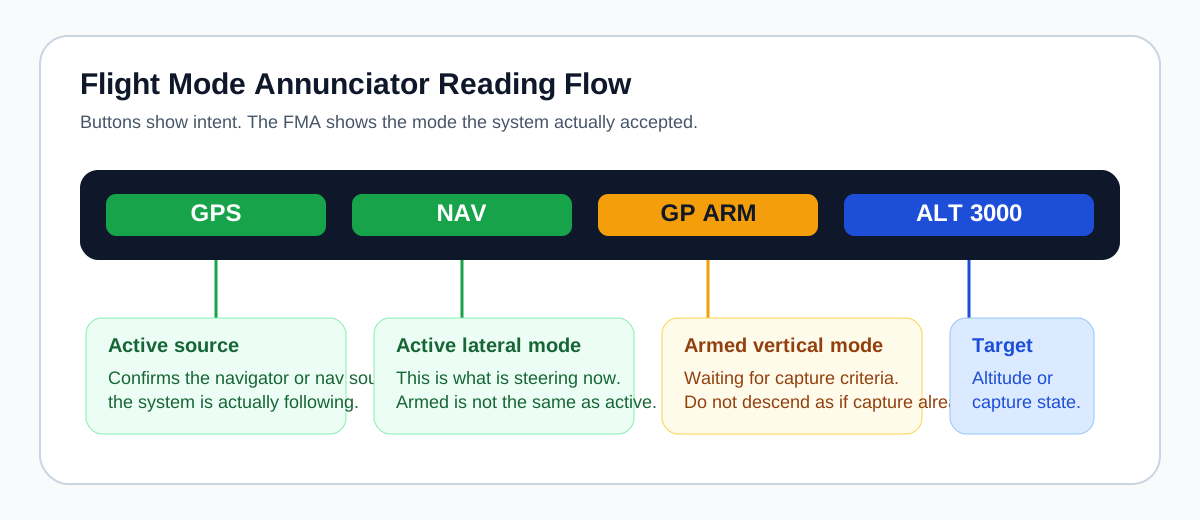
- Active versus armed: armed means the mode is waiting for capture criteria, not flying yet.
- Lateral versus vertical: a correct vertical mode does not prove the lateral mode is correct, and the reverse is also true.
- Source confirmation: the FMA must agree with the selected source, such as GPS, LOC, or VOR, before intercept or descent is trusted.
- Reversion awareness: go-around, approach downgrades, and missed-approach transitions can revert the autopilot into a simpler mode than the pilot expected.
A practical instrument callout is: mode green, source green, altitude bugged. In a training cockpit, the student should say it out loud whenever a new mode is engaged or captured.
GPS CDI Scaling
GPS CDI sensitivity does not stay fixed through an IFR flight. As the navigator transitions from en route to terminal to approach logic, the same needle width represents less lateral error. That is why a correction that looks small in cruise can become aggressive inside the final segment.
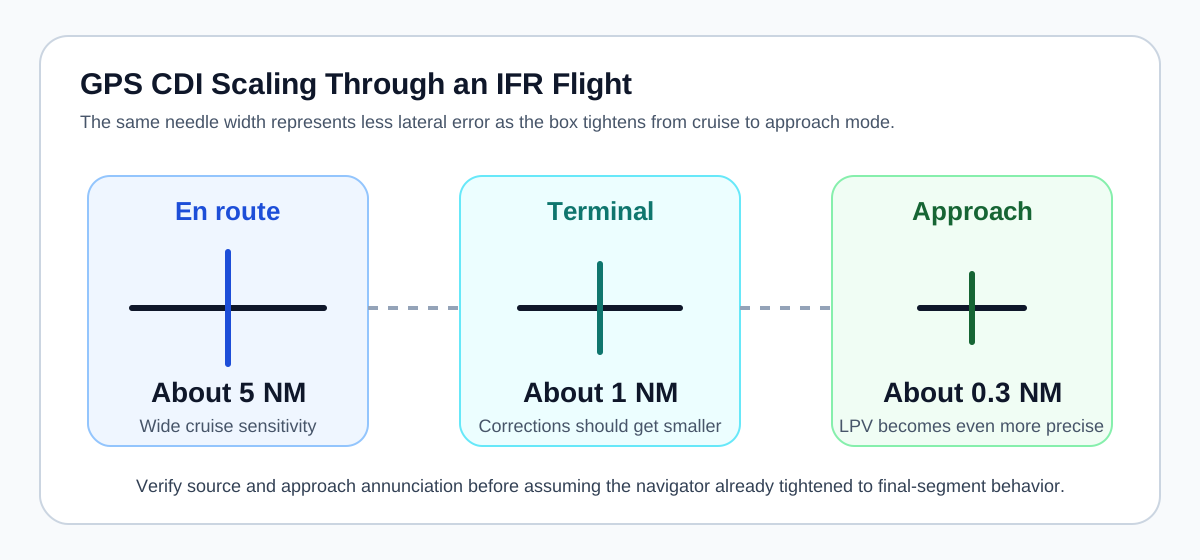
En route
On many IFR GPS installations, full-scale CDI sensitivity is about 5 NM. This is wide enough for cruise tracking and reroutes.
Terminal
Terminal sensitivity typically tightens to about 1 NM full-scale, so intercepts and corrections should already become smaller and cleaner.
Approach
Approach mode tightens further, commonly to 0.3 NM full-scale, and LPV sensitivity becomes even more precise closer to the threshold.
- Do not chase a narrowing needle: smaller, earlier corrections work better as sensitivity tightens.
- Do not assume the box changed modes: verify approach mode annunciation before relying on final-segment sensitivity.
- Do not brief one behavior for every RNAV approach: LPV, LNAV/VNAV, and LNAV do not all drive the same vertical and lateral picture near minimums.
VNAV vs Advisory VNAV
This is one of the most important modern IFR distinctions. Approved VNAV or glidepath guidance supports a DA-based final descent when the procedure and installation allow it. Advisory VNAV is only a reference path. It can help the pilot descend smoothly, but it does not create a new minima line and it does not turn an LNAV procedure into a glidepath approach.
Approved vertical guidance
LPV or LNAV/VNAV
- Uses a published DA decision point.
- Requires the right procedure, equipment, and annunciation.
- Can be coupled when the installation permits and the correct mode is armed.
Advisory only
Advisory VNAV or +V
- Does not change the published minima line.
- Still requires LNAV-style altitude and missed-approach discipline.
- Must never be treated as permission to descend below step-down or MDA limits.
The fast briefing question is: am I flying to a DA with approved vertical guidance, or am I flying an LNAV-style approach that merely shows a helpful descent cue?
Mode Confusion Traps
Automation traps are usually not equipment failures. They are expectation failures. The pilot believes the airplane is in one mode while the autopilot, flight director, or navigator is still obeying something else.
- Button push without FMA confirmation: the pilot sees an armed mode as if it were already active.
- Wrong source, right mode: NAV is active, but it is tracking the wrong source because GPS or LOC selection was never verified.
- Vectors-to-final used too early: the procedure logic or missed-approach sequence is broken because the box was forced into the wrong leg at the wrong time.
- LPV expectation bias: the pilot assumes the approach will stay LPV and misses a downgrade that requires LNAV or LNAV/VNAV handling instead.
- Go-around surprise: the airplane reverts to a simple pitch or roll mode after TOGA, but the pilot expects it to fly the published missed without further setup.
- Heads-down repair during a busy phase: the pilot tries to rebuild the box at the exact moment when hand-flying, intercept, or missed-approach stability should be first.
The recovery script is simple: stabilize, verify source, read the FMA, then reprogram. If that order reverses, the pilot is already behind the airplane.
G1000 and G3X Style Examples
Garmin-style glass panels are a good teaching example because many GA IFR cockpits use some version of the same logic, even when the exact button names or autopilot supplements differ. The details still depend on the installed navigator, autopilot, and flight manual supplement, so treat these as mental-model examples rather than universal button sequences.
Departure Example
A G1000 NXi or G3X-style departure brief should answer four automation questions before takeoff: what lateral mode is expected first, what altitude is bugged, what source is active, and whether the autopilot will stay off until the aircraft is stabilized in the climb.
- Before takeoff: load the departure or first leg, confirm GPS source if the departure requires it, set the initial altitude, and bug the heading or runway track as needed.
- After liftoff: fly or engage the flight director to the expected roll mode, then confirm the FMA instead of assuming the system captured the intended path.
- Trap: the heading bug or ROL mode may still be flying while the pilot believes NAV capture has already happened.
RNAV Approach Example
On a Garmin-style RNAV approach, the key is not simply loading the procedure. The key is proving that the approach, source, sequencing, minima logic, and final-mode annunciation all agree before the FAF.
- Load early: put the full approach in the box before the terminal phase gets busy.
- Confirm the active leg: verify whether you are flying a full transition, vectors-to-final, or direct-to a fix.
- Watch the annunciation: confirm the navigator and FMA show the correct approach state before trusting GP, VNAV, or APR coupling.
- Brief the downgrade: if LPV does not appear, know whether the approach is now LNAV/VNAV or LNAV and how the decision strategy changes.
Missed Approach Example
The missed approach in a G1000 or G3X-style cockpit is where pilots often overestimate automation. The system can help, but only after the climb and first segment are stabilized.
- Go around first: press TOGA or apply the go-around flow the installation uses, then pitch for climb and verify the FMA reversion.
- Navigate the first segment: confirm the source and first missed routing before touching deeper sequencing or hold setup.
- Only then reconfigure: once the airplane is climbing and cleaned up, re-engage the desired lateral mode or activate the next procedure step if required by that installation.
IFR and CFI-I Use
This topic matters for instrument applicants because the ACS expects safe automation use even when the task title does not mention a specific brand of panel. It matters for CFI-Is because poor automation discipline usually reveals itself as altitude busts, unstable approaches, and missed-approach confusion rather than as neat avionics mistakes.
- For instrument students: build a repeatable callout habit for source, leg, mode, and bug before every high-workload phase.
- For CFI-Is: teach failure recognition by asking what the airplane will do next if nothing else is touched for five seconds.
- For scenario lessons: force one downgrade, one late runway or vector change, and one missed-approach transition so the student has to manage the automation instead of simply riding it.
The teaching standard should be: the student can explain what the autopilot is doing, why the FMA proves it, what the navigator is sequencing, and what the airplane will revert to if the plan changes.
References
- FAA Instrument Flying Handbook: automation management, instrument scan discipline, approach technique, and missed-approach cockpit flow.
- Instrument Rating ACS: avionics setup, procedure compliance, approach management, and risk-management expectations across instrument tasks.
- IFR Procedures: procedure flow that this page supports with source, mode, and sequencing discipline.
- Approaches: minima selection and RNAV or localizer families that must match the avionics annunciation.
- Integrated IFR Procedures: longer scenario-based cockpit flows from clearance through missed approach.
- Aircraft-specific supplements and pilot guides: use the installed autopilot and navigator documentation for exact buttonology, because mode labels and capture logic vary by installation.
Go Deeper
- GPS and RNAV Systems: Sensitivity and Scaling — the navigator-side explanation for changing CDI behavior.
- Approaches: RNAV Minima Selection — the plate brief that has to match the annunciations and guidance actually available.
- Missed Approaches: Transition to Hold or Next Clearance — where automation discipline matters most after TOGA or go-around mode.
- Integrated IFR Procedures — longer phase-of-flight scenarios where automation errors compound across the whole IFR flow.