Theories of Lift
Why Bernoulli, Newton, circulation, and angle of attack all belong in the same practical explanation of lift.
Quick Reference
Key points
Short-answer refresher for returning pilots before diving into the full page.
Quick Reference
Key points
Short-answer refresher for returning pilots before diving into the full page.
- Bernoulli and Newton are complementary ways of describing the same lift result rather than rival explanations a pilot has to choose between.
- Angle of attack is the pilot-controlled lever that matters operationally, because lift changes with the wing’s relationship to the airflow.
- When angle of attack exceeds critical value, the wing stalls regardless of what the airspeed alone seems to suggest.
Standards & References
FAA doctrinal and ACS cross-reference
Use this box to line the topic up with the FAA’s primary instrument handbooks, the most relevant ACS task areas, and the knowledge, skill, and risk elements that usually drive checkride evaluation.
- IFH Ch. 5, Attitude Instrument Flying: understanding angle of attack, lift, and drag helps explain power-and-attitude changes in instrument flight.
- IFH Ch. 6, Basic Flight Maneuvers: lift and angle-of-attack awareness support precise maneuvering and trim changes by reference to instruments.
- Supporting only: lift theory is background knowledge for the stabilized aircraft performance assumed in IPH Ch. 1 through Ch. 4.
- IV.B Basic Instrument Maneuvers.
On This Page
Overview
Pilots often hear that lift comes from Bernoulli's principle, Newton's third law, angle of attack, or some combination of all three. That can sound like a debate, but it is better understood as several views of the same physical result. A wing produces lift by changing the pressure distribution around itself and by turning airflow downward. Those are not competing events. They are tightly linked parts of the same flow field.
The useful goal is not to win a theoretical argument. It is to understand what the wing needs in order to keep producing lift, why it stalls, and what the pilot can control. That makes the topic operational instead of just academic.
Why There Are Multiple Lift Explanations
Lift is a fluid-dynamics result, and fluid dynamics can be described from more than one angle. Pressure, velocity, momentum change, and circulation are all legitimate ways to describe the same airflow. Trouble starts when one explanation is treated like the only truth and the others are dismissed.
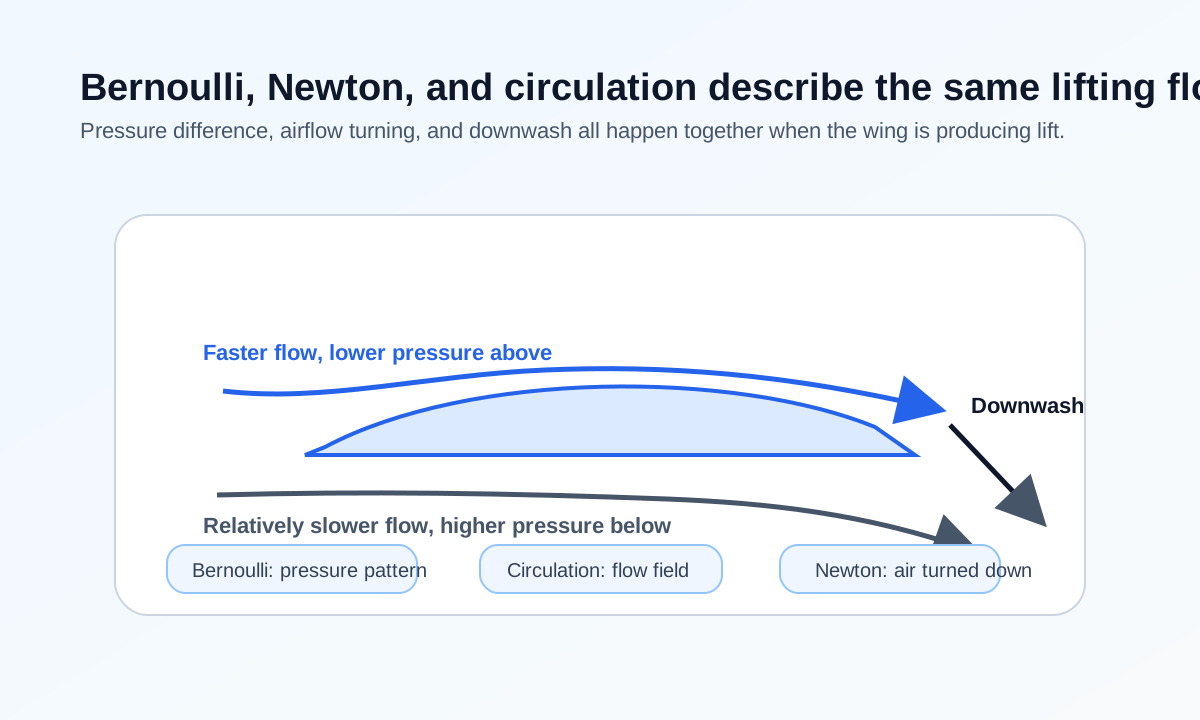
- Bernoulli view: the wing creates lower pressure above and relatively higher pressure below.
- Newton view: the wing deflects air downward, and the reaction force contributes upward lift.
- Circulation view: the wing reshapes the surrounding flow, changing velocity and pressure around the airfoil.
All three are compatible. The pilot does not need to master advanced equations to use them correctly, but the pilot should understand that lift is a whole-flow result, not a single memorized slogan.
Bernoulli and Pressure Difference
Bernoulli's principle links higher local airflow speed with lower static pressure along a streamline, assuming the flow behaves smoothly enough for that model to apply. Around a wing, the airflow usually accelerates over portions of the upper surface, which contributes to lower pressure there. Pressure on the lower surface is usually higher relative to the upper surface, and that pressure difference contributes to upward lift.
The common oversimplification is the "equal transit time" story, which claims the air going over the top of the wing must race to meet the air below at the trailing edge. That claim is not generally true and is not the reason lift exists. The more useful point is that the wing shape and angle of attack establish a pressure distribution that makes the upper-surface flow accelerate and the lower-surface flow support the wing.
Newton and Downwash
Newton's third law says that if the wing pushes air downward, the air pushes the wing upward with an equal and opposite force. This is not a separate theory from the pressure view. The wing turns the airflow, and that turning shows up both as a momentum change in the wake and as a pressure pattern around the wing surfaces.
This perspective is especially useful for pilots because it connects directly to what the wing is doing to the surrounding air. A wing producing lift leaves a downwash behind it. If the wing is forced to work harder through higher angle of attack or load factor, the downwash and induced drag both increase.
Circulation, Flow Turning, and Upwash
The circulation model helps tie the pressure and momentum views together. A lifting airfoil changes the flow around itself so that the air approaches with slight upwash ahead of the wing and leaves with downwash behind it. That altered flow pattern is part of why the pressure distribution and wake structure look the way they do.
Pilots do not need circulation equations to benefit from this idea. The practical lesson is that lift is not confined to the metal skin of the wing. It is produced by the wing and the surrounding flow field together. That is also why nearby wings, flaps, tail surfaces, or even ice contamination can significantly change the lift picture by disturbing that flow.
Angle of Attack, Airfoil Shape, and Camber
An airfoil's shape matters, but angle of attack is usually the pilot-controlled variable that matters most in flight. A cambered wing can produce useful lift at lower geometric angles, but any wing still depends on how it meets the relative wind. Even a symmetrical airfoil will produce lift when set at a positive angle of attack.
- Camber: helps shape the pressure distribution and can improve lift characteristics at ordinary operating angles.
- Angle of attack: changes the airflow pattern and usually has the strongest immediate effect on lift and induced drag.
- Airspeed: changes how much lift that airfoil and AOA combination can generate.
This is why operational flying logic centers on AOA even when no AOA display is installed. Pulling to climb, banking harder, gust response, or slowing down all change the angle relationship the wing sees.
Boundary Layer Separation and Stall
The wing stalls when the airflow can no longer stay attached enough to maintain the needed pressure distribution. As AOA rises toward the critical angle, the boundary layer has a harder time following the wing contour, especially on the upper surface. Once separation becomes large enough, lift decreases sharply and drag rises. That is the stall.
This explains several practical truths:
- A stall can occur at many different indicated airspeeds because the true trigger is critical angle of attack.
- Ice, roughness, contamination, and abrupt maneuvering can worsen separation behavior and reduce margin.
- Stall recovery works because reducing AOA allows the airflow to reattach and the wing to rebuild lift.
The stall is therefore not a mysterious failure. It is the predictable limit of the lift-producing flow picture the pilot has been asking the wing to maintain.
What a Pilot Should Actually Take Away
A pilot does not need a graduate fluid-dynamics model in the cockpit. The practical takeaways are much simpler:
- The wing produces lift by changing the surrounding airflow, pressure, and momentum together.
- Angle of attack is the pilot-controlled lever that matters most for lift margin.
- Lift and drag are linked, so asking the wing to work harder usually creates more induced drag.
- Stalls happen because the airflow separates when AOA exceeds the critical limit, not because one exact airspeed was reached.
If those four points are clear, the theory has already become useful. They explain why slow flight feels draggy, why steep turns raise stall speed, why contaminated wings are dangerous, and why a good stall recovery begins by unloading the wing instead of pulling harder.
Use this page with Principles of Flight for the behavior side and Forces of Flight for the force-balance side.
References
- Pilot's Handbook of Aeronautical Knowledge — FAA treatment of lift, airfoils, stalls, and angle of attack.
- Principles of Flight — how lift theory shows up in stall behavior, turns, stability, and margin management.
- Aerodynamic Factors — operational consequences of contamination, loading, and performance changes.
- Forces of Flight — system view of lift, weight, thrust, and drag working together.