Types of Altitude
Indicated, calibrated, pressure, density, true, and absolute altitude — what each means and when it matters.
Quick Reference
Key points
Short-answer refresher for returning pilots before diving into the full page.
Quick Reference
Key points
Short-answer refresher for returning pilots before diving into the full page.
- Know which altitude answers which question: indicated for ATC, pressure for performance and flight levels, density for aircraft capability, and true or absolute for terrain picture.
- Every 0.01 in. Hg of altimeter-setting error is about 10 feet, so stale settings create real vertical error even when the instrument looks precise.
- High density altitude is a performance problem, not just a textbook definition; treat it as lost climb, longer runway, and less margin.
Standards & References
FAA doctrinal and ACS cross-reference
Use this box to line the topic up with the FAA’s primary instrument handbooks, the most relevant ACS task areas, and the knowledge, skill, and risk elements that usually drive checkride evaluation.
- IFH Ch. 4, Flight Instruments: altimeter interpretation, pressure-setting discipline, and vertical instrument awareness.
- IFH Ch. 8, Flight Planning: altitude selection, terrain clearance, and cold-temperature or performance considerations before launch.
- IPH Ch. 1, Departure Procedures: obstacle-clearance altitudes, climb restrictions, and textual altitude notes.
- IPH Ch. 4, Approaches: stepdowns, DA/MDA use, and charted altitude compliance on instrument procedures.
- I.E National Airspace System.
- VI.A through VI.C instrument-approach altitude compliance.
On This Page
Overview
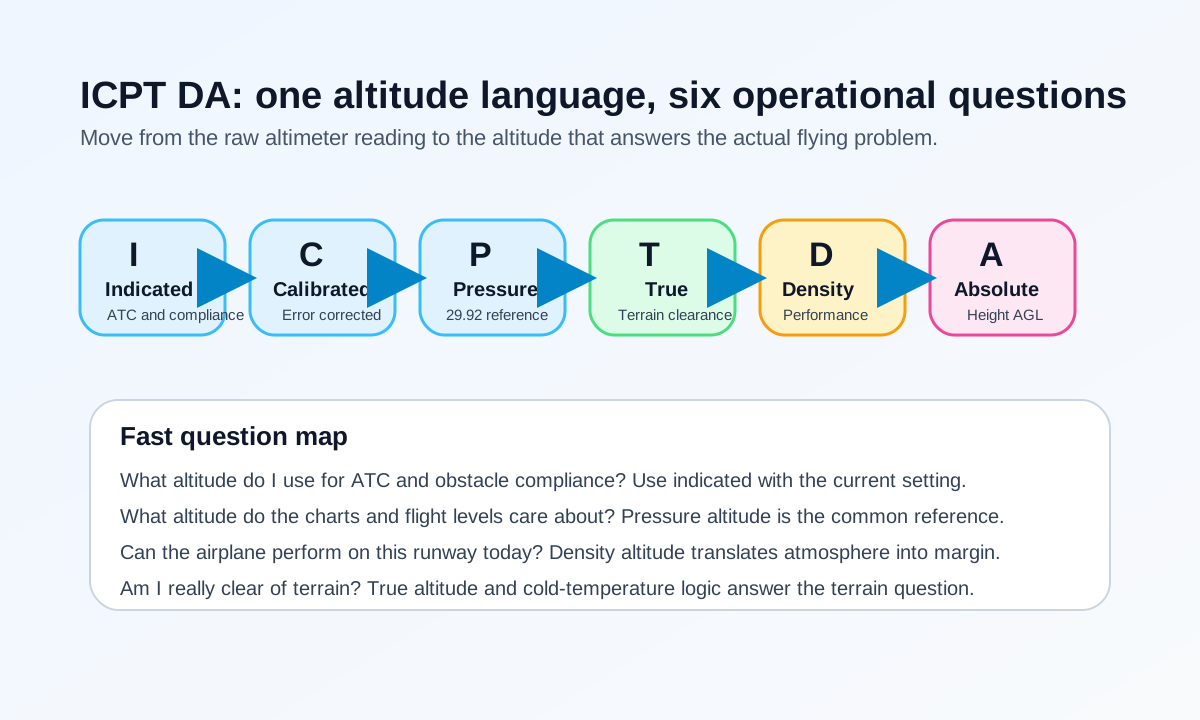
Pilots work with six distinct definitions of altitude, each answering a different question about where the aircraft is or how it is performing. Confusing them is a persistent source of errors in performance planning, instrument flight, and ATC compliance. The six types are:
- Indicated Altitude (IA) — what the altimeter displays with the current altimeter setting.
- Calibrated Altitude (CA) — indicated altitude corrected for instrument and position error.
- Pressure Altitude (PA) — height above the standard datum plane (29.92" Hg / 1013.25 hPa).
- Density Altitude (DA) — pressure altitude corrected for non-standard temperature; the altitude the aircraft "feels" for performance purposes.
- True Altitude (TA) — actual height above mean sea level (MSL).
- Absolute Altitude (AA) — actual height above the terrain directly below (AGL).
In standard atmospheric conditions at sea level, all six are equal. In the real atmosphere they diverge, and the differences have direct operational consequences for terrain clearance, ATC separation, performance calculations, and instrument approach minima.
Indicated Altitude
Indicated altitude is the value read directly from the altimeter when it is set to the current local altimeter setting (QNH). It is the altitude pilots use for ATC communications, terrain and obstacle clearance, and compliance with altitude assignments in controlled airspace.
How the altimeter works
An aneroid altimeter measures static air pressure and translates it into an altitude reading using the relationship between pressure and altitude defined by the International Standard Atmosphere (ISA). A Kollsman window allows the pilot to dial in the current local altimeter setting, which offsets the reading to account for the difference between standard pressure (29.92" Hg) and actual sea-level pressure at the reporting station.
Altimeter setting (QNH)
- What it represents: The sea-level pressure corrected for the elevation of the reporting station. When set correctly, the altimeter displays the aircraft's approximate MSL altitude directly.
- Source: Obtained from ATIS, AWOS/ASOS, or ATC before takeoff and updated en route as required. In the U.S., 14 CFR § 91.121 requires the nearest station altimeter setting within 100 NM be used.
- High to low, look out below: Flying from a high-pressure area to a lower-pressure area without updating the altimeter setting causes the altimeter to read higher than the actual MSL altitude — the aircraft is lower than indicated. The mnemonic "from high to low, look out below" captures this risk.
Effect of altimeter setting on the reading
The Kollsman window is a mechanical offset: dialing in a higher setting shifts the altitude reading up; dialing in a lower setting shifts it down. The relationship is linear and consistent:
Rule: each 0.01" Hg change in altimeter setting = approximately 10 ft change in indicated altitude
- Higher setting → altimeter reads higher
- Lower setting → altimeter reads lower
Calculating the effect
To find how much the indicated altitude changes when the altimeter setting changes:
- Formula: Altitude change = (New setting − Old setting) × 1,000
- A positive result means the altimeter reads higher with the new setting; negative means lower.
Worked examples
- Setting increases from 29.96 to 30.11 (e.g., flying from a low-pressure area into a
high-pressure area and updating the altimeter):
(30.11 − 29.96) × 1,000 = 0.15 × 1,000 = +150 ft
The altimeter reads 150 ft higher after the update. The aircraft has not moved — the reading changed because the setting corrected for higher ambient pressure. This is the correct operation; the new reading more accurately reflects the aircraft's true MSL altitude. - Setting decreases from 30.11 to 29.96 (e.g., flying into lower pressure without
updating):
(29.96 − 30.11) × 1,000 = −0.15 × 1,000 = −150 ft
If the pilot does not update the altimeter, the reading remains 150 ft too high. The aircraft is 150 ft lower than the altimeter indicates — the "high to low, look out below" scenario. - Setting differs from standard (30.11 set, actual QNH 29.92):
(29.92 − 30.11) × 1,000 = −0.19 × 1,000 = −190 ft
Pressure altitude = Indicated altitude − 190 ft. An aircraft indicating 5,000 ft with 30.11 set has a pressure altitude of 4,810 ft — the figure used for performance charts and transponder encoding.
Stale altimeter setting in flight
Every 0.01" Hg of uncorrected altimeter setting error produces 10 ft of altitude error. A setting that is 0.15" Hg stale — entirely plausible on a long flight or in a fast-moving weather system — places the aircraft 150 ft above or below its indicated altitude. Over rising terrain or on a precision approach, this margin is operationally significant. Update the altimeter setting as frequently as practical, and always obtain the destination setting before beginning an approach.
Limitations
- Indicated altitude equals true altitude only when the atmosphere exactly matches ISA conditions. In non-standard temperature or pressure, a correction is needed to obtain true altitude.
- Instrument error and position (static port) error can cause small discrepancies between indicated and calibrated altitude, typically within ±75 ft for certificated aircraft.
Calibrated Altitude
Calibrated altitude is indicated altitude corrected for instrument error and position (static source) error. These errors arise from manufacturing tolerances in the altimeter mechanism and from the static port location on the aircraft, which may sense a slightly different pressure than true free-stream static pressure depending on aircraft attitude and speed.
Magnitude and significance
- For most transport-category and well-maintained general aviation aircraft, instrument and position error combined is typically less than ±50 ft at normal airspeeds — small enough that indicated and calibrated altitude are treated as equal in routine operations.
- Errors can be larger at very low airspeeds, high angles of attack, or with non-standard flap configurations. The Pilot's Operating Handbook (POH) position error correction table gives the correction for each airspeed and configuration.
- Calibrated altitude is used as the starting point for calculating true altitude and for precise performance work.
Pressure Altitude
Pressure altitude is the height above the standard datum plane — the theoretical level at which atmospheric pressure is 29.92" Hg (1013.25 hPa). It is obtained by setting the altimeter's Kollsman window to 29.92 and reading the indicated altitude, or by applying a correction to the indicated altitude based on the difference between the actual altimeter setting and 29.92.
How to find pressure altitude
- Direct method: Set the altimeter to 29.92" Hg. The reading is pressure altitude.
- Calculation method: For each 0.01" Hg the altimeter setting differs from 29.92,
the pressure altitude differs from indicated altitude by approximately 10 ft.
Formula: PA = Indicated Altitude + (29.92 − Altimeter Setting) × 1,000
Example: Field elevation 1,500 ft MSL, altimeter setting 29.72" Hg → PA = 1,500 + (29.92 − 29.72) × 1,000 = 1,500 + 200 = 1,700 ft PA
Primary uses
- Performance calculations: Aircraft flight manuals reference pressure altitude for takeoff distance, climb performance, and cruise performance charts. Using indicated altitude instead of pressure altitude in performance calculations introduces error when the altimeter setting is not 29.92.
- Flight levels: Above 18,000 ft MSL in the U.S. (the transition altitude), all aircraft set their altimeters to 29.92 and report altitude in flight levels (FL180, FL250, etc.). This ensures uniform vertical separation regardless of local pressure variations.
- Transponder altitude encoding: Mode C and ADS-B transponders encode pressure altitude (29.92 reference), not indicated altitude. ATC radar displays apply the current altimeter setting to convert the encoded value to a displayed altitude. This is why the transponder altitude may differ from the altimeter reading by the position error correction.
- Oxygen requirements: 14 CFR § 91.211 oxygen requirements are referenced to pressure altitude, not indicated altitude.
Density Altitude
Density altitude is pressure altitude corrected for non-standard temperature. It represents the altitude in the standard atmosphere that has the same air density as the actual conditions. Because aircraft and engine performance depend on air density — not altitude per se — density altitude is the operationally critical value for all performance planning.
Why it matters
At high density altitudes the air is less dense, which means:
- Wings generate less lift at a given indicated airspeed, so true airspeed and ground speed are higher than indicated airspeed at rotation and climb.
- Engines produce less power (naturally aspirated piston engines lose approximately 3% power per 1,000 ft density altitude increase).
- Propellers are less efficient in thinner air, reducing thrust for a given RPM.
- The combined effect is significantly longer takeoff rolls, reduced climb rates, and higher landing speeds — hazards that have caused numerous accidents at high-elevation airports on hot days.
Calculating density altitude
- Approximate formula:
DA ≈ PA + 120 × (OAT°C − ISA Temperature°C)
where ISA Temperature at a given pressure altitude = 15°C − (2°C × PA in thousands of feet).
Example: PA = 5,000 ft, OAT = 30°C, ISA temp at 5,000 ft = 15 − 10 = 5°C
DA = 5,000 + 120 × (30 − 5) = 5,000 + 3,000 = 8,000 ft DA - E6-B flight computer: Align OAT against pressure altitude on the density altitude window to read density altitude directly.
- Airport AWOS/ASOS: Many stations broadcast density altitude directly, particularly at higher-elevation airports.
High density altitude operations
- Use performance charts in the POH — never rely on memory or rule-of-thumb corrections alone for takeoff and climb performance when density altitude is high.
- A density altitude above the aircraft's service ceiling makes sustained level flight impossible.
- High density altitude can exist at sea-level airports on very hot days. An airport at sea level with a temperature of 38°C (100°F) and standard pressure has a density altitude of approximately 3,000 ft.
True Altitude
True altitude is the actual height of the aircraft above mean sea level. It is what is depicted on aeronautical charts for terrain, obstacles, and airport elevations. In ISA standard conditions, true altitude equals indicated altitude. In practice, the two diverge whenever temperature differs from standard — and this difference is most significant in cold weather.
Why indicated altitude differs from true altitude
The altimeter converts pressure to altitude using the ISA temperature profile. When the actual temperature is colder than ISA, the air is denser — pressure levels are compressed closer to the surface, so the actual altitude is lower than the altimeter indicates. When it is warmer than ISA, the air is less dense and the actual altitude is higher than indicated.
- Cold air → lower than indicated: In below-standard temperatures, the aircraft is always lower than the altimeter reads. This directly affects obstacle and terrain clearance on instrument approaches and departures. The colder the temperature and the higher the altitude above the altimeter setting source, the greater the error.
- Warm air → higher than indicated: In above-standard temperatures, the aircraft is higher than indicated. This is generally a favorable error for terrain clearance but affects fuel planning and cruise level optimization.
True altitude correction formula
An approximate correction can be applied using the outside air temperature:
- True Altitude ≈ Indicated Altitude + [Indicated Altitude × (OAT°C − ISA Temp°C) / 273]
- More practically, the E6-B flight computer has a true altitude window that computes the correction given indicated altitude, OAT, and station elevation.
- For most en route operations the error is small enough to ignore, but on instrument approaches with low terrain clearance in very cold temperatures (below −10°C), the correction is operationally significant.
ATC and chart altitudes are true altitudes
- All terrain and obstacle elevations on sectional charts, approach plates, and en route charts are true (MSL) altitudes.
- Minimum altitudes published on instrument procedures (MEA, MOCA, MDA, DA) are also referenced to MSL true altitude — they assume standard temperature. Cold temperature corrections must be applied when temperatures are significantly below ISA to ensure published obstacle clearance is actually achieved.
Absolute Altitude
Absolute altitude is the height of the aircraft above the terrain directly below — the actual above-ground level (AGL) height. It is measured by a radio altimeter (radar altimeter) on equipped aircraft, or calculated by subtracting terrain elevation from true altitude.
Operational uses
- Radio altimeter: Directly measures absolute altitude by timing a radio wave reflection from the ground. Used for GPWS/TAWS alerts, autoland systems, and decision height on Category II/III ILS approaches.
- Terrain clearance: The difference between true altitude and terrain elevation. Over mountainous terrain or when crossing ridge lines, the AGL value must be checked against minimum safe altitudes even when indicated altitude is well above the MEA.
- VFR operations: Many VFR altitude restrictions (Class D airspace ceilings, cloud clearance requirements, minimum safe altitudes under 14 CFR § 91.119) are expressed in AGL — they refer to absolute altitude.
Relationships & the ICPT Sequence
The six altitude types relate to each other in a logical sequence. A useful way to remember the progression from "raw reading" to "real height" is the acronym ICPT DA:
- Indicated → raw altimeter reading with current QNH set.
- Calibrated → corrected for instrument and position error.
- Pressure → referenced to 29.92; used for performance and flight levels.
- True → corrected for non-standard temperature; actual MSL height.
- Density → pressure altitude corrected for temperature; governs performance.
- Absolute → height AGL; used for terrain clearance and low-altitude ops.
In ISA standard conditions at sea level
All six are equal. As conditions deviate from standard, each type diverges:
- High altimeter setting (above 29.92) → Indicated altitude is higher than pressure altitude.
- Low altimeter setting (below 29.92) → Indicated altitude is lower than pressure altitude.
- Cold temperature → True altitude is lower than indicated altitude (aircraft is lower than the altimeter shows).
- Hot temperature → Density altitude is higher than pressure altitude (performance degrades).
- High terrain below → Absolute altitude is less than true altitude.
When specific pairs are equal
When is pressure altitude equal to true altitude?
When the temperature throughout the atmosphere is standard (ISA) — 15°C at sea level decreasing at 2°C per 1,000 ft. The altimeter converts measured pressure to altitude using the ISA temperature model; when actual temperature matches that model, the conversion is exact and pressure altitude equals true altitude. Temperature is the determining factor for this pairing — not the altimeter setting, which only affects whether indicated equals pressure altitude.
When is indicated altitude equal to pressure altitude?
When the altimeter is set to 29.92" Hg (standard datum). This is the definition of pressure altitude — it is simply what the altimeter reads with 29.92 set, regardless of temperature.
When is indicated altitude equal to true altitude?
When both conditions above are met simultaneously — the altimeter setting is the current QNH and temperature is standard (ISA). In practice this is rarely exact, but the combination of a correct altimeter setting and near-standard temperature makes indicated altitude a reliable approximation of true altitude for most en route operations.
Practical memory check
- ATC clearance / terrain / obstacle clearance? → Use indicated altitude (with current QNH set).
- Performance charts (takeoff, climb, cruise)? → Use pressure altitude as the chart entry.
- Can the aircraft perform? Hot and high? → Check density altitude.
- Am I really clear of the terrain? → Compare true altitude to chart elevations; apply cold temperature corrections in cold weather.
- How far am I above the ground right now? → Absolute altitude (radio altimeter or true altitude minus terrain elevation).
Cold Temperature Altitude Corrections
Cold temperature correction is one of the most under-appreciated altitude topics in general aviation. When surface temperatures are significantly below ISA standard (15°C), altimeters over-read — the aircraft is lower than the indicated altitude. On instrument approaches with small obstacle clearance margins, this difference can be the margin between clearing and hitting terrain.
The ICAO cold temperature correction table
The FAA publishes cold temperature correction tables in the AIM (7-2-3) and on instrument approach plates at airports that require them. The table gives the altitude correction in feet based on:
- The height above the altimeter setting source (airport elevation), and
- The reported surface temperature at the airport.
Example: At −20°C, a published MDA of 1,000 ft above the airport requires adding approximately 230 ft to the published MDA to maintain the intended obstacle clearance. The pilot flies 1,230 ft on the altimeter but the approach plate minimum remains 1,000 ft — the correction is added to the altitude flown, not the published minimum.
When corrections are required
- Mandatory: Some airports publish cold temperature restrictions directly on approach plates (e.g., "Apply cold temperature corrections below −15°C"). When published, the correction is not optional.
- Discretionary: At airports without published restrictions, pilots operating in IMC in cold temperatures should apply corrections when the temperature is significantly below standard and terrain or obstacle clearance is limited.
- ATC coordination: When applying cold temperature corrections that result in flying an altitude other than the published value, coordinate with ATC so controllers know the aircraft's actual intended altitude for separation purposes.
Rule of thumb
- For every 10°C below standard temperature, an aircraft flying at 1,000 ft above the altimeter source is approximately 40 ft lower than indicated. The error grows with altitude above the source and with decreasing temperature.
- At −30°C and 3,000 ft above the airport, the correction can exceed 500 ft — enough to place an aircraft below published minimums if not applied.
Operational Summary
Each altitude type has a specific role. Using the wrong one for a given task introduces systematic errors that compound with other uncertainties.
Below 18,000 ft (below the transition altitude)
- Set the altimeter to the current QNH (local altimeter setting) and use indicated altitude for ATC compliance, terrain clearance, and airspace altitude limits.
- Use pressure altitude (set 29.92 temporarily) as the entry for performance charts and for computing density altitude.
- Apply true altitude corrections when flying in very cold temperatures on instrument procedures with limited terrain clearance.
At and above 18,000 ft (flight levels)
- Set altimeter to 29.92 and report altitude as a flight level. All aircraft use the same reference, providing consistent separation regardless of local pressure.
- ATC uses pressure altitude (encoded by the transponder) as the basis for separation; the flight level system is essentially a pressure altitude system with a uniform datum.
Performance planning
- Always compute density altitude before takeoff when temperature is above ISA, field elevation is high, or both. High density altitude significantly extends takeoff roll and reduces initial climb rate.
- The POH performance charts are entered with pressure altitude and OAT — the charts themselves account for the density altitude effect without requiring the pilot to compute DA explicitly.
References
- Pilot's Handbook of Aeronautical Knowledge (FAA-H-8083-25B) — Chapter 8 (Flight Instruments) covers altimeter operation, types of altitude, and density altitude in depth.
- Instrument Flying Handbook (FAA-H-8083-15B) — Chapter 2 covers altimetry for IFR operations including pressure altitude, transition altitude, and altimeter errors.
- FAA AIM § 7-2-2 and 7-2-3 — Altimeter setting procedures and cold temperature corrections for instrument procedures.
- 14 CFR § 91.121 — Altimeter settings regulatory requirements.
- 14 CFR § 91.211 — Supplemental oxygen requirements referenced to pressure altitude.
- FAA Aviation Weather Handbook (FAA-H-8083-28) — Background on ISA and the standard atmosphere used as the basis for altimetry.
- AC 91-116 — Cold Temperature Corrections — FAA advisory circular on applying cold temperature altitude corrections on instrument approaches.