Advanced IFR Weather Interpretation
A practical IFR weather page for reading skew-Ts, using radar correctly, forecasting turbulence, judging ceiling and visibility trends, and making better weather decisions.
Quick Reference
Key points
Short-answer refresher for returning pilots before diving into the full page.
Quick Reference
Key points
Short-answer refresher for returning pilots before diving into the full page.
- Start broad, then narrow: synoptic setup first, vertical structure second, tactical products and PIREPs third.
- Use skew-Ts to answer practical IFR questions about cloud depth, freezing-level exposure, inversions, shear, and convective potential.
- If the setup, layers, and current observations disagree, trust the larger system picture over the single optimistic product.
Standards & References
FAA doctrinal and ACS cross-reference
Use this box to line the topic up with the FAA’s primary instrument handbooks, the most relevant ACS task areas, and the knowledge, skill, and risk elements that usually drive checkride evaluation.
- IFH Ch. 8, Flight Planning: advanced weather interpretation for route selection, alternate quality, and forecast-confidence decisions before launch.
- IFH Ch. 9, IFR Flight: revising altitudes, arrivals, or the entire plan when radar, turbulence, or ceiling trends invalidate the original brief.
- Supporting only: this page sharpens the weather interpretation needed to use the procedures in IPH Ch. 1 through Ch. 4 with real operational judgment.
- I.F Weather Information.
- Risk-management elements embedded throughout the Instrument Rating ACS when weather changes route, alternate, and approach viability.
Checkride Focus
How this topic is typically evaluated
Use this block as the ACS-ready summary: what task areas this page supports, what the applicant should know, what the applicant should be able to do, and what risks must be managed without prompting.
Checkride Summary
This page is checkride-useful because it turns weather products into a route decision instead of a product recital. The evaluator is listening for whether the applicant can connect soundings, radar, turbulence clues, and ceiling trends into one practical go, delay, reroute, or no-go answer.
Knowledge
- Know what a skew-T or forecast sounding reveals about cloud depth, freezing levels, inversions, wind shear, and convective structure.
- Understand the strengths and limitations of radar products, including delay, attenuation, overshoot, and the difference between tactical and strategic use.
- Know the weather setups that usually produce turbulence, low ceilings, fog, and forecast-confidence problems for IFR flights.
Skills
- Build one coherent weather picture from TAFs, METAR trends, radar, soundings, turbulence products, and PIREPs instead of relying on a single product.
- Explain how the weather picture changes altitude choice, departure timing, alternate selection, and approach feasibility.
- Recognize when uncertainty itself is the risk driver and respond by adding margin, delaying, rerouting, or cancelling early.
Risk Management
- Over-trusting one clean product, especially a favorable TAF or a misleading radar gap, while the broader system picture is deteriorating.
- Treating datalink or web radar as tactical close-range weather penetration guidance.
- Using a legal alternate or marginal arrival plan that depends on forecast improvement unsupported by observations.
On This Page
Overview
IFR pilots rarely get into trouble because they forgot one weather definition. The trouble usually starts when several weather clues are individually familiar but never turned into one operational picture. A TAF hints at lowering ceilings, radar shows scattered returns, a sounding shows a saturated layer, and a PIREP mentions light chop. None of those facts alone answers the real question: what is the route likely to do to workload, margins, and escape options?
This page focuses on the interpretation gap that often sits between basic weather knowledge and real instrument decision-making. Use it with General Weather, Stability and Temperature Inversions, Vertical Structure, Icing, and IFR Risk Management and Personal Minimums.
IFR Weather Workflow
The best advanced-weather habit is to move from the large picture to the aircraft-specific question. Do not start by staring at one airport forecast. Start by asking what synoptic setup is driving the day, then work down to the route, the layers, and finally the arrival window.
1
Setup
Fronts, pressure systems, terrain effects, moisture source, and whether the route is mostly stratiform, convective, mountain, or post-frontal.
2
Layers
Use soundings and freezing-level data to find cloud depth, icing exposure, inversions, turbulence layers, and whether the descent path is trapped in the worst band.
3
Verification
Cross-check TAFs with METAR trends, PIREPs, radar, satellite, and nearby stations to see whether the forecast is actually verifying.
4
Margins
Convert the forecast into altitude options, fuel buffer, alternate quality, turbulence tolerance, and whether the route still works after one missed approach or reroute.
5
Decision
Launch, delay, reroute, choose an easier altitude, or cancel before the weather converts into single-pilot workload at the worst possible phase.
Fast rule
When one product says go and the rest of the weather system says caution, trust the system picture more than the isolated product. IFR weather mistakes often come from over-trusting the cleanest answer on the screen.
Skew-T Interpretation
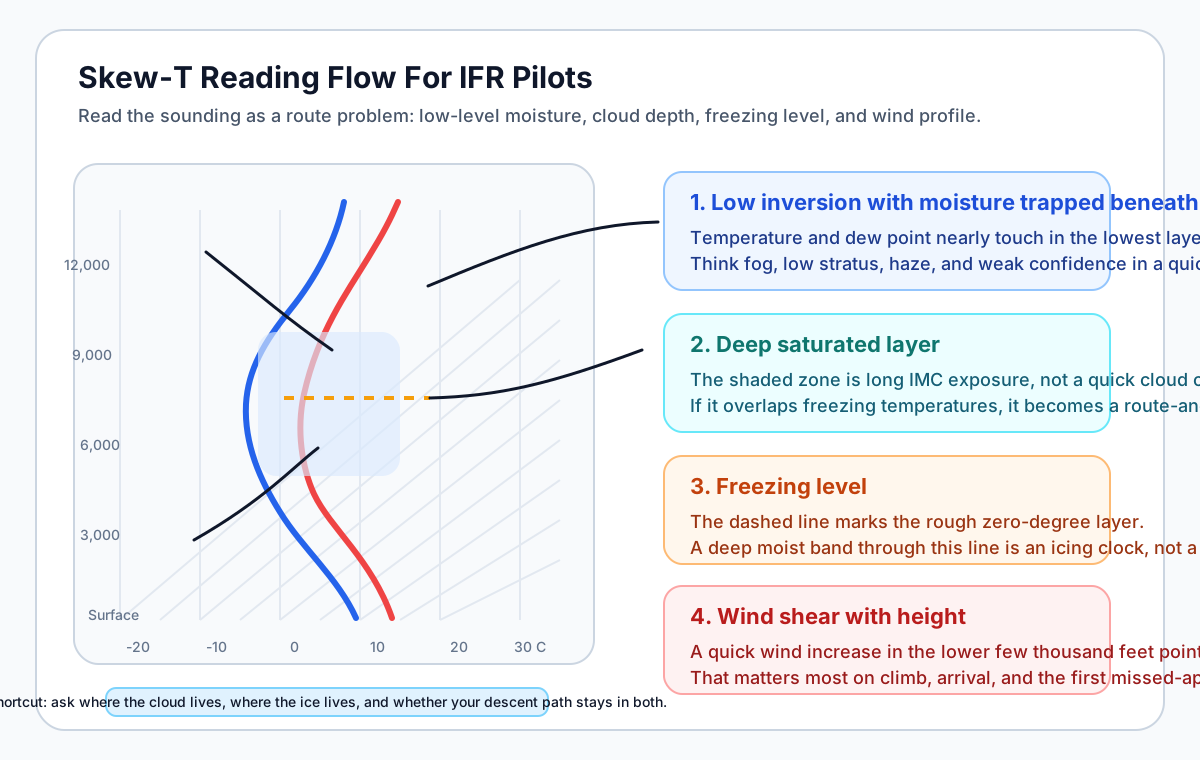
A skew-T or forecast sounding is the best tool for seeing the vertical story that surface products hide. IFR pilots do not need to become meteorologists, but they do need a repeatable way to extract the few details that matter operationally.
What to look for first
- Temperature and dew point spacing: where the lines come together, expect saturation, clouds, and potentially icing if that layer is below freezing.
- Depth of the moist layer: a thin saturated layer may be a brief nuisance; a deep saturated layer means longer IMC exposure, more icing time, and fewer easy outs.
- Inversions and caps: a right-turning temperature trace reveals inversions that trap haze, low stratus, fog, wind shear, or convective energy beneath a cap.
- Freezing level and warm noses: these define whether the route crosses a simple icing band or a more dangerous layered setup with sleet or freezing rain potential.
- Wind profile: large speed or direction changes with height are early warnings for turbulence, LLWS, mountain wave, or demanding approach energy management.
- Convective structure: CAPE, CIN, and the relationship between moist layers and lapse rates help judge whether the atmosphere is quietly layered or close to a convective release.
IFR use cases
| What you see on the sounding | What it usually means | Pilot consequence |
|---|---|---|
| Near-surface temperature and dew point almost touching below a low inversion | Fog, haze, or low stratus formation is likely if winds remain light. | Do not trust a hopeful improving TAF unless nearby observations and sunrise mixing support it. |
| Deep saturated layer straddling the freezing level | Long-duration cloud and icing exposure instead of a quick crossing. | Pick a route or altitude with a real exit, or treat the day as a no-go in a non-FIKI airplane. |
| Strong low-level wind increase through 1,000 to 2,000 feet AGL | LLWS or sharp shear is likely during departure or approach. | Brief the go-around early, respect PIREPs, and avoid being surprised in the flare or initial climb. |
| Strong cap above a humid and unstable boundary layer | Convection may be delayed, then break rapidly when the cap weakens. | Treat timing uncertainty as risk, especially if the arrival window overlaps the expected cap break. |
A good IFR shortcut is to read the sounding in this order: low-level moisture, cloud depth, freezing level, wind profile, then convective potential. That sequence answers the questions that most often decide whether a trip remains routine.
Radar Interpretation
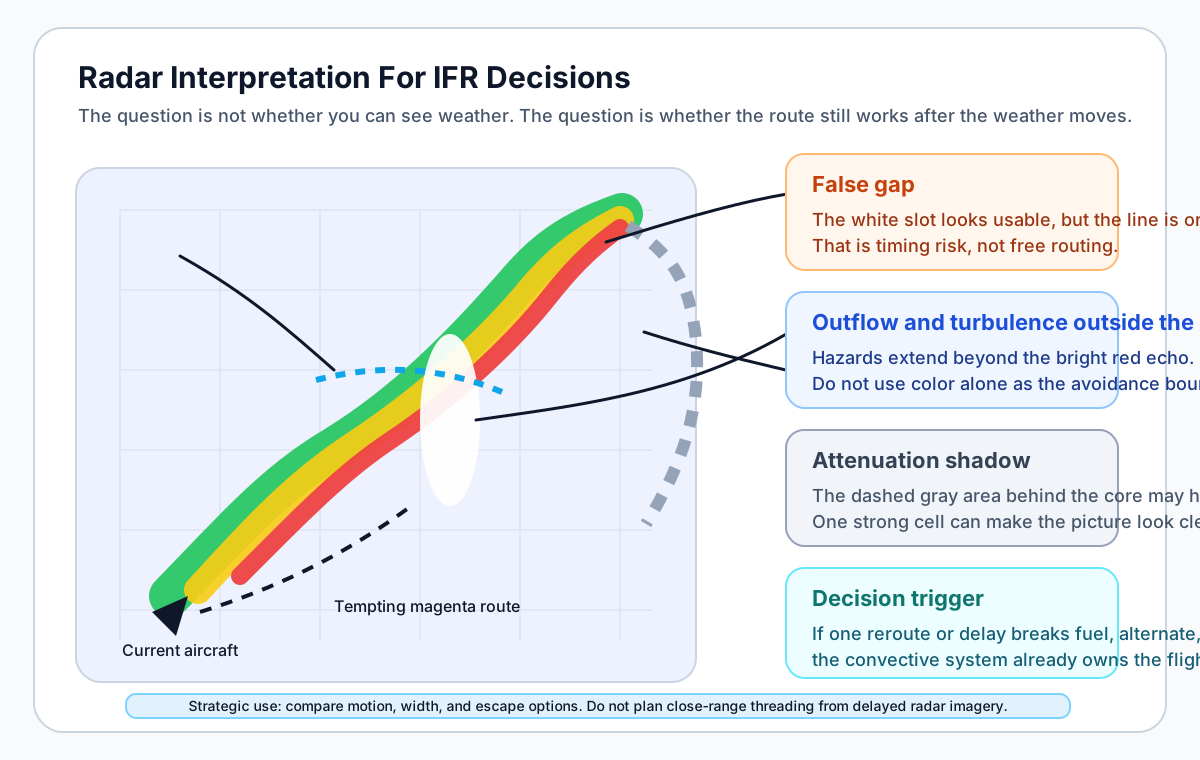
Radar is valuable, but pilots get into trouble when they treat it like an exact live map of where the danger is. Precipitation radar mainly shows returned energy from hydrometeors. It does not directly show turbulence, hail size, or every hazardous part of a convective system, and cockpit or web radar can lag the real weather.
What radar does well
- Precipitation coverage and movement: it helps answer whether the route crosses isolated cells, broad stratiform rain, or a nearly continuous line.
- Intensity trends: increasing reflectivity and growth over successive frames matter more than one static image.
- System shape: bowing lines, hooks, embedded clusters, and broad shield structure reveal whether the problem is tactical or strategic.
- Verification: if the forecast called for scattered showers but radar now shows a continuous convective barrier, the brief is already outdated.
What radar does poorly
- Age-sensitive tactics: data-linked radar is for strategic avoidance, not close-range threading.
- Beam geometry: farther from the radar site, the beam overshoots low precipitation and may understate what is happening near the surface.
- Attenuation and shadowing: strong cells can hide weather behind them, creating false gaps.
- Non-precipitation hazards: outflow boundaries, severe turbulence, hail margins, and lightning-rich regions can extend well beyond the bright core.
- Composite versus base reflectivity confusion: composite can make a wide area look equally bad even when the lowest levels differ, while base reflectivity can miss high hazardous structure if you only glance once.
Radar trap
The most common IFR radar mistake is seeing a narrow green or yellow gap and assuming it is a route. If the line is organized, embedded, building, or moving across the route, that "gap" is often just a late snapshot of a closing door.
IFR radar checklist
- Look at motion first: where will the line or cell be at your arrival time, not where is it now?
- Measure width, not color alone: a broad light-echo shield may be strategically worse than a tiny bright return you can route around with huge margin.
- Cross-check lightning, SIGMETs, convective outlooks, and pireps: radar is only one piece of the convective picture.
- Ask whether the route still works after a reroute: if one deviation would break fuel, alternate, or daylight margin, the weather already owns the flight.
- Stay strategic: datalink and web radar support delay, reroute, or cancel decisions. They are not permission for precision threading near cells.
- Assume embedded convection is worse than it looks: if the clouds hide the structure, treat the uncertainty as added risk instead of a smaller problem.
- Use airborne radar only if you understand tilt and range limits: otherwise the display can be more misleading than helpful.
Turbulence Forecasting
Turbulence forecasting is not one product. It is a pattern-recognition exercise that combines the forcing mechanism, the wind profile, terrain, stability, and real-world reports. The best predictor is often the agreement between several imperfect clues.
Common IFR turbulence setups
- Convective turbulence: the most obvious and least negotiable. Avoid cells, anvils, and outflow regions generously.
- Inversion and LLWS turbulence: a stable low layer can still produce sharp shear and chop at the inversion top or on short final.
- Mountain wave and lee-side rotor: strong winds across ridges with stable layering can create severe wave and rotor far from visible cloud clues.
- Clear-air turbulence near jets: strong upper-level wind gradients and jet-core structure can produce turbulence in apparently clear air.
- Mechanical turbulence: terrain, buildings, and rough surfaces matter most in the low-altitude phases when the airplane is also least tolerant of surprises.
Forecast logic
- Start with winds aloft and the sounding: sharp vertical shear is the root of many turbulence problems.
- Use GTG, G-AIRMET Tango, and SIGMETs as placement clues: they frame the region, but they still need terrain, altitude, and timing interpretation.
- Weight PIREPs heavily: altitude-specific reports are often the deciding clue for whether the hazard is theoretical or active.
- Check for daytime heating and lapse-rate support: convective mixing can turn a modest wind day into a rough low-altitude day.
- Respect terrain orientation: a 40-knot wind across ridges is not the same problem as 40 knots aligned with a valley route.
For IFR planning, turbulence is rarely just a comfort issue. It increases instrument scan load, degrades approach stability, makes ice accumulation harder to manage, and can turn a legal approach into a poor one for a single pilot.
Ceiling and Visibility Logic
Ceiling and visibility forecasting becomes much more accurate when you stop treating the TAF as the whole answer. Most bad IFR decisions in low weather come from missing the logic behind the trend.
What usually lowers ceilings and visibility
- Overrunning and warm-front lift: expect broad lowering layers that often affect the alternate region too.
- Nocturnal inversion plus high humidity: radiation fog and low stratus are likely if winds stay light and the dew point spread collapses.
- Marine or upslope flow: moisture depth and terrain lift can produce stubborn ceilings that improve slower than a TAF implies.
- Post-rain moisture under clearing skies: a classic overnight fog setup if winds weaken and the boundary layer decouples.
- Stable air under a cap: reduced mixing lets haze, smoke, and moisture accumulate with little visible warning.
Cross-check logic
| Clue | What to ask | Dispatch meaning |
|---|---|---|
| TAF improvement later in the period | Are nearby METARs already trending that way, or is the improvement still theoretical? | Do not plan a marginal arrival around optimism that observations do not support yet. |
| Dew point spread narrowing after sunset | Is wind going calm or nearly calm? Is there recent rain, valley terrain, or an inversion signal? | Assume fog or stratus risk rises quickly even if the official ceiling is not low yet. |
| Widespread IFR in airports west of the destination with a warm front approaching | Is the destination simply later in the same deterioration path? | Treat the destination and alternate as a system, not as isolated airports. |
| MOS or LAMP worse than the TAF at a non-TAF alternate | Is the automated guidance matching the broader weather pattern even if no forecaster product exists there? | Demand more fuel and a better backup, not just a legally convenient alternate. |
The strongest forecasting habit here is to compare what should happen next to what is already happening now. When those disagree, your planning margin should get bigger, not smaller.
Decision Scenarios
Scenario practice is where advanced weather becomes useful. The goal is not to prove that a launch is technically legal. The goal is to decide whether the weather picture still leaves an easy out when the plan degrades.
Warm Front and Stratus Trap
You are planning a morning IFR trip into an airport with a good ILS. The destination TAF shows ceilings hovering just above your personal buffer. Radar shows light precipitation west of the route. Nearby stations upwind are already trending down, and the sounding shows a deep saturated layer with the freezing level just above your planned cruise altitude.
- Interpretation: this is not just a low-ceiling destination. It is a broad overrunning system with long IMC exposure, potential icing, and a realistic chance the alternate corridor degrades too.
- Good decision logic: either choose an arrival window with clearer trend evidence, move the route or altitude away from the icing layer, or replace the alternate with one outside the same frontal regime.
- Trap: letting the good runway and legal destination minimums distract you from the fact that the entire weather system is sliding the margins downward.
Convective Line With Thin Gaps
An afternoon route crosses a broken line of showers and thunderstorms. The radar animation shows narrow gaps, but the line is organizing and drifting toward your route. The sounding shows high moisture and weakening inhibition. ATC can probably give deviations, but the route is already fuel-tight if one deviation becomes two.
- Interpretation: the decision is strategic, not tactical. The line is likely to become more connected and the gaps are less trustworthy by arrival time.
- Good decision logic: delay for the line to pass, reroute well around the organized area, or cancel before fuel and alternates become hostage to convective timing.
- Trap: reading the current radar image like a stable picture and assuming ATC plus avionics will solve a weather system that is still intensifying.
Night Fog and Weak Alternate
You are returning after dark to a familiar airport. The TAF is still VFR for your arrival, but recent rain left everything wet, the wind is going calm, the dew point spread is collapsing, and nearby valley stations are already dipping. The only convenient alternate has no TAF and its MOS guidance is worse than you would like.
- Interpretation: you have a classic radiation-fog setup with weak forecast confidence exactly when your route depends on confidence.
- Good decision logic: leave earlier, divert before the inversion sets up fully, or pick a stronger alternate with better lighting, better terrain, and better forecast support.
- Trap: leaning on familiarity with the destination and forgetting that fog and low stratus are often decided by boundary-layer timing, not by how comfortable the airport feels on better days.
References
- Aviation Weather Center GFA for clouds, hazards, freezing levels, and route-scale context.
- Aviation Weather Center TAF and METAR pages for forecast and observation trend checks.
- Aviation Weather Center turbulence products for GTG, G-AIRMET Tango, and related hazard guidance.
- Aviation Weather Center SIGMET page for significant convective and turbulence hazards.
- University of Wyoming upper-air soundings for observed skew-T plots and archive access.
- NOAA LAMP for airport-specific automated ceiling and visibility guidance where TAF coverage is limited.
- FAA Aviation Weather Services and FAA Aviation Weather Handbook for product definitions and operational interpretation.
- NOAA JetStream for deeper background on soundings, fronts, turbulence, and convective structure.
Go Deeper
- Approaches: Weather Decision At Minima — where this weather interpretation turns into a landing or missed-approach decision.
- IFR Risk Management and Personal Minimums — how to convert the weather picture into go/no-go and alternate margins.
- IFR Flight Planning — the filing, alternate, and dispatch side of low-weather planning.
- Missed Approaches — the segment that matters when the weather supports an approach but not a landing.