Holding Entry Geometry
How to choose a holding entry from the inbound course and holding side, and why protected-side thinking matters more than memorizing a perfect diagram.
Quick Reference
Key points
Short-answer refresher for returning pilots before diving into the full page.
Quick Reference
Key points
Short-answer refresher for returning pilots before diving into the full page.
- Build the hold picture first with fix, inbound course, turn direction, and protected side; the entry choice comes after the geometry is clear.
- Direct, teardrop, and parallel entries are just different ways to stay inside protected airspace and arrive inbound stabilized.
- Nonstandard holds demand a full mental reset rather than a mirrored memory trick, because the protected side is what matters most.
Standards & References
FAA doctrinal and ACS cross-reference
Use this box to line the topic up with the FAA’s primary instrument handbooks, the most relevant ACS task areas, and the knowledge, skill, and risk elements that usually drive checkride evaluation.
- IFH Ch. 9, IFR Flight: entry selection, workload control near the fix, and keeping the first holding circuit predictable in IMC.
- IPH Ch. 2, En Route Operations: holding entries, protected-side logic, and standard versus nonstandard holding geometry.
- IPH Ch. 4, Approaches: hold-in-lieu-of-procedure-turn geometry and the transition from holding logic back to the inbound approach segment.
- V.B Holding Procedures.
On This Page
Overview
Holding entries are often taught as a memory exercise, but they make more sense as a geometry problem. The aircraft is arriving at a fix from some heading. The hold has an inbound course, a protected side, and a turn direction. The only real job of the entry is to move the airplane from its arrival path into that protected racetrack without creating confusion or wandering too far onto the unprotected side.
That is why FAA guidance puts more value on protected-side awareness and a stable first circuit than on drawing a perfect textbook picture. A pilot who understands the geometry usually chooses an acceptable entry quickly. A pilot who memorized three names without understanding the protected side often hesitates right when the fix is approaching.
Build the Picture First
Before picking an entry, build the hold mentally from the inside out:
- Fix: where the pattern is anchored.
- Inbound course: the course flown back to the fix.
- Turn direction: right for standard holds unless otherwise published or assigned.
- Holding side: the protected side on which the racetrack lives.
Only after that picture is clear should the pilot ask the entry question: from my current arrival heading, what is the cleanest way to end up established in that pattern? If the pilot asks the entry question first, the picture is backwards and the risk of picking the wrong side goes up immediately.
Sector Method
The familiar FAA training method divides the airspace around the fix into direct, teardrop, and parallel sectors using the inbound holding course as the anchor reference. For a standard hold, one sector lies on the holding side for teardrop entry, one large sector supports direct entry, and the opposite side supports parallel entry.
The exact degree boundaries matter less than pilots sometimes think. They are a tool for choosing a safe first turn, not a legal trap. If the airplane stays predictable and protected, a slightly different but reasonable entry is usually better than delaying the decision until the fix is already under the nose.
That practical point matters in real IFR because arrival headings are often not perfectly stable when the clearance is received. Vectors, wind correction, or last-minute approach changes can shift the picture. The pilot should therefore use the sector method as a quick geometry aid, not as a protractor exercise.
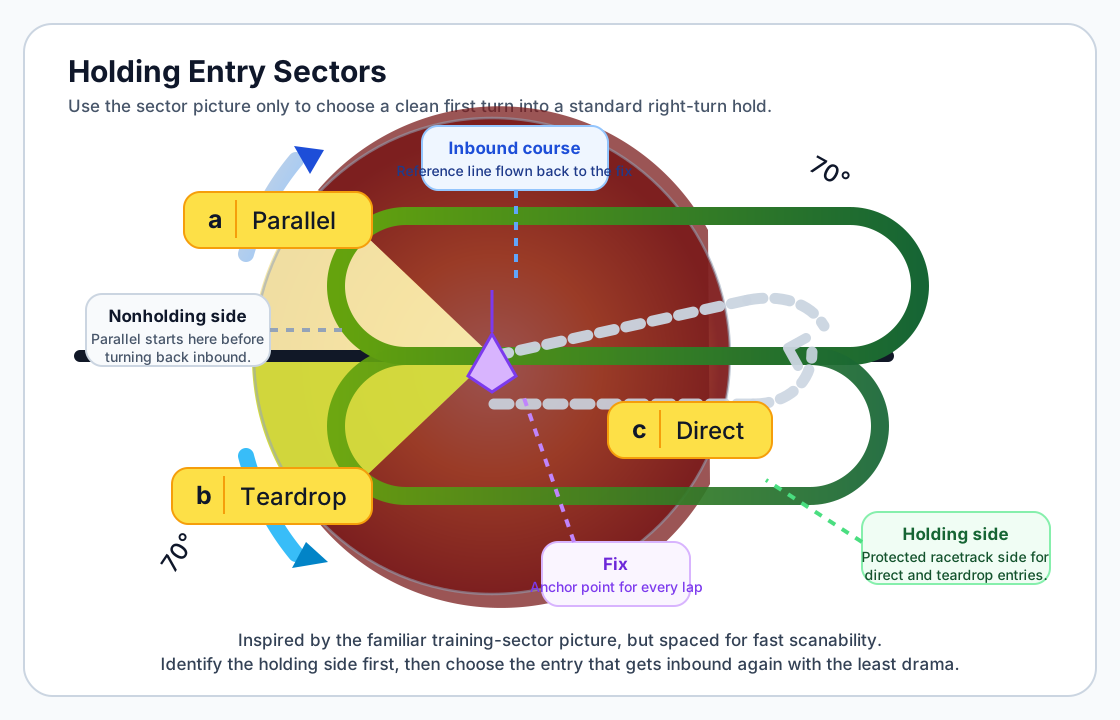
Direct Entry
Direct entry is the simplest case. The aircraft crosses the fix and turns directly into the normal racetrack on the holding side. It works when the arrival heading already favors joining the hold without first spending a leg on the nonholding side or flying an offset away from the fix.
The value of direct entry is not that it is easy to memorize. The value is that it keeps the airplane aligned with the protected side immediately. If the picture looks natural and the first turn takes the airplane into the published pattern without awkward crossing back through the fix, direct entry is usually the right answer.
Teardrop Entry
Teardrop entry begins by crossing the fix and then flying an outbound heading offset into the holding side before turning back to intercept the inbound course. Geometrically, it solves the problem of arriving from a heading that is close to the holding side but not lined up well enough for an immediate direct entry.
The teardrop works because it introduces the airplane to the protected side early and then lets the aircraft curve back toward the inbound course in a controlled way. It is not meant to be wide or decorative. It is meant to be compact enough that the first full holding circuit starts under control rather than with a rushed overshoot.
Parallel Entry
Parallel entry is the one most pilots dislike at first because it begins on the nonholding side. After crossing the fix, the aircraft flies outbound roughly parallel to the inbound course, then turns in the holding direction to reintercept inbound and join the normal racetrack.
What makes it manageable is remembering what the geometry is doing. The airplane is not being sent to the wrong side forever. It is using one structured leg to reverse the arrival picture and come back inbound in a way that avoids a large unplanned maneuver near the fix. If the pilot focuses on the next inbound intercept rather than on making the path look pretty, the entry becomes much easier to fly.
Nonstandard Holds
A nonstandard hold uses left turns, which means the protected side flips with it. That is why nonstandard holds create entry errors so easily: pilots often memorize the direct, teardrop, and parallel pattern for standard right turns and forget to rebuild the geometry when the turn direction changes.
The correct fix is not to memorize a second unrelated set of pictures. The correct fix is to rebuild the same four elements again: fix, inbound course, turn direction, holding side. Once that is clear, the entry choice follows from the geometry just as it does in a standard hold.
Practical Simplification
In real IMC, the best holding entry is often the one that preserves control and keeps the airplane on the protected side with the least confusion. That is why many experienced instrument pilots simplify the decision to two questions:
- Which side of the fix is protected?
- From my present heading, what entry gets me established there with the least drama?
If the exact sector line feels close or ambiguous, a conservative protected-side choice is usually better than a last-second argument with the diagram. The FAA is evaluating whether the hold is flown safely and predictably, not whether the pilot won a geometry contest by one degree.
For the execution side of holding, including timing, wind correction, and the triple-drift rule, see Holding Patterns. This page stays focused on the entry picture only.
Published Reversals and HILPT
Holding entry geometry matters on instrument approaches because holds are not always delays. A hold in lieu of procedure turn is a published course-reversal device. In that context, the entry is not just about staying organized in holding. It also determines how cleanly the airplane returns inbound to begin the approach segment.
That is why approach holding should always be briefed with the next segment in mind: what altitude applies in the hold, when the course reversal is complete, and what event transitions the airplane from holding logic to inbound approach logic. The navigation picture and the procedure picture must connect before the fix, not after it.
References
- FAA Instrument Flying Handbook: holding entry concepts, protected-side awareness, and cockpit technique.
- FAA Instrument Procedures Handbook: published holds, HILPT interpretation, and procedure-based holding geometry.
- FAA Aeronautical Information Manual (AIM): operational holding guidance and standard IFR expectations.
Go Deeper
- Holding Patterns: Entries — the execution side of the same direct, teardrop, and parallel choices.
- Holding Patterns: Published Holds and HILPT — where the geometry becomes a charted procedure segment.
- Approaches: Procedure Turns — the broader course-reversal context that builds on this entry picture.
- Missed Approaches: Transition to Hold or Next Clearance — what happens when the hold appears after the missed instead of before the approach.