IFR Risk Management and Personal Minimums
IFR-specific pilot, aircraft, weather, and pressure factors, with personal minimums templates and go / no-go tools tied directly to IFR planning and weather hazards.
Quick Reference
Key points
Short-answer refresher for returning pilots before diving into the full page.
Quick Reference
Key points
Short-answer refresher for returning pilots before diving into the full page.
- Personal minimums should reflect current margin, not best-day capability or bare legal currency.
- Several moderate hazards stacked together deserve the same respect as one obvious red flag, especially in single-pilot IFR.
- A useful alternate is legal, reachable, weather-resilient, and something you actually want after a miss, not just a box checked on paper.
Standards & References
FAA doctrinal and ACS cross-reference
Use this box to line the topic up with the FAA’s primary instrument handbooks, the most relevant ACS task areas, and the knowledge, skill, and risk elements that usually drive checkride evaluation.
- IFH Ch. 2, Human Factors: pilot readiness, fatigue, workload, automation traps, and decision-making errors that matter more in IMC.
- IFH Ch. 8, Flight Planning: personal minimums, alternate thinking, and route or aircraft suitability before launch.
- IFH Ch. 9, IFR Flight: single-pilot workload management, task saturation cues, and cockpit discipline as the flight gets busier.
- IPH Ch. 1, Departure Procedures: departure and initial-climb complexity as early no-go or delay triggers.
- IPH Ch. 2, En Route Operations: route changes, holding, and navigation-management demands that influence workload and alternate logic.
- IPH Ch. 3, Arrivals and Ch. 4, Approaches: alternate realism, arrival workload, and missed-approach complexity as practical risk drivers.
- I.C Cross-Country Flight Planning.
- I.F Weather Information.
- III.B Compliance with Departure, En Route, and Arrival Procedures and Clearances.
- VI.A through VI.C Instrument Approaches and Missed Approach.
Checkride Focus
How this topic is typically evaluated
Use this block as the ACS-ready summary: what task areas this page supports, what the applicant should know, what the applicant should be able to do, and what risks must be managed without prompting.
Checkride Summary
Risk management becomes checkride-ready when the applicant can defend a go or no-go decision with written margins, then reassess those margins as weather, equipment, or workload changes in flight.
Knowledge
- Know how personal minimums, alternate realism, forecast confidence, automation traps, and task saturation change IFR dispatch quality.
- Understand how PAVE and 3P apply specifically to instrument departures, arrivals, approaches, and missed approaches.
- Know the difference between legal minima and the pilot-aircraft-weather margin needed for a routine flight.
Skills
- Build written go or no-go criteria for pilot, aircraft, weather, alternate, and fuel decisions.
- Identify mitigations early, such as delay, reroute, simpler destination, more fuel, or lower complexity.
- Decide when to delay, divert, or go missed before the cockpit becomes rushed or option-limited.
Risk Management
- Confusing legal dispatch with safe dispatch, especially when the weather picture is thin or trending down.
- Using a paper alternate that is legal but not operationally attractive after one missed approach.
- Allowing external pressure, automation dependence, or task saturation to soften written standards in real time.
On This Page
Overview
IFR risk management is not just general ADM with lower ceilings. Instrument flying adds tighter tolerances, more procedural workload, less visual redundancy, more dependence on equipment, and a higher penalty for getting behind the airplane. That is why practical IFR planning needs written personal minimums instead of vague intentions to "be careful."
This page is the operational bridge between IFR Flight Planning, IFR Regulations and Legal Interpretation, Weather Icing, and Fog. Legal minima define the floor. Personal minimums define whether the specific pilot, airplane, and weather picture still leave real margin today.
RMH and ACS Coverage
This is the IFR-specific risk block that turns the FAA Risk Management Handbook into instrument-dispatch decisions and instrument-lesson decisions. It is meant for both instrument students building usable go / no-go standards and CFI-Is who need clear prompts for teaching, scenario design, and debriefing.
1
IFR personal minimums
Written pilot, aircraft, weather, approach, alternate, and fuel thresholds that go beyond legal minima.
2
PAVE / 3P applied to IFR
Pilot, aircraft, environment, and pressure factors narrowed into phase-gate decisions before launch, before descent, and before the final approach.
3
Weather risk matrices
Dispatch grading for ceilings, visibility, icing, winds, forecast confidence, and alternate quality rather than one simple METAR check.
4
Alternate planning logic
A practical check for whether the alternate is legal, usable, trend-resistant, reachable after a miss, and still low-workload when you actually need it.
5
Automation traps
Mode confusion, heads-down programming, stale setup, overtrust, and underuse during the busiest IFR phase changes.
6
Task saturation management
Recognition cues, stabilization moves, and explicit triggers for delaying, holding, diverting, or going missed before the cockpit gets rushed.
How to use this page
Instrument applicants can use it to build written dispatch standards and missed-approach decision triggers. CFI-Is can use the same sections to structure scenario briefings, evaluate risk management in debriefs, and force the student to explain why a plan is safe instead of merely legal.
Why IFR Risk Is Different
In VFR, the outside view often catches small deviations early. In IMC or at night on instruments, that backup is weak or absent. A small planning error in fuel, routing, alternate choice, automation setup, or weather interpretation can persist longer before it is recognized, and the correction usually arrives at a busier phase of flight.
IFR risk is also cumulative. A low ceiling alone may be manageable. The same ceiling paired with a non-FIKI airplane, freezing levels near the MEA, an unfamiliar airport, weak recent IMC experience, and a schedule-driven launch is a different decision entirely. The right question is not whether each item is legal in isolation. The right question is whether the total picture still leaves spare capacity.
PAVE and 3P in IFR
PAVE and 3P remain the best practical risk-management frameworks, but IFR makes each letter and each step much more specific. The framework only becomes useful when it points to concrete no-go lines, mitigation choices, and phase gates.
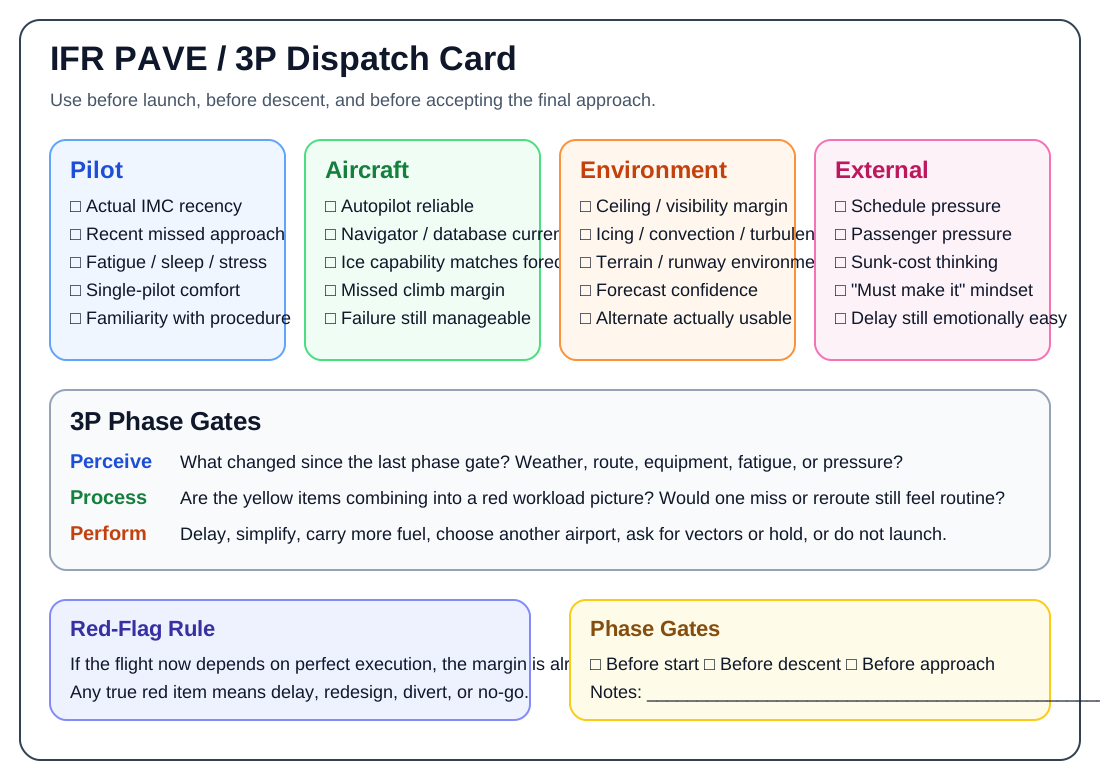
PAVE: Pilot
Actual IMC recency, missed-approach proficiency, fatigue, single-pilot readiness, and how fast the pilot can absorb reroutes or runway changes.
PAVE: Aircraft
Autopilot reliability, navigator capability, anti-ice equipment, climb margin, and how ugly the flight becomes after one equipment failure.
PAVE: Environment
Ceilings, visibility, freezing level, turbulence, terrain, runway environment, alternate quality, and forecast confidence rather than one METAR snapshot.
PAVE: External
Schedule pressure, passengers, sunk-cost thinking, and the subtle urge to keep accepting risk because the trip is already in motion.
- Perceive: identify the real hazards at each phase gate: before launch, before descent, and before accepting the final approach.
- Process: ask whether the hazards are independent or combining. Two yellow items in IFR often create a red workload picture later.
- Perform: change the plan early by delaying, choosing an easier destination, carrying more fuel, using a different alternate, reducing automation dependence, or not launching.
Pilot Factors
Pilot risk in IFR starts with a distinction many pilots blur: currency is not competence. Logging the legal approaches, holding, and intercepting tasks may satisfy 14 CFR § 61.57(c), but that does not guarantee smooth performance in actual low IMC, busy arrivals, or unexpected missed approaches.
- Recency: How much actual IMC, not just simulated IMC, has happened recently? Have holds, approaches, and missed approaches been flown in the last few weeks or only logged to stay current?
- Proficiency: Can the pilot fly raw data, brief quickly, copy amendments, and stay ahead of the airplane without obvious strain?
- Fatigue: Tired instrument flying usually shows up as slower scan, weaker radio work, and poorer judgment before it shows up as obvious control loss.
- Currency versus competence: A legal six-approach pilot may still be a poor candidate for low ceilings, strong winds, or night single-pilot IFR into unfamiliar airports.
A practical pilot-factor minimum sounds like: I will not launch single-pilot into night IMC below my training-weather comfort zone unless I have recent actual IMC, recent missed approaches, and enough rest that I can hand-fly and rebrief without rushing.
Aircraft and Automation
The aircraft side of IFR risk is not just "is it legal?" The real question is whether the airplane has margin for this route, weather, and workload. A technically IFR-capable airplane may still be a poor match for the day.
- Equipment status: autopilot, navigator, PFD, pitot heat, alternator redundancy, and approach-appropriate avionics all affect workload and dispatch quality.
- FIKI versus non-FIKI: a non-FIKI airplane should treat forecast icing as a much harder limit than a FIKI-equipped airplane, and even a FIKI airplane still needs an escape route, accumulation limit, and performance margin.
- Performance margins: climb capability, climb gradient, cruise altitude options, missed approach performance, and runway performance matter more in cold, high, heavy, or icing-prone IFR.
- Failure tolerance: if the autopilot drops offline or the primary navigator degrades in the terminal area, is the flight still inside the pilot-airplane envelope?
In practice, aircraft personal minimums often need separate lines for "all systems normal," "autopilot unavailable," and "known icing equipped but not comfortable staying in icing." That makes the limits honest instead of theoretical.
Automation traps deserve their own line in IFR planning because they often feel like workload reducers until they suddenly become workload multipliers. Common traps include:
- Mode confusion: assuming NAV, APR, or VNAV is doing one thing while the airplane is actually flying another.
- Heads-down programming: trying to repair the box during a climb, vector, intercept, or missed approach instead of stabilizing the airplane first.
- Overtrust: letting the autopilot or navigator hide the fact that the route, minima, or missed setup is still not mentally clear.
- Underuse: refusing useful automation and burning cognitive capacity that is needed for weather, phraseology, or contingency planning.
- Stale setup: carrying a prior runway, arrival, or missed expectation too far after ATC has already changed the plan.
A strong IFR minimum often includes a sentence like: If the autopilot is unavailable, all weather buffers go up and all procedure complexity goes down.
Task Saturation
Task saturation is the IFR failure mode that sits between simple mistakes and actual loss of control. It happens when the pilot is still doing tasks, but not in the right order anymore. The classic signs are delayed readbacks, unbriefed approaches, chasing the box, forgotten altitudes, and feeling "just a little behind" for too long.
- High-risk seams: departure amendment in the climb, late runway change on the arrival, automation failure near the FAF, and missed approach plus reroute.
- Early warning signs: two radio calls behind, unsure of the active mode, approach not fully briefed, or no longer certain what the missed starts with.
- Stabilization moves: ask for delay vectors, hold, or a slower pace; use the autopilot if it is trustworthy; simplify the clearance; or discontinue the approach before the cockpit becomes hurried.
The best IFR phrase in this section is: aviate, navigate, communicate, then reprogram. If the order flips, saturation is already starting.
Weather Risk Matrix
IFR weather minimums need to account for more than the destination METAR. They should connect directly to the larger planning flow on IFR Flight Planning and to the specific hazards explained on Weather Icing, Fog, and Advanced IFR Weather Interpretation.
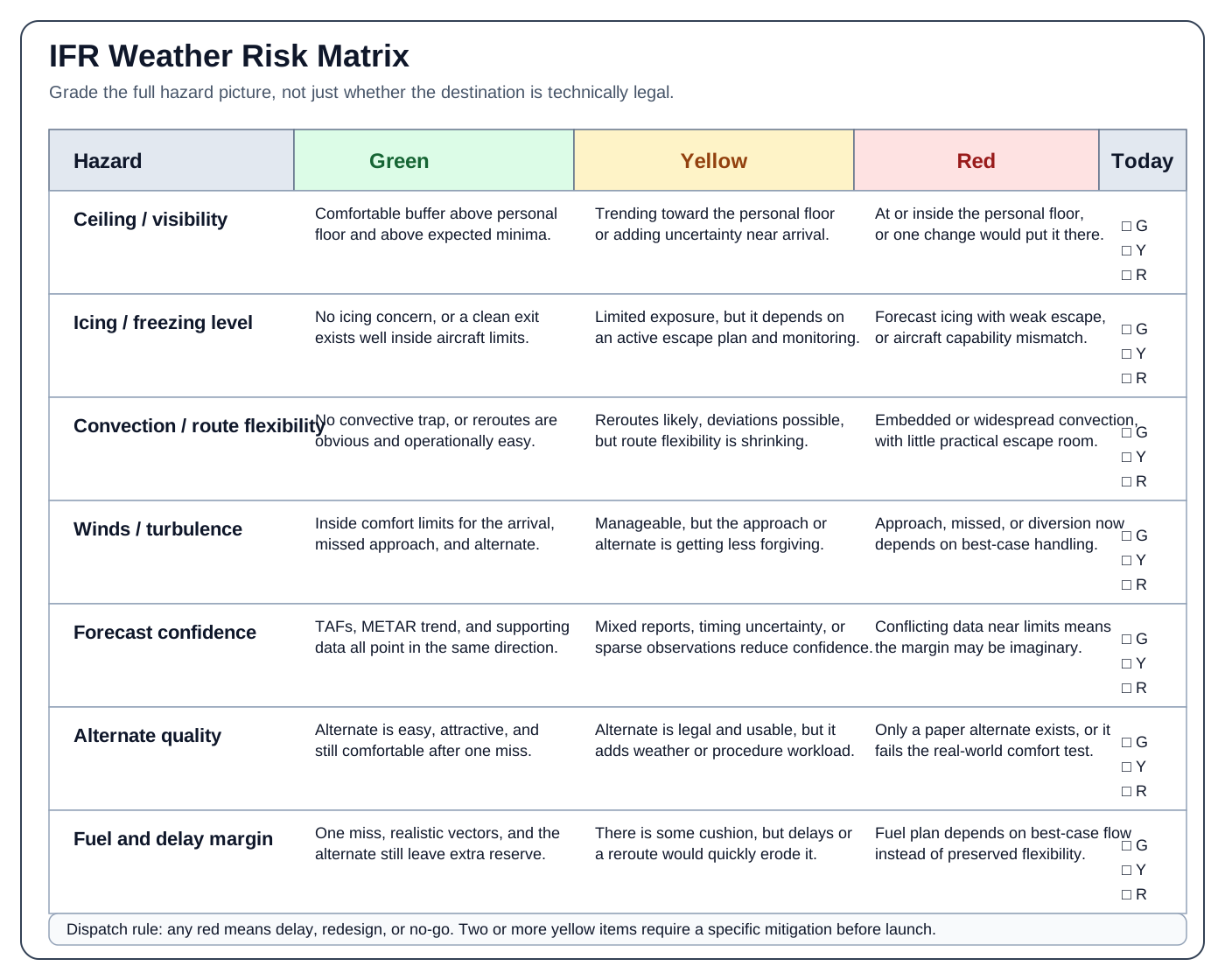
- Ceilings and visibility: use buffers above DA or MDA, not just published minima, especially at night or into unfamiliar airports.
- Icing: connect freezing level, cloud tops, precipitation type, PIREPs, and aircraft anti-ice capability into one dispatch decision. Non-FIKI plus forecast icing should often be a hard stop.
- Convective weather: embedded convection, broad lines, and weak reroute options can turn a nominal IFR cross-country into a system-management problem rather than a routine trip.
- Winds aloft and surface winds: headwinds affect fuel and alternate reach; crosswinds affect the arrival risk picture; strong winds aloft can erase planned buffers.
- Forecast confidence: TAF trends, recent METAR history, sparse reporting, and conflicting model guidance change how much margin the pilot should demand.
- Alternate quality: choose alternates that are actually usable, not just legal. Fog trends, icing layers, runway lighting, and approach type all matter.
Weather personal minimums should be written in operational language, such as "no forecast freezing rain," "no single-pilot launch when destination is forecast within 500 feet and 1 mile of LNAV-only minima," or "no morning radiation fog destination without a clearly better alternate and extra fuel for delay."
Alternate Risk Logic
Legal alternate filing is the starting point, not the real decision. An alternate is only useful if it remains operationally attractive after one missed approach, a small delay, or a worsening trend. In IFR risk management, the alternate is part of the primary plan, not a paperwork afterthought.
- Legal: does the airport meet the filing rule in § 91.169(b) and any nonstandard alternate minima required by § 91.169(c)?
- Usable: does it have an approach type, runway environment, and lighting system that fit today's pilot and aircraft?
- Trend-resistant: is it improving, stable, or likely to degrade for the same reason the destination is degrading?
- Compatible: can the airplane reach it with one missed approach, realistic vectors, and personal fuel reserve still intact?
- Workload-safe: if the destination fails, does the alternate still feel routine, or does it create a second high-workload approach when the pilot is already stressed?
A paper alternate is one that is legal but unattractive for actual use. IFR personal minimums should explicitly reject paper alternates.
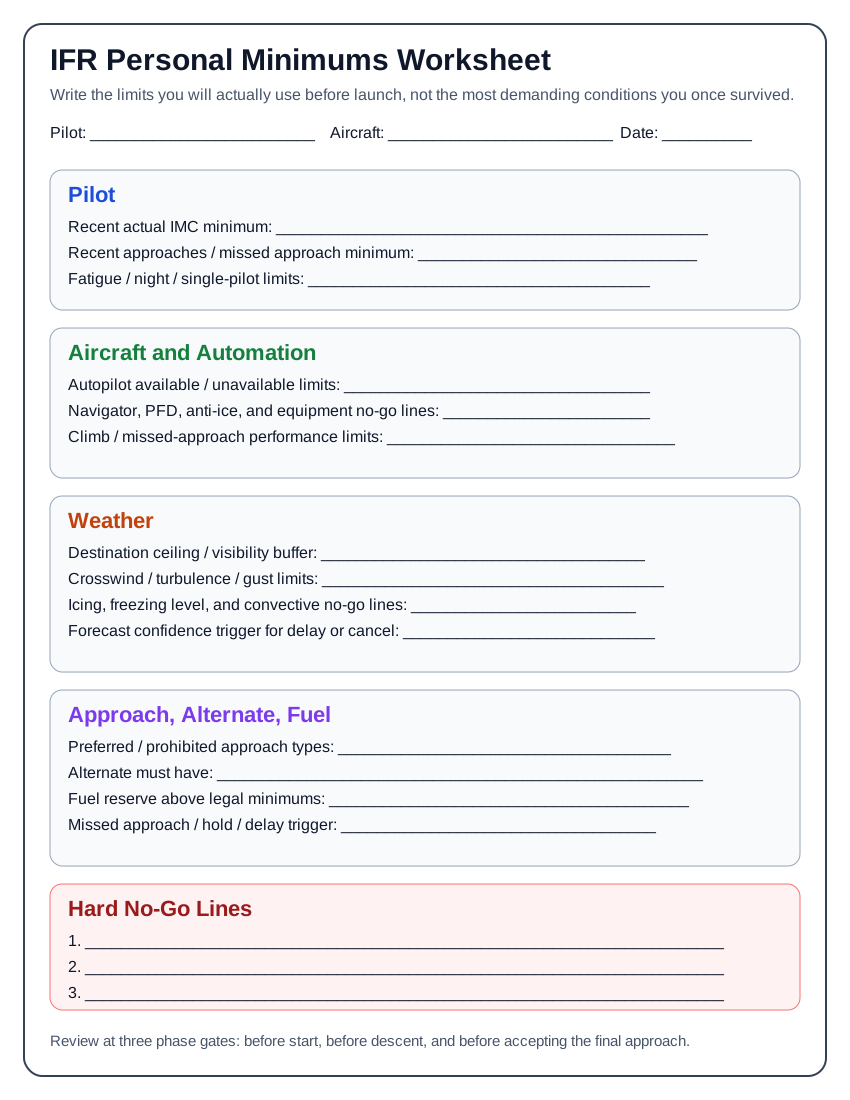
Personal Minimums Template
Use this as a starting template for single-pilot piston IFR. The values below are examples only, not universal targets. The point is to write measurable thresholds that fit the pilot, the airplane, and the operation. The printable blank worksheet is linked in the next section.
| Item | Sample Written Minimum | Why It Exists |
|---|---|---|
| Recent actual IMC | No launch below 1,000 foot ceilings and 3 miles unless I have logged actual IMC and at least one missed approach in the last 45 days. | Protects against leaning on legal currency when the flight demands recent sharpness. |
| Fatigue | No single-pilot night IFR after a short-sleep night or when cumulative fatigue is obvious. | Fatigue usually degrades scan, radio work, and approach stability before it feels dramatic. |
| Approach minima buffer | Destination weather must be at least 500 feet and 1 mile above planned approach minima for routine single-pilot IFR, more at night or when unfamiliar. | Creates room for runway changes, downgraded guidance, or a missed approach without immediately using the full margin. |
| Approach type | No circling at night, no LNAV-only in marginal weather, and no unfamiliar high-workload procedure without a larger weather buffer. | Approach complexity is often the real workload driver once weather becomes marginal. |
| Autopilot unavailable | Raise destination weather and lower procedure complexity if the autopilot is inoperative or unreliable. | Changes the workload envelope even if the airplane remains fully legal. |
| Icing | No launch in forecast icing if non-FIKI. If FIKI-equipped, require a defined escape altitude, exit route, and light-icing-only comfort limit. | Separates weather legality from airframe capability and exit strategy. |
| Alternates and fuel | Carry enough fuel for one missed approach, realistic vectors or delay, the alternate, and a personal reserve above legal minimums. | Fuel margin is what keeps one weather or routing change from becoming an emergency. |
| Task saturation triggers | If I am unsure of the active mode, missed approach, or next clearance, I will ask for delaying vectors, hold, or discontinue the approach before pressing into a rushed setup. | This converts vague discomfort into a specific workload mitigation rule. |
| Alternate quality | No dispatch with an alternate that is legal but would still require an approach type, runway, or weather margin I do not actually want after one miss. | Prevents the common mistake of treating a paper alternate as real margin. |
Used properly, this template becomes a preflight dispatch standard and an en route reassessment tool. The point is to make the flight easier than your maximum capability, not merely possible.
Printable Templates
These local templates are meant to be opened in the browser and printed as working sheets, not just read once. They are intentionally blank enough to become the pilot's own standard instead of locking in one canned set of numbers.
Printable 1
IFR Personal Minimums Worksheet
Blank lines for pilot, aircraft, weather, approach, alternate, and fuel limits that can be reviewed before launch.
Printable 2
IFR Weather Risk Matrix
Hazard-by-hazard worksheet for ceilings, icing, winds, forecast confidence, route flexibility, and alternate quality.
Printable 3
PAVE / 3P Dispatch Card
Compact briefing card for pilot, aircraft, environment, pressure, and the perceive-process-perform loop at each phase gate.
Print note
Each button opens the printable in a new tab. Use the browser print command there for the cleanest result. The personal minimums worksheet prints best in portrait; the weather matrix and PAVE / 3P card print best in landscape.
Go / No-Go Red Flags
A simple matrix keeps the decision from turning into an argument with yourself. One useful format is green, yellow, and red by category, with a clear dispatch rule.
| Category | Green | Yellow | Red |
|---|---|---|---|
| Pilot | Recent actual IMC, rested, recent approaches and missed approaches, confident with the procedure. | Legal and basically sharp, but little recent actual IMC or higher fatigue than preferred. | Barely current, fatigued, rusty, or uncomfortable with the exact procedure and workload. |
| Aircraft | All key systems normal, good performance margin, no capability mismatch. | Autopilot unavailable or one nuisance item, but the route and weather remain comfortably inside the envelope. | Capability shortfall, weak climb or ice margin, or a failure that turns the flight into a workload trap. |
| Weather | Comfortable ceiling and visibility buffer, no icing or convective trap, solid alternate. | Moderate weather margin, but one factor is tightening: lowering ceilings, stronger winds, or forecast uncertainty. | Forecast icing in a non-FIKI airplane, embedded convection, fog-driven thin alternate picture, or destination near hard limits. |
| Pressure | Easy to delay, divert, or cancel with no emotional pushback. | Some schedule or passenger pressure is present, but openly acknowledged and manageable. | The trip feels like it must happen, and that pressure is affecting the weather or capability judgment. |
Use the matrix with explicit red flags. Common IFR red flags include:
- Pilot: legal but rusty, poor sleep, no recent actual IMC, or no recent missed approach in a flight that may need one.
- Automation: unreliable autopilot, unfamiliar navigator behavior, or a route that requires heads-down programming during busy phases.
- Weather: destination or alternate forecast sitting close to the personal floor, icing without a clean escape, or low forecast confidence.
- Alternate logic: only one attractive alternate, or an alternate that is legal but not a place you actually want to go after one missed approach.
- Pressure: the trip feels like it must happen, and that story is already starting to soften the pilot's own written standards.
A practical dispatch rule is:
- Any red: no-go, delay, or redesign the plan.
- Two or more yellow: add a mitigation before launch, such as a higher weather floor, easier destination, more fuel, or a delay.
- All green: go, but still re-check the matrix before descent and before the final approach.
The point of the matrix is not scoring for its own sake. It is to make the final judgment traceable and repeatable instead of emotional.
Delay, Divert, or Go Missed
Good IFR ADM requires predetermined triggers for saying no. Without them, pilots tend to keep renegotiating with worsening conditions. The safest time to choose a delay, diversion, or missed approach is usually before the situation becomes urgent.
Useful IFR decision triggers include:
- The departure, arrival, or approach no longer fits the written pilot-factor minimums for recency or fatigue.
- Weather has degraded below written personal minimums even if still above legal minima.
- The airplane is now depending on a failure-free outcome to make the approach, miss, or alternate routine.
- An alternate still exists on paper but no longer feels operationally attractive because of fog, icing, winds, or fuel margin.
- The missed approach, hold, or diversion now feels rushed instead of routine.
If the flight now depends on everything going right, the margin is already gone. IFR decision-making is strongest when the pilot acts while options are still wide, not after they have narrowed to one hurried choice.
Worked IFR Risk Scenarios
Risk tools become useful when they are applied to a specific dispatch decision. These examples tie pilot, aircraft, weather, and pressure factors together instead of treating them as separate checkboxes.
Scenario 1: Icing Layer En Route, Fog at the Alternate
A non-FIKI single-pilot aircraft is planning an IFR cross-country with a freezing level near the MEA, light icing PIREPs along the route, and morning fog that may persist at the most convenient alternate. The destination is still legal and the route is still fileable.
The right decision sequence is:
- Pilot: ask whether recent actual IMC and recent ice-escape decisions are genuinely current, not just legally logged.
- Aircraft: a non-FIKI airplane means forecast icing is not just a caution item, it is close to a hard no-go line.
- Weather: if the alternate is also vulnerable to fog timing, the dispatch margin is shrinking on both the route and the backup.
- Perform: delay, reroute to stay out of the icing band, pick a clearly better alternate, or do not launch.
This is where tying the decision to icing planning, fog trends, and alternate planning matters. Legal dispatch is not the same thing as resilient dispatch.
Scenario 2: Automation Loss Near Minimums with a Distant Alternate
A pilot launches in benign weather for a destination forecast to stay comfortably above minima. En route, the weather trends down, the planned runway changes twice, and the autopilot begins dropping offline intermittently. The alternate is legal but requires a circling maneuver at night in gusty winds.
The right decision sequence is:
- Aircraft: treat intermittent automation as a real dispatch change, not as a nuisance item, because terminal workload is now rising while redundancy is dropping.
- Weather: shrinking destination margin means the approach is more likely to go missed, which makes the alternate plan more important.
- Alternate: if the alternate is only legal on paper and still looks ugly after one miss, it is not preserving real margin.
- Perform: divert early to a simpler airport, better weather, or a runway or approach that remains comfortable without automation.
This is the classic single-pilot IFR trap: nothing is catastrophic by itself, but the combined effect creates a red task-saturation picture before the pilot admits it.
Scenario 3: Legal But Not Proficient, With Schedule Pressure
A pilot is instrument current but has little recent actual IMC, no recent holds or missed approaches, and is trying to make an important family event. The route is into a familiar airport, but the weather is forecast near minimums with gusty winds and an LNAV-only backup if the preferred approach is unavailable.
The correct response is not to focus on the familiar airport or the legal currency box. The better sequence is:
- Pilot: admit that legal currency does not equal low-weather competence today.
- Weather: the forecast is already near the personal-minimums edge, and the backup approach type is less forgiving.
- Pressure: the family schedule is now biasing the interpretation of both the weather and the pilot readiness.
- Perform: delay, bring another pilot or instructor, choose a simpler destination, or cancel.
This is exactly why personal minimums need to be written before the trip matters emotionally. Once the pressure is active, the safer option becomes harder to see clearly.
References
- FAA Instrument Flying Handbook: instrument proficiency, human factors, automation management, and single-pilot workload control.
- FAA Risk Management Handbook: personal minimums, hazard recognition, and mitigation methods.
- FAA Instrument Procedures Handbook: approach, alternate, missed-approach, and procedure-selection context.
- IFR Flight Planning: route, alternate, fuel, and capability decisions that this page turns into personal minimums.
- IFR Regulations and Legal Interpretation: legal floor versus operational judgment.
- Weather Icing, Fog, and Aerodynamics: Icing Effects: weather hazard recognition plus aircraft-performance consequences.
- Pilot Proficiency, Aeronautical Decision-Making, and Operational Risk Management: the broader framework and methods that this page narrows into IFR-specific use.