Atmospheric Structure
How the atmosphere is layered, why pressure and temperature change with altitude, and how those changes drive performance and weather.
Quick Reference
Key points
Short-answer refresher for returning pilots before diving into the full page.
Quick Reference
Key points
Short-answer refresher for returning pilots before diving into the full page.
- Most day-to-day aviation weather lives in the troposphere, while the tropopause marks a major stability and turbulence transition above it.
- Pressure and temperature change with altitude in predictable patterns, but local departures from standard atmosphere are what create operational weather.
- Think vertically, because cloud layers, freezing levels, turbulence, and winds all depend on how the atmosphere is stacked above you.
Standards & References
FAA doctrinal and ACS cross-reference
Use this box to line the topic up with the FAA’s primary instrument handbooks, the most relevant ACS task areas, and the knowledge, skill, and risk elements that usually drive checkride evaluation.
- IFH Ch. 8, Flight Planning: weather interpretation, forecast use, and atmospheric conditions that shape route and alternate choices.
- IFH Ch. 9, IFR Flight: adapting the plan when actual atmospheric conditions change workload, icing exposure, or approach feasibility.
- Supporting only: atmospheric structure drives the practical use of the procedures in IPH Ch. 1 through Ch. 4 but is not taught in a dedicated IPH chapter.
- I.F Weather Information.
On This Page
Overview
The atmosphere is not just background scenery around the airplane. It is the medium that produces lift, carries weather, determines engine and propeller performance, and sets the vertical structure that makes ceilings, freezing levels, turbulence, and winds meaningful. Pilots who understand the atmosphere as a layered system make better decisions about climb performance, cruise altitude, icing exposure, and approach feasibility.
Most practical flying uses a simple working model: pressure drops with altitude, temperature usually drops with altitude in the lower atmosphere, moisture changes how clouds and precipitation form, and stability determines whether air tends to rise, sink, or stay layered. Those four ideas explain a large share of what pilots encounter in day-to-day weather and performance planning.
Composition and Standard Atmosphere
Dry air is mostly nitrogen and oxygen, with smaller amounts of argon, carbon dioxide, and trace gases. Water vapor is variable, and that variability matters operationally because it changes density, cloud formation, visibility, and icing risk. For aeronautical calculations, pilots use the International Standard Atmosphere (ISA) as the baseline reference.
- Sea-level pressure: 29.92 in. Hg or 1013.25 hPa.
- Sea-level temperature: 15 C.
- Standard lapse rate in the troposphere: about 2 C per 1,000 feet.
ISA is not a forecast. It is a common baseline that lets altimeters, performance charts, and flight planning data speak the same language. The practical question is always how far actual conditions are from standard, because that gap is where density altitude, altimeter error, and weather hazards begin.
Atmospheric Layers
The atmosphere is divided into layers by how temperature changes with altitude. For pilots, the most important layer by far is the troposphere, because that is where almost all day-to-day weather and almost all general aviation flying occur.
The troposphere
- Extends from the surface to roughly 20,000 feet near the poles and up to around 60,000 feet near the equator.
- Contains most atmospheric moisture, clouds, precipitation, and convective activity.
- Temperature generally decreases with altitude, which supports mixing and weather development.
The tropopause
The tropopause is the transition zone between the troposphere and stratosphere. It matters because it often acts like a lid on vertical motion. Thunderstorm tops may flatten near it, and strong winds near the tropopause help form the jet stream. Clear-air turbulence is also commonly associated with this boundary.
The stratosphere
Above the tropopause, temperature stops decreasing and may even increase with altitude because of ozone absorption of solar radiation. The stratosphere is generally much drier and more stable than the troposphere, which is why large-scale layered weather usually lives below it.
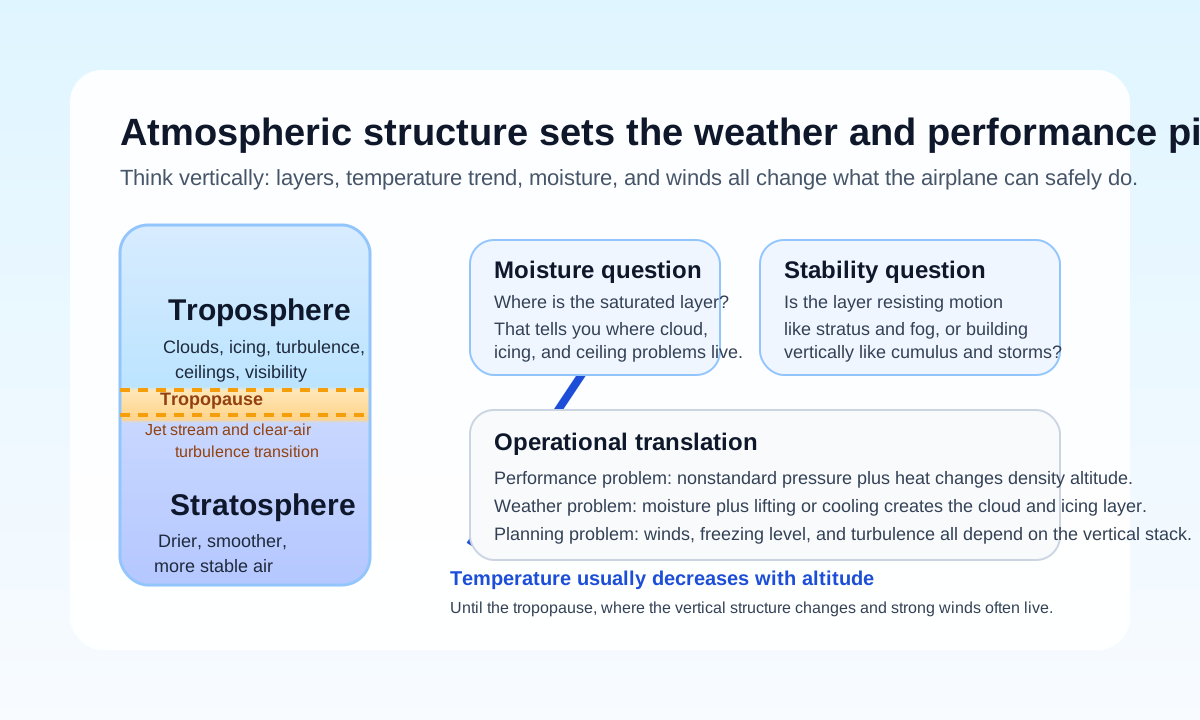
Pilot shortcut
If the question is about clouds, icing, turbulence, ceilings, or visibility, the answer is usually in the troposphere first and only rarely in the upper layers.
Pressure and Temperature with Altitude
Atmospheric pressure decreases with altitude because there is less air above the measurement point. The decrease is not perfectly linear, but for most operating discussions the important fact is simple: higher altitude means lower pressure, and lower pressure means lower air density unless temperature changes offset it.
Temperature usually decreases with altitude in the troposphere. That downward temperature trend supports vertical motion and explains why colder air aloft can create instability when the surface is warm. When the atmosphere departs from that normal pattern, such as in an inversion, the flying implications change quickly.
Why pilots care
- Altimetry: Altimeters convert pressure into indicated altitude using the standard atmosphere model. When pressure or temperature differ from standard, the altimeter is only an approximation of true altitude.
- Performance: Lower pressure and higher temperature both reduce air density, which increases density altitude and degrades takeoff, climb, and cruise performance.
- Weather: Temperature structure controls freezing level, cloud layering, and whether precipitation arrives as rain, freezing rain, sleet, or snow.
This is the direct handoff to Types of Altitude: pressure altitude and density altitude are not abstract terms, they are the operational translation of how the atmosphere departs from standard.
Moisture, Dew Point, and Saturation
Water vapor is the atmosphere's weather fuel. Warm air can hold more moisture than cold air, so cooling an air mass without removing moisture drives the relative humidity upward. When the air reaches saturation, condensation begins and clouds, fog, or precipitation can develop if condensation nuclei are present.
Key terms
- Dew point: the temperature to which air must be cooled to become saturated.
- Relative humidity: how close the air is to saturation, expressed as a percentage.
- Temperature-dew point spread: a quick operational clue for fog, stratus, and low-ceiling risk.
A shrinking spread means the atmosphere is approaching saturation. That does not guarantee fog or cloud, but it should push the pilot to ask what mechanism might provide the last bit of cooling or lifting: radiation overnight, upslope flow, frontal lifting, or an inversion trapping moisture near the surface.
This is why moisture is a vertical problem, not just a surface observation. An airport can report good visibility while a saturated layer sits just above pattern altitude, or a dry surface report can hide a cloud layer and icing band a few thousand feet above. That bigger picture is where Vertical Structure becomes operationally valuable.
Stability and Vertical Motion
Atmospheric stability describes whether displaced air tends to keep moving or return toward its original level. Stable air resists vertical motion and favors layered clouds, smooth air, and trapped moisture. Unstable air supports rising currents, turbulence, and convective cloud growth.
Stable air tends to produce
- stratus-type clouds,
- smooth air away from terrain and mechanical mixing,
- poor visibility in haze or mist, and
- persistent low ceilings or fog when moisture is trapped.
Unstable air tends to produce
- cumuliform clouds,
- showers and thunderstorms,
- gusty surface winds and turbulence, and
- better visibility between cloud buildups because vertical mixing is stronger.
An inversion is one of the clearest signs of stability. In an inversion, temperature increases with altitude instead of decreasing. That stable layer can trap smoke, moisture, and pollutants near the surface, support fog and stratus, and create wind shear where stronger winds exist above the inversion. The operational link is strong enough that pilots should read Stability and this page together.
Circulation, Winds, and the Jet Stream
Atmospheric circulation is driven by uneven heating of the earth's surface. Warm equatorial air rises, colder polar air sinks, and the pressure differences between those regions create large-scale wind systems. The rotation of the earth bends those flows through the Coriolis effect, which is why large-scale winds rarely move in a straight line from high pressure to low pressure.
For pilots, the practical outputs are surface wind patterns, frontal systems, winds aloft, and the jet stream. The jet stream is a narrow band of strong winds near the tropopause, usually stronger in winter when horizontal temperature gradients are greater. It matters for flight planning because it changes groundspeed, fuel burn, turbulence risk, and the location of frontal activity.
- Near strong temperature contrasts: expect stronger upper-level winds and more organized weather systems.
- Near terrain: the large-scale flow may create mountain waves, rotor turbulence, or abrupt local wind shifts.
- Near fronts: expect vertical motion, cloud layering, precipitation, and wind shifts tied to the boundary, not just the local airport report.
Operational Takeaways
Atmospheric structure matters because it turns weather interpretation from a surface-only habit into a three-dimensional picture. A few practical questions make the page operational:
- Performance: How far from ISA are temperature and pressure, and what does that do to density altitude?
- Icing: Where is the freezing level, and how deep is the visible-moisture layer above and below it?
- Ceilings and visibility: Is the atmosphere layered and stable, or mixed and convective?
- Turbulence: Is vertical motion driven by instability, terrain, inversion shear, or tropopause winds?
A pilot who thinks vertically sees more than just today's METAR. That pilot sees where the hazards live in the layer stack, and that is usually the difference between merely accepting weather and actually managing it.
References
- FAA Aviation Weather Handbook — the FAA's primary source for atmospheric structure, stability, moisture, and operational weather interpretation.
- Pilot's Handbook of Aeronautical Knowledge — foundational discussion of the standard atmosphere, atmospheric layers, and moisture concepts.
- FAA Instrument Flying Handbook — operational use of atmospheric information in IFR flight planning and decision-making.
- Advanced IFR Weather Interpretation — the applied weather-planning continuation of this foundational page.
- Vertical Structure — the vertical weather picture for freezing levels, winds, cloud layers, and turbulence.