Missed Approaches
Immediate missed-approach actions, hold transitions, phraseology, and common trap management after DA or MAP.
Quick Reference
Key points
Short-answer refresher for returning pilots before diving into the full page.
Quick Reference
Key points
Short-answer refresher for returning pilots before diving into the full page.
- The first missed-approach segment matters more than the hold; power, pitch, climb, and the first lateral action come first.
- Brief the miss before the FAF with four anchors: first climb instruction, first lateral instruction, missed-approach fix, and what comes after it.
- Do not reprogram or sort the hold until the airplane is clean, climbing, and tracking the initial missed segment correctly.
Standards & References
FAA doctrinal and ACS cross-reference
Use this box to line the topic up with the FAA’s primary instrument handbooks, the most relevant ACS task areas, and the knowledge, skill, and risk elements that usually drive checkride evaluation.
- IFH Ch. 9, IFR Flight: decision-making at DA or MAP and the immediate transition from approach to climb or diversion logic.
- IFH Ch. 10, Emergency Operations: unstable-approach or degraded-guidance situations where the missed becomes the safer or required maneuver.
- IPH Ch. 4, Approaches: missed-approach instructions, navigation-source transitions, hold expectations, and published next-step logic after the runway is not acquired.
- IPH Appendix A, Emergency Procedures: continuity when the missed is complicated by communications or equipment problems.
- VI.A through VI.C Instrument Approaches and Missed Approach.
- VII.A Emergency Operations.
Checkride Focus
How this topic is typically evaluated
Use this block as the ACS-ready summary: what task areas this page supports, what the applicant should know, what the applicant should be able to do, and what risks must be managed without prompting.
Checkride Summary
A missed approach is judged first on immediate control and correct first-segment execution. The examiner is not looking for fancy programming; the examiner is looking for climb, source, route, and order of operations.
Knowledge
- Know the DA or MAP trigger, the first climb requirement, the first route or fix, and whether the missed is published or amended.
- Understand hold expectations, source transitions, and what the autopilot or navigator may do during go-around logic.
- Know how the missed connects to alternate, diversion, or further-clearance planning.
Skills
- Apply power, pitch, and configuration changes immediately at the missed-approach decision point.
- Follow the correct source and first published or assigned routing before doing secondary tasks.
- Communicate with ATC after the airplane is stabilized on the missed climb and route.
Risk Management
- Hesitating at DA or MAP while trying to salvage the landing.
- Programming or briefing the hold before the airplane is safely climbing on the correct first segment.
- Using the wrong source or wrong missed routing after a go-around or guidance change.
On This Page
Overview
A missed approach is not an improvised escape. It is a published IFR segment with its own climb, course, fix, and often a hold or further clearance expectation. The procedure starts the moment landing is no longer an option, whether because the runway environment is not in sight, the approach is unstable, or the guidance has degraded beyond what was briefed.
Immediate Actions
- Power: apply missed-approach power.
- Pitch: establish the climb attitude that protects obstacle clearance.
- Configure: clean up on schedule without skipping the aircraft-specific sequence.
- Navigate: confirm the correct source, mode, and initial published routing.
- Communicate: tell ATC once the airplane is climbing on the right path.
The order matters. The hold or next approach is not the first task. The initial missed segment is.
Missed Approach Callouts
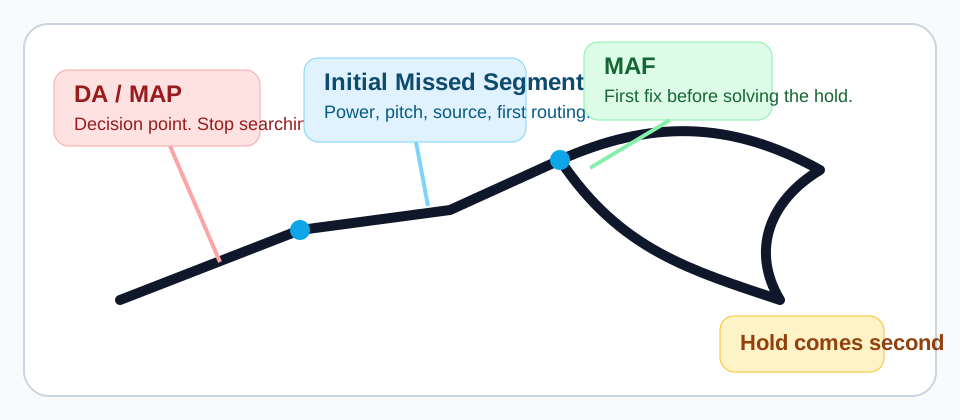
A good missed-approach brief identifies four things before the final segment starts: the first climb instruction, the first lateral instruction, the missed approach fix, and what comes after reaching that fix. If any of those are fuzzy, the approach is not briefed deeply enough yet.
Real-Chart Example
Missed approaches are easiest to understand when compared across different real plates. Use the current FAA charts for KOSH ILS OR LOC RWY 36, KAPA RNAV (GPS) RWY 35R, and KASE LOC/DME-E to compare three different missed-approach workloads: a classic ILS miss from DA, an RNAV miss that may change with the active minima line, and a circling or terrain-sensitive miss where the first escape action has to be loaded before the visual maneuver starts.
What to compare across the actual charts
- Decision trigger: identify whether the miss starts at DA on a vertical path or at the MAP after an MDA segment.
- First climb and first turn: isolate the first two actions before reading the rest of the published text.
- Navigation source trap: note what source or mode needs to be alive for the published miss to work immediately.
- What comes after the fix: determine whether the chart is sending you to a hold, to vectors, or to a terrain-sensitive escape path that cannot be improvised late.
This is why the missed approach belongs in the briefing before the FAF. The plate already tells you what will happen if the runway never appears; the job is to convert that published text into a first-five-seconds cockpit script.
Transition to Hold or Next Clearance
Many misses terminate in a hold, but the hold is a later task. Fly the first climb and routing segment first, stabilize the airplane, then identify the hold entry, EFC, or amended clearance. A surprising number of missed-approach errors happen because the pilot starts solving the hold before the airplane is truly climbing on the correct path.
Scenario Walkthroughs
Scenario 1
DA reached, runway not acquired
On an LPV approach the visual references never appear, so the miss begins exactly at DA.
- Power up and pitch to the missed-approach climb picture without delaying to keep searching outside.
- Verify the navigation source and the first published missed segment.
- Clean up on schedule while holding the climb stable.
- Once the airplane is climbing and tracking correctly, make the call: "Tower, Three Four X-ray missed approach, published."
Scenario 2
Missed to published hold with a late reroute
Approach control issues a new clearance while you are still in the first missed segment and the published miss terminates in a hold.
- Continue flying the first missed segment unless ATC gives a clear, workable amended instruction you can accept safely.
- Do not reprogram or brief the hold while the airplane is still unstable in the climb.
- Once established, identify the hold side, expected entry, and what the amended clearance changed.
- Say: "Missed first, reroute second."
ATC Phraseology
Audio-style missed examples
Pilot: “Tower, Skylane Three Four X-ray missed approach, published.”
Approach: “Three Four X-ray, fly published missed, maintain three thousand, contact departure.”
Pilot: “Published missed, maintain three thousand, over to departure, Three Four X-ray.”
Departure: “Three Four X-ray, after the hold, expect vectors for another approach.”
Common Traps
- Searching too long: delaying the miss below DA or beyond the MAP while hoping the runway appears.
- Briefing the hold too early: skipping the first climb and source-confirmation steps.
- Mode confusion: assuming the box captured the published miss when the source or leg is wrong.
- Talking before flying: making a long radio call before the airplane is climbing on the correct path.
References
- FAA Instrument Procedures Handbook: missed-approach design, hold transitions, and approach-segment logic.
- FAA Instrument Flying Handbook: practical cockpit technique for missed-approach execution and transition management.
- Holding Patterns
- Integrated IFR Procedures
Go Deeper
- Approaches: Missed Approach — the approach-brief side of deciding exactly when the miss begins.
- Automation and Avionics Management: Missed Approach Example — FMA and source management after TOGA or a go-around trigger.
- Holding Entry Geometry — how to think about the hold that often comes after the first missed segment is stabilized.
- Holding Patterns: Entries — execution details once the missed actually terminates in a hold.