Principles of Flight
The aerodynamic ideas that explain why the airplane behaves the way it does in climbs, descents, turns, stalls, and stable instrument flight.
Quick Reference
Key points
Short-answer refresher for returning pilots before diving into the full page.
Quick Reference
Key points
Short-answer refresher for returning pilots before diving into the full page.
- Lift depends on angle of attack, airflow, density, and wing shape, so the airplane’s margin changes with configuration and environment.
- Stalls are angle-of-attack events, not simple airspeed numbers, which is why weight, bank, and loading all change the picture.
- Use the basic principles to explain the maneuver, because climbs, descents, turns, and stalls are the same aerodynamics in different combinations.
Standards & References
FAA doctrinal and ACS cross-reference
Use this box to line the topic up with the FAA’s primary instrument handbooks, the most relevant ACS task areas, and the knowledge, skill, and risk elements that usually drive checkride evaluation.
- IFH Ch. 5, Attitude Instrument Flying: control/performance flying relies on the aircraft-behavior principles summarized here.
- IFH Ch. 6, Basic Flight Maneuvers: stable climbs, descents, and turns by reference to instruments depend on these aerodynamic principles.
- Supporting only: these principles support the stabilized aircraft control assumed throughout IPH Ch. 1 through Ch. 4.
- IV.B Basic Instrument Maneuvers.
On This Page
Overview
The principles of flight are broader than the four-force list alone. They describe the relationships that make aircraft behavior predictable: angle of attack, lift, drag, airspeed, load factor, stability, and configuration effects. Once those relationships are understood, many separate flying rules stop feeling separate.
This is why good aerodynamics study pays off in practical flying. A climb is not a special event. It is the force and energy picture changing. A stall is not just a speed number. It is an angle-of-attack limit. A steep turn is not just more bank. It is a new load-factor problem. The principles tie those events together.
Angle of Attack as the Core Variable
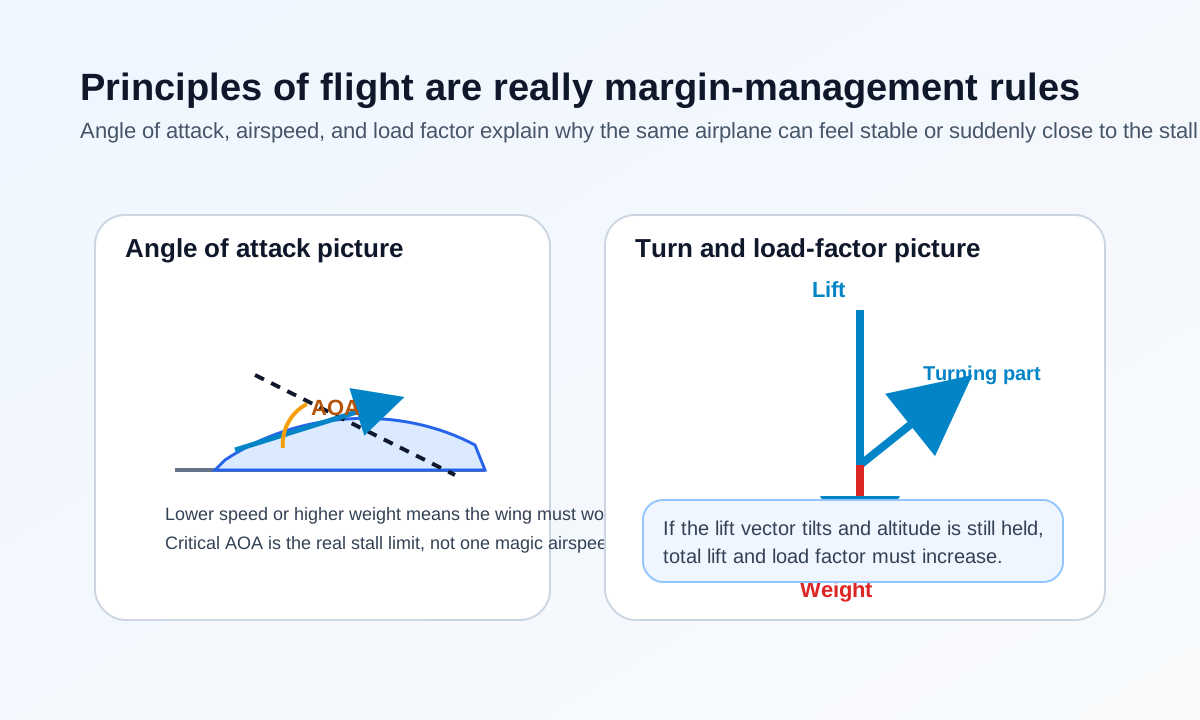
Angle of attack (AOA) is the angle between the wing's chord line and the relative wind. It is one of the most important aerodynamic variables because it determines how much lift the wing produces and how close it is to the stall. In practical terms, AOA tells the pilot how hard the wing is working.
Lift generally increases as AOA increases, but only up to a point. As the wing approaches the critical angle of attack, the airflow begins to separate more aggressively, drag rises sharply, and the lift increase slows or reverses. Beyond that point, the wing stalls.
This is why pilots should think in AOA logic even when the airplane has no AOA indicator. Pitch attitude, weight, bank, configuration, and gusts all influence the AOA the wing must carry. Airspeed is only one clue to that margin, not the whole story.
Airspeed, Energy, and Margin
Airspeed matters because it changes the lift available for a given angle of attack. More airspeed means the wing can produce the required lift at a lower AOA. Less airspeed means the wing must operate at a higher AOA to support the same weight. That is why slowing down always means moving closer to the stall unless other variables also change.
Energy management is the broader picture behind this. An airplane trades energy between airspeed, altitude, and power. If the pilot pulls back to climb without enough excess power, airspeed decays. If the pilot banks steeply without enough lift increase, altitude decays. If drag rises because of configuration or icing, more power or a new flight path is needed to maintain the same performance.
Useful mental model
The airplane is always spending a limited performance budget. If it uses more of that budget for climb, bank, drag, or weight, there is less left for stall margin and acceleration.
Stalls and Critical Angle of Attack
A stall happens when the wing exceeds its critical angle of attack, not when the airplane reaches one universal airspeed. Stall speed changes because the AOA required for a given task changes. More weight, more load factor, contamination, and turbulence all change how close the wing is operating to that critical limit.
- Heavier airplane: more lift required, so higher AOA and usually higher stall speed.
- Banked turn: more total lift required to support weight, so stall speed rises with load factor.
- Ice or contamination: airfoil shape changes, critical AOA behavior worsens, and stall cues may become less reliable.
This is the aerodynamic reason behind many training cautions. A steep base-to-final overshoot with back pressure and rudder is dangerous not because of a magic checklist item, but because it can rapidly raise load factor and AOA while the pilot is already low and slow.
Turns and Load Factor
In a turn, the lift vector tilts. Part of lift now turns the airplane, so less of it remains to oppose weight. If altitude is to be maintained, total lift must increase. That increase in required lift raises load factor, and higher load factor raises stall speed.
That relationship explains why steep turns are not just heading-control exercises. They are also margin-management exercises. The pilot must carry the bank, add enough back pressure to maintain altitude, and understand that the airplane is now working harder than it was in level flight.
Even moderate bank angles can matter in turbulence, at higher weight, or close to the ground. The principle is simple: if the lift vector is tilted and altitude is still being held, the wing is doing more work than before.
Stability and Control
Stability is the airplane's tendency to return toward or diverge from its original flight condition after a disturbance. Control is the pilot's or autopilot's ability to command the new condition deliberately. A stable airplane is easier to fly because it resists random departures from trimmed flight, but excessive stability can also make maneuvering sluggish.
- Longitudinal stability: pitch stability, strongly affected by CG and tail design.
- Lateral stability: roll stability, affected by dihedral, sweep, and wing geometry.
- Directional stability: yaw stability, strongly influenced by the vertical tail.
For pilots, stability matters because it shapes workload. A stable airplane trims well and gives the pilot time. An unstable or poorly trimmed airplane constantly steals attention. That is one reason instrument flying emphasizes pitch, power, and trim so heavily: trim is part of reducing unnecessary aerodynamic workload.
Configuration and CG Effects
Configuration changes alter the aerodynamic picture immediately. Flaps usually increase both lift and drag. Landing gear adds drag. Ice changes airfoil shape and can degrade lift while increasing drag. CG location shifts stability and control feel, especially in pitch.
A more forward CG usually improves pitch stability but increases trim drag and required control force. An aft CG reduces those demands but can reduce stability and make stall or spin recovery more difficult. That tradeoff is practical, not academic: loading decisions affect how forgiving the airplane will feel in maneuvers, go-arounds, and unusual attitudes.
Why This Matters in the Cockpit
These principles are most useful when they explain the airplane's behavior under workload. If the aircraft is sluggish to climb, the pilot should think power, drag, density altitude, and weight. If altitude is drifting in a turn, the pilot should think tilted lift vector and load factor. If the airplane is getting slow and mushy in the pattern, the pilot should think angle of attack before thinking only about a target airspeed.
This is especially useful in instrument flying, where the pilot must interpret behavior from instruments rather than sight picture. The aerodynamic explanation is often what keeps the instrument correction small and deliberate instead of late and aggressive.
Use Control and Performance Method for the cockpit translation of these principles, and Forces of Flight for the matching force-balance explanation.
References
- Pilot's Handbook of Aeronautical Knowledge — angle of attack, load factor, stability, CG, and stall relationships.
- FAA Instrument Flying Handbook — practical application of aerodynamic principles to instrument control and maneuvers.
- Theories of Lift — deeper look at why the wing produces lift and why stalls occur.
- Forces of Flight — force-balance foundation that pairs with these behavioral principles.