ADF and NDB Navigation
How ADF equipment interprets NDB signals, what the needle is actually telling you, and why wind and error management matter more than raw needle chasing.
Quick Reference
Key points
Short-answer refresher for returning pilots before diving into the full page.
Quick Reference
Key points
Short-answer refresher for returning pilots before diving into the full page.
- ADF points to the station and the pilot turns that bearing into a track using wind correction, not raw needle chasing.
- Homing and tracking are different skills; tracking is the one that survives real IFR wind and timing requirements.
- Expect larger signal errors near storms, coastlines, terrain, and night effects, and brief the miss early if the needle gets unreliable.
Standards & References
FAA doctrinal and ACS cross-reference
Use this box to line the topic up with the FAA’s primary instrument handbooks, the most relevant ACS task areas, and the knowledge, skill, and risk elements that usually drive checkride evaluation.
- IFH Ch. 9, IFR Flight: bearing interpretation, intercepting and tracking, and workload management while flying legacy navigation systems in IMC.
- IFH Ch. 4, Flight Instruments: ADF/RMI interpretation and the instrument indications that support bearing-based navigation.
- IPH Ch. 2, En Route Operations: conventional navaid use, fixes, and navigation-source management in the IFR system.
- IPH Ch. 4, Approaches: NDB approach structure, station-passage awareness, and bearing-based nonprecision procedure use.
- V.A Intercepting and Tracking Navigational Systems and DME Arcs.
- VI.A Nonprecision Approach.
On This Page
Overview
An automatic direction finder (ADF) is the aircraft receiver. A non-directional beacon (NDB) is the ground transmitter it points to. Together they create one of the oldest IFR navigation systems still discussed in FAA training material. Even though many pilots will see RNAV and localizer procedures far more often than NDB procedures, the ADF/NDB system still matters because it teaches a core IFR skill: understanding what a navigation indicator actually means before trying to fly it.
Unlike a VOR, an NDB does not tell the aircraft which radial it is on. It simply gives bearing information to the station. That means the pilot must convert the pointer into a mental picture of aircraft heading, relative bearing, wind drift, and the desired track. The system is simple in theory and surprisingly easy to misuse in practice.
System Components
The system has two parts:
- NDB: a low- or medium-frequency ground station transmitting in all directions.
- ADF receiver: the airborne equipment that senses the station and displays the bearing with a fixed-card indicator, rotating-card indicator, or RMI-style pointer.
Because NDBs operate at lower frequencies than VORs, they behave differently around terrain, weather, coastlines, and night conditions. That wider list of environmental effects is the main reason ADF technique requires more skepticism than a pilot may be used to with modern GPS-based navigation.
Operationally, the ADF becomes much more useful when it is paired with a heading reference. A fixed-card indicator shows only relative bearing, so the pilot has to do mental math. A rotating-card ADF or RMI reduces that workload by tying the pointer to current heading and showing magnetic bearing directly.
Bearing Concepts
The ADF needle points to the station. That sentence is true, but it is not complete enough for safe IFR use. What matters is how it points:
- Relative bearing: the angle between the airplane's nose and the station, measured clockwise from the nose.
- Magnetic bearing to the station: the aircraft magnetic heading plus the relative bearing.
- Magnetic bearing from the station: the reciprocal of the magnetic bearing to the station.
If the airplane is heading 090 and the ADF needle points 45 degrees to the right, the relative bearing is 045 and the magnetic bearing to the station is 135. That tells you where the station is. It does not tell you that the airplane is tracking a stable course over the ground. Wind may still be pushing the airplane away from the desired track.
This is why FAA guidance treats ADF flying as a geometry problem, not a pointer-chasing problem. The needle is one clue. Heading, wind, and desired course are the rest of the picture.
Homing vs. Tracking
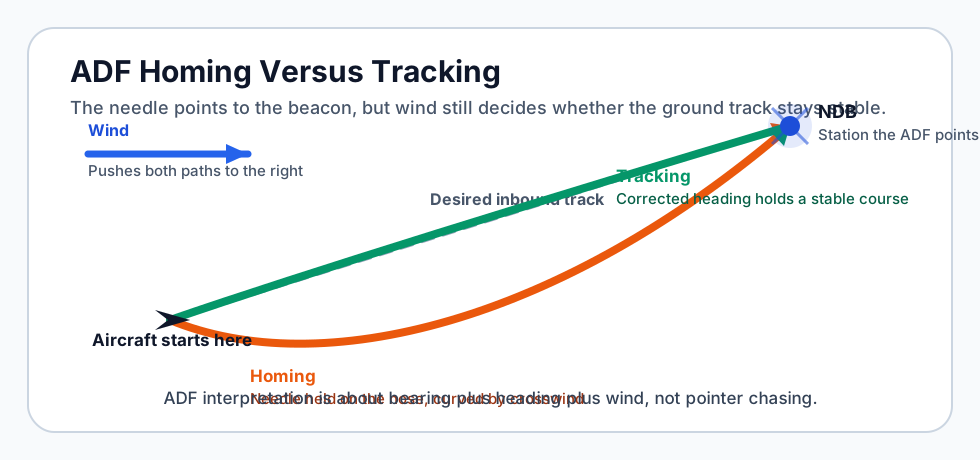
Homing means keeping the needle pointed straight ahead and flying wherever the wind takes the airplane. That will eventually take the aircraft to the station in no-wind conditions, but with crosswind it produces a curved path and wastes time, distance, and protected airspace margin.
Tracking means correcting for wind so the airplane follows a stable ground track to or from the station. The practical sequence is:
- Determine the desired bearing or course relative to the station.
- Choose an intercept heading to get onto that course.
- Observe whether the needle drifts off because of wind.
- Apply a heading correction and hold it long enough to judge the result.
The difference is important in instrument flight. Homing may still lead to the beacon, but it can place the airplane well off the intended arrival, missed-approach, or course-reversal geometry. Tracking preserves predictability. That is the standard that matters in the IFR system.
Errors and Limitations
NDB navigation is usable only when the pilot expects it to be imperfect. Common errors include:
- Thunderstorm effect: lightning can pull the needle toward electrical activity instead of the station.
- Night effect: signal propagation changes after sunset can distort bearings, especially at longer range.
- Terrain and shoreline refraction: mountains and coastline crossings can bend the signal path and create false indications.
- Bank error: in a turn, the needle may lag or momentarily point inaccurately.
- Station passage ambiguity: close to the beacon the pointer can become unstable or swing rapidly.
Those limitations do not mean the system is useless. They mean the pilot should cross-check it with heading, timing, DME if available, GPS situational awareness if permitted, and the larger chart picture. ADF flying becomes dangerous when the pilot assumes every pointer movement is trustworthy.
Station Passage
Station passage with an ADF is less clean than station passage over a VOR. As the airplane approaches the beacon, the needle may become increasingly sensitive and then swing rapidly as the aircraft passes overhead or abeam the station. In turbulence or wind, that moment can be easy to misread.
The correct mental model is not to wait for a perfectly crisp flip. Instead, brief what station passage should mean for the procedure you are flying. Is it the missed approach point? The outbound turn point for a procedure? The hold fix? When the pointer behavior, timing, and charted sequence all line up, station passage becomes much easier to recognize safely.
IFR Use
The FAA still teaches ADF/NDB knowledge because it appears in core intercept-and-track logic and in some legacy procedures. In actual IFR operations, an NDB may still show up as:
- a standalone en route or terminal navaid,
- a locator outer marker substitute,
- part of a missed-approach hold or course reversal, or
- the primary guidance source for an older nonprecision approach.
The pilot's workload question is always the same: is the pointer giving me a bearing cue only, or am I treating it as if it were a course signal? That distinction matters because an ADF needle does not center like a CDI. It rotates continuously, which tempts pilots to overcontrol and chase it.
Approach Considerations
NDB approaches are now less common, but they remain useful training examples because they force disciplined interpretation. On an NDB approach, the pilot should brief:
- How the final approach course is defined: inbound bearing to the beacon, outbound bearing from it, or a procedure segment anchored by the station.
- How the FAF and MAP are identified: timing, station passage, DME, crossing fixes, or another supporting source.
- What wind will do to the track: a stable inbound bearing does not automatically mean a stable ground course.
- What backup cues exist: clock, altitude gates, GPS overlay awareness if legal for situational awareness, and missed-approach setup.
That is the same discipline emphasized in Approaches. The navigation source may be older, but the IFR standard is unchanged: brief the lateral logic, the vertical limits, and the event that ends each segment before entering it.
Practical Technique
Good ADF flying is quiet flying. Pick a heading, wait for the bearing trend, and correct deliberately rather than immediately reacting to every twitch. A practical cockpit sequence is:
- Tune and positively identify the NDB.
- Decide whether you need bearing to the station, bearing from the station, or a tracked inbound or outbound course.
- Use heading plus pointer position to build the mental picture before maneuvering.
- Apply a wind correction and let the result develop.
- Cross-check with time, altitude, and the next procedural event.
If the airplane is being flown in real IMC with a modern panel, the ADF should usually be treated as a specialty source rather than the place where all attention goes. Aircraft control, scan discipline, and approach sequencing still come first.
References
- FAA Instrument Flying Handbook: ADF interpretation, tracking technique, and practical IFR use of bearing-based navigation.
- FAA Instrument Procedures Handbook: NDB procedure structure, chart interpretation, and approach integration.
- FAA Aeronautical Information Manual (AIM): operational guidance on NAVAIDs and IFR procedure usage.
Go Deeper
- Approaches: NDB — where the older navigation source shows up inside the actual approach families and minima discussion.
- Approaches: Procedure Turns — how station passage, timing, and lateral geometry fit into a charted reversal.
- Missed Approaches — the next segment to brief when the beacon or locator is part of the missed setup.
- IFR Procedures — a shorter procedure flow page that ties older nav sources back into whole-flight instrument task management.