Magnetic Compass
How the magnetic compass works, why it errors, and how pilots use it correctly in real flight conditions.
Quick Reference
Key points
Short-answer refresher for returning pilots before diving into the full page.
Quick Reference
Key points
Short-answer refresher for returning pilots before diving into the full page.
- Variation is earth-based and deviation is airplane-based, so use the chart for one and the correction card for the other.
- Turning and acceleration errors grow on north and south headings, which is why the compass is a backup truth source and not a maneuver instrument.
- Use the compass in straight, unaccelerated flight and let the heading indicator do the short-term work between stable checks.
Standards & References
FAA doctrinal and ACS cross-reference
Use this box to line the topic up with the FAA’s primary instrument handbooks, the most relevant ACS task areas, and the knowledge, skill, and risk elements that usually drive checkride evaluation.
- IFH Ch. 4, Flight Instruments: magnetic-compass indications, errors, and limitations that affect heading control and cross-check.
- IFH Ch. 5, Attitude Instrument Flying: supporting-instrument use and heading control inside a disciplined scan.
- Supporting only: compass knowledge underpins heading compliance during the procedures in IPH Ch. 2 and Ch. 4 but is not a stand-alone IPH chapter.
- IV.A Instrument Cockpit Check.
- IV.B Basic Instrument Maneuvers.
On This Page
Overview
The magnetic compass is the most basic direction-sensing instrument in the airplane and one of the few that does not require electrical power or gyroscopic rigidity to indicate heading. That simplicity is exactly why it remains important: when more capable systems fail, the compass is still the final heading reference available in many aircraft.
At the same time, the compass is one of the least intuitive instruments to use well. It is affected by the earth's magnetic field, local magnetic interference, bank, acceleration, and latitude. A pilot who understands those errors can still use the compass effectively; a pilot who treats it like a perfectly stable heading display will often chase bad indications.
Principles
A magnetic compass aligns itself with the horizontal component of the earth's magnetic field. In an aircraft compass, small permanent magnets are attached to a float assembly that is free to rotate in fluid. The compass card then points to magnetic north, allowing the pilot to read magnetic heading directly.
Because the earth's magnetic field is not perfectly horizontal and because the airplane itself contains electrical equipment and metal structure, the compass indication is only approximately correct unless the instrument has been properly compensated and the pilot understands its normal errors.
The key point is that the magnetic compass indicates magnetic heading, not true heading. That is why compass use connects directly to variation, deviation, and practical chart navigation.
Variation and Deviation
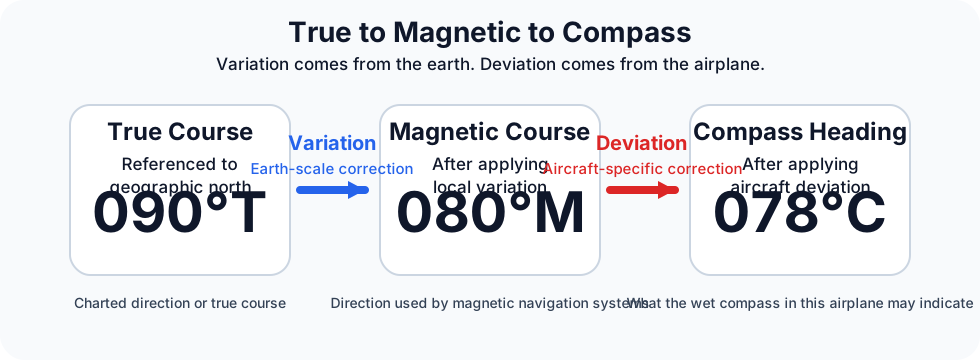
Variation is the angular difference between true north and magnetic north. It exists because the magnetic poles are not located at the geographic poles. Aeronautical charts account for variation, and pilots use it when converting between true courses and magnetic courses.
Deviation is compass error caused by magnetic influences within the aircraft itself. Radios, wiring, structural metal, speakers, and other installed equipment can all disturb the local magnetic field around the compass. This is why aircraft compasses are adjusted during maintenance and why a compass correction card is installed near the instrument.
Operationally, the sequence is simple: charted directions often begin as true, variation converts them to magnetic, and deviation corrects the airplane's actual compass reading. Variation comes from the earth. Deviation comes from the airplane.
Magnetic Dip
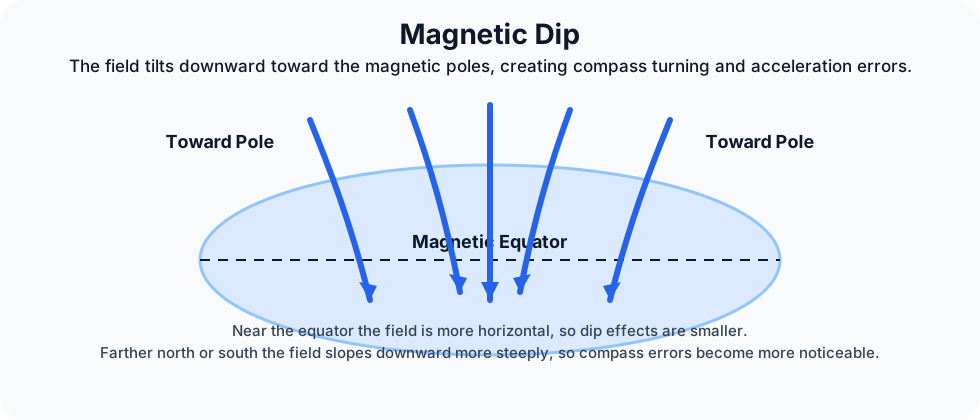
The earth's magnetic field tilts downward toward the magnetic poles rather than remaining perfectly horizontal. This downward slant is called magnetic dip. Compasses are designed with weights and fluid damping to minimize its effects, but dip still produces some of the most important compass errors seen in flight.
Magnetic dip is small near the magnetic equator and greater at higher latitudes. That means compass turning and acceleration errors become more noticeable as operations move farther north or south. In practical training, most mnemonic-based compass errors are taught for the Northern Hemisphere, but their directions reverse in the Southern Hemisphere.
The reason dip matters is that it makes the compass respond to motion in ways that do not simply reflect heading. In straight, unaccelerated flight the compass can be reasonably useful. In turning or accelerating flight, dip can make the indication lag, lead, or swing in ways that are not intuitive unless the pilot already expects them.
Turning Errors
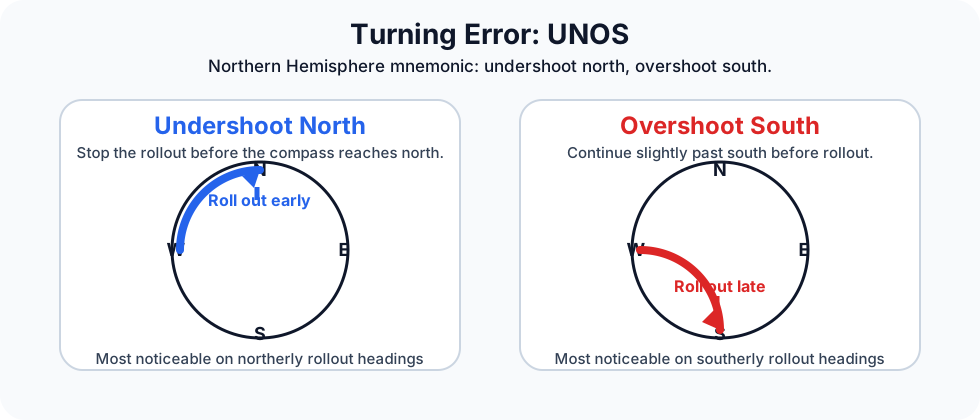
Turning errors are caused by magnetic dip. In the Northern Hemisphere, when turning from a northerly heading, the compass initially indicates a turn in the opposite direction or lags behind the actual turn. When turning from a southerly heading, the compass tends to lead the turn and indicate arrival at the new heading before the airplane actually gets there.
The standard memory aid is UNOS: undershoot north, overshoot south. That means when rolling out on a northerly heading, the pilot should stop the turn before the compass reaches the desired heading. When rolling out on a southerly heading, the pilot should continue slightly past the indicated heading before rollout.
The size of this error depends on latitude and bank angle. It is most noticeable on north and south headings and least noticeable on east and west headings. The error also becomes larger at higher latitudes, which is why magnetic compass technique matters more as the airplane operates farther from the magnetic equator.
Acceleration and Deceleration Errors
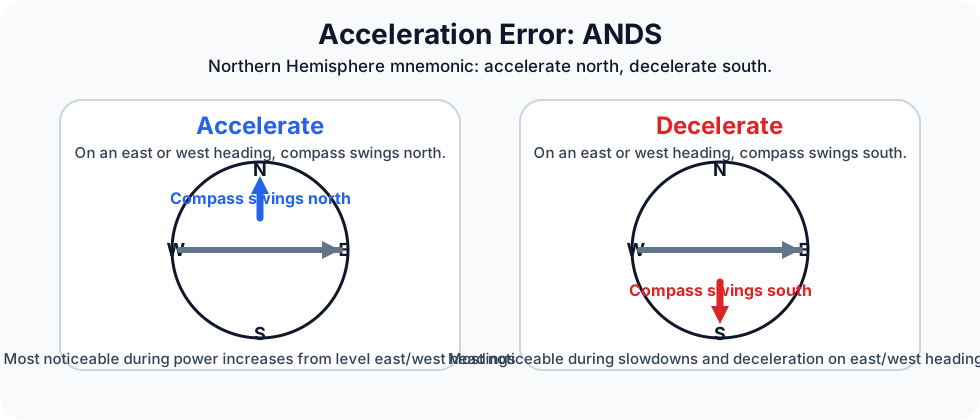
Acceleration errors also come from magnetic dip. In the Northern Hemisphere, when the aircraft is on an east or west heading and accelerates, the compass indicates a momentary turn toward north. When the aircraft decelerates, the compass indicates a momentary turn toward south.
The standard memory aid is ANDS: accelerate north, decelerate south. This does not mean the airplane is actually turning north or south. It means the compass temporarily swings that way because of how the dip-corrected magnetic system reacts to the change in speed.
These errors are most noticeable on east and west headings and much smaller on north and south headings. As with turning errors, the direction reverses in the Southern Hemisphere. The practical result is that a pilot should not trust a rapidly moving compass during power changes, especially during climbout, go-arounds, or slow-flight transitions.
Practical Use
The magnetic compass is most useful in straight-and-level, unaccelerated flight. That is the condition in which it gives the most reliable indication. If a pilot needs to reset or verify a heading indicator, the airplane should first be stabilized, wings level, and free of acceleration as much as possible.
In real cockpit use, the compass is often paired with the heading indicator rather than used as the primary maneuvering instrument. The heading indicator gives stable short-term heading information, while the compass provides the long-term magnetic reference used to realign the heading indicator periodically.
Good technique is to use the compass for confirmation and correction, not constant chasing. If the compass is oscillating during bumps or minor attitude changes, the pilot should avoid overcontrolling to every swing and instead wait for the indication to settle.
Limitations and Technique
- Oscillation: The compass card can swing and lag in turbulence or during abrupt control inputs.
- Fluid damping limits: Fluid reduces oscillation, but it does not eliminate turning and acceleration errors.
- Latitude sensitivity: Dip-related errors increase farther from the magnetic equator.
- Aircraft-specific deviation: The correction card must be honored because each aircraft's magnetic environment is different.
- Not a maneuvering instrument: During turns, climbs, descents, and power changes, the compass is best interpreted with known error patterns in mind.
A practical scan is: stabilize the airplane, check the heading indicator, compare it to the magnetic compass, apply the correction card if needed, and then trust the heading indicator for short-term control. That technique uses each instrument for what it does best.
References
- FAA Pilot's Handbook of Aeronautical Knowledge: primary FAA reference for magnetic compass construction, variation, deviation, dip, and standard compass errors.
- FAA Airplane Flying Handbook: practical instrument-scan and basic attitude flying technique that supports compass use in training and backup navigation.
- FAA Aeronautical Information Manual (AIM): operational context for magnetic versus true directions and navigation procedures in the U.S. system.