Attitude Instrument Flying
How to control the airplane by reference to instruments using scan technique, instrument interpretation, and structured control methods.
Quick Reference
Key points
Short-answer refresher for returning pilots before diving into the full page.
Quick Reference
Key points
Short-answer refresher for returning pilots before diving into the full page.
- The core loop is cross-check, interpretation, and control: scan continuously, decide what the airplane is doing, make one small correction, then rescan.
- Attitude is the hub and performance instruments confirm the result; chasing lagging instruments breaks the control picture.
- Use whichever framework keeps the airplane stable under workload: primary/supporting for scan discipline or control/performance for cause-and-effect control.
Standards & References
FAA doctrinal and ACS cross-reference
Use this box to line the topic up with the FAA’s primary instrument handbooks, the most relevant ACS task areas, and the knowledge, skill, and risk elements that usually drive checkride evaluation.
- IFH Ch. 5, Attitude Instrument Flying: instrument interpretation, control/performance relationships, and attitude-based aircraft control.
- IFH Ch. 6, Basic Flight Maneuvers: maneuver precision and unusual-attitude recovery fundamentals.
- Supporting only: this is prerequisite control skill applied while flying the published procedures detailed in IPH Chs. 1 through 4.
- IV.B Basic Instrument Maneuvers.
- IV.C Recovery from Unusual Flight Attitudes.
Checkride Focus
How this topic is typically evaluated
Use this block as the ACS-ready summary: what task areas this page supports, what the applicant should know, what the applicant should be able to do, and what risks must be managed without prompting.
Checkride Summary
This topic becomes checkride-relevant when the applicant can convert scan and instrument interpretation into stable aircraft control without fixation, overcontrol, or delayed recovery.
Knowledge
- Explain the cross-check, instrument-interpretation, and control loop used in attitude instrument flying.
- Distinguish primary-and-supporting logic from control-and-performance logic and know when each helps.
- Know the usual scan errors, trim traps, and lagging-instrument cues that create chasing behavior.
Skills
- Hold altitude, heading, and airspeed by reference to instruments with small, deliberate corrections.
- Transition smoothly between basic maneuvers without losing the overall scan.
- Recover from developing deviations or unusual attitudes before the error compounds.
Risk Management
- Fixation, omission, or emphasis that lets one control axis drift while another gets all the attention.
- Overcontrol or poor trim discipline that makes the panel look busier than it is.
- Spatial-disorientation cues after takeoff, in turbulence, or during high workload.
On This Page
Overview
Attitude instrument flying is the practical skill of controlling the airplane by reference to the flight instruments instead of the natural horizon. This is the part of IFR flying that answers the user's real question in the clouds: how do I keep the airplane where I want it in pitch, bank, power, and performance when I cannot trust outside visual cues?
The FAA Instrument Flying Handbook treats this as a complete system built on three repeating tasks: cross-check, instrument interpretation, and aircraft control. That framework matters because instrument flying is not one long stare at a single gauge. It is a disciplined cycle of seeing, understanding, and correcting.
This page focuses on airplane attitude instrument flying. The same FAA handbook also discusses helicopter instrument technique, but helicopter control responses and performance references differ enough that they should not be mixed casually into an airplane-centric scan discussion.
Core Instrument-Flying Cycle
The basic cycle is:
- Cross-check: scan the instruments continuously rather than fixating on one display.
- Interpretation: decide what the airplane is actually doing from the combined indications.
- Control: make small, deliberate pitch, bank, and power changes, then cross-check again.
The importance of this cycle is that the instruments do not all tell the same story at the same speed. Some are attitude references, some are performance references, and some lag behind the actual control input. The Instrument Flying Handbook emphasizes that good instrument flying comes from combining these references correctly rather than chasing whichever needle moved last.
A useful mental model is: the attitude indicator suggests what to set, the supporting instruments confirm whether that setting is producing the desired result, and the next scan cycle decides whether the correction worked. That is the root of stable aircraft control in IMC.
Scan Methodology
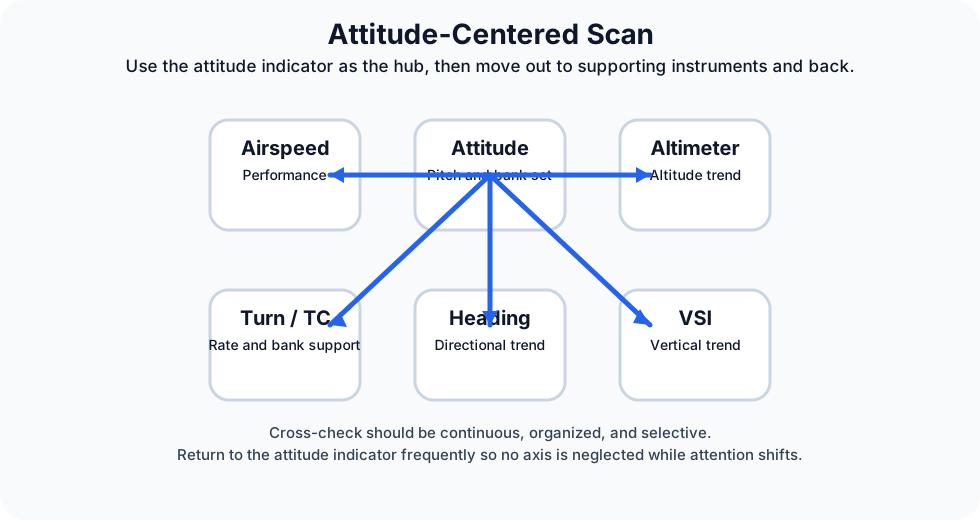
An instrument scan is not a rigid eye pattern performed for its own sake. It is a way to keep the pilot from fixating, from missing trend information, and from letting one control axis drift while concentrating on another. In the FAA model, the scan should be continuous, deliberate, and centered on the attitude instrument while still touching the performance instruments often enough to detect change early.
Radial and Selective Scan
A radial or hub-and-spoke style scan starts at the attitude indicator, moves to one supporting instrument, then returns to the attitude indicator before moving outward again. This works well because the pilot repeatedly recenters on the instrument showing the airplane's basic pitch and bank relationship. In practical use, the scan becomes selective: if altitude is drifting, the altimeter and VSI get more attention; if heading control is the problem, the heading indicator and turn information get more attention.
The important idea is not that one scan picture is universally correct. The important idea is that the scan must stay organized. A scattered scan causes missed deviations, especially when workload increases or turbulence disrupts the panel picture.
Inverted-V and Rectangular Scan
Common training patterns such as the inverted-V and rectangular scan are useful because they give the pilot a repeatable way to avoid fixation. An inverted-V scan typically emphasizes attitude indicator to performance instruments and back again. A rectangular scan moves methodically around the main instrument group. Both are training tools for disciplined cross-check, not laws of cockpit movement.
What matters operationally is whether the scan works under pressure. The best scan is the one that keeps the airplane stable, catches deviations early, and naturally shifts emphasis when the flight phase changes. A climb, a timed turn, and an approach do not demand the exact same scan emphasis even though the underlying method is the same.
Control Frameworks
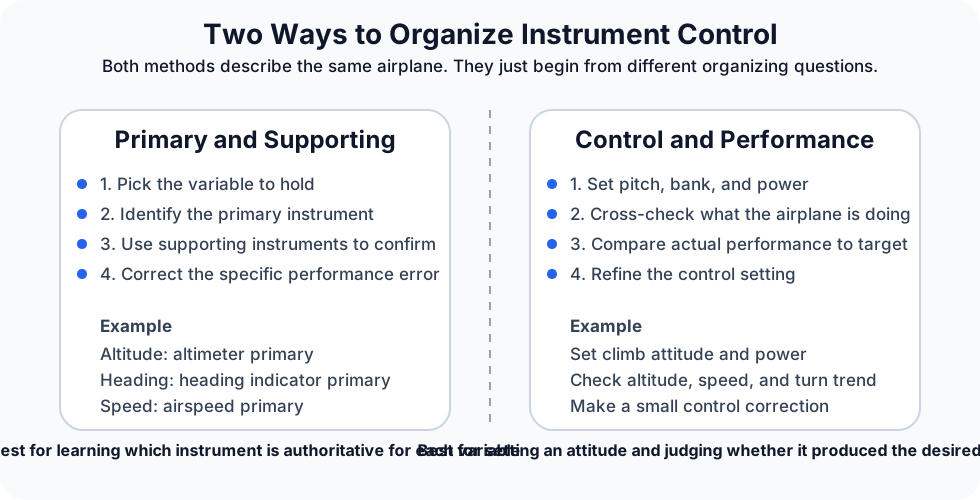
The FAA commonly presents attitude instrument flying through two related methods: primary and supporting instruments and control and performance. They are not contradictory. They are two ways of organizing the same job.
Primary and Supporting
In the primary-and-supporting method, one instrument becomes primary for a specific variable, while others support it. For example, in straight-and-level flight the altimeter may be primary for altitude, the heading indicator primary for heading, and the airspeed indicator primary for speed, while the attitude indicator and power instruments support those targets.
This method helps students learn which instrument has the final authority for a given performance goal. The danger is oversimplifying it into a checklist of fixed instrument roles. Primary instruments change with the maneuver. What is primary in level flight may not be primary in a constant-rate climb or a standard-rate turn.
Control and Performance
In the control-and-performance method, the pilot first sets an attitude and power combination, then checks whether performance matches the target. This is often the more operationally useful framework because it starts with what the pilot can actually control: pitch, bank, and power. Performance instruments then confirm whether the airplane is doing what was intended.
For example, if the pilot wants a standard-rate climbing turn, the first action is not to chase the vertical speed indicator. The first action is to set the approximate pitch, bank, and power combination that should produce the maneuver, then verify altitude trend, airspeed, and turn performance in the scan. This method is especially valuable in turbulence or partial-panel situations because it keeps the pilot focused on controllable variables instead of lagging symptoms.
Basic Maneuvers on Instruments
The point of scan methodology is not academic. It supports the basic maneuvers that make up real IFR flying: straight-and-level flight, standard-rate turns, constant-airspeed climbs, constant-airspeed descents, timed turns, and transitions between them. Each maneuver shifts scan emphasis slightly.
- Straight and level: emphasizes small pitch and bank corrections, trim, altitude stability, and heading control.
- Climbs and descents: emphasize pitch-power coordination and trend recognition so the pilot does not chase airspeed and vertical speed against each other.
- Turns: emphasize bank control, heading trend, altitude preservation, and rollout timing.
- Transitions: emphasize anticipation. The pilot should not wait for a large error before changing pitch or power.
This is why the Airplane Flying Handbook and Instrument Flying Handbook both stress trim, standardization, and smooth control pressures. A good scan is ineffective if the pilot is making abrupt or inconsistent control inputs.
Common Scan Errors
The classic errors in attitude instrument flying are fixation, omission, and emphasis. These are not abstract training terms; they describe exactly how pilots lose control precision in IMC.
- Fixation: staring too long at one instrument and missing what the rest of the airplane is doing.
- Omission: skipping an instrument long enough that an error develops unnoticed.
- Emphasis: giving one control problem too much attention and neglecting another axis or performance target.
These errors usually show up as chasing altitude with pitch, chasing heading with excessive bank, or allowing airspeed to drift while focusing on vertical control. The remedy is almost always the same: widen the scan, reset the attitude, and make a smaller correction than instinct first suggests.
Partial Panel and Failures
Attitude instrument flying matters even more when an instrument fails. Partial-panel flying forces the pilot to rely on the remaining instruments while recognizing which information has been lost. If the attitude indicator or heading indicator fails, the scan has to shift toward supporting references such as the turn coordinator, airspeed, altimeter, VSI, compass, and power settings.
The key principle is not to pretend the missing instrument is still there mentally. The scan must be rebuilt around the remaining usable references. The Instrument Flying Handbook treats partial-panel control as a restructuring problem: the pilot needs a new scan and a simpler control strategy, not just more concentration.
Practical IMC Technique
In actual IMC, the most useful habits are the least dramatic ones: trim early, make small corrections, cross-check continuously, and avoid trying to fix multiple problems with one control movement. Instrument flying should feel methodical, not frantic.
A practical technique is:
- Set the approximate attitude and power for the maneuver.
- Trim so the airplane is not fighting the pilot.
- Cross-check for trend, not just present position.
- Correct the first small deviation before it grows into a large one.
- After each correction, return to a normal scan instead of staring at the corrected instrument.
This is the missing bridge between knowledge and execution. IFR supporting knowledge matters, but without attitude instrument flying skill the pilot cannot reliably hold altitude, heading, airspeed, and workload together in cloud. That is why scan methodology is not a side topic under IFR. It is the operational foundation.
References
- FAA Instrument Flying Handbook: primary FAA reference for attitude instrument flying, scan patterns, common errors, and maneuvering by reference to instruments.
- FAA Airplane Flying Handbook: control smoothness, trim, attitude flying habits, and basic maneuver execution that support instrument control.
- FAA Pilot's Handbook of Aeronautical Knowledge, Flight Instruments: instrument-system background that helps the pilot interpret what the scan is showing.