Forces of Flight
Lift, weight, thrust, and drag as a moving force balance rather than four isolated definitions.
Quick Reference
Key points
Short-answer refresher for returning pilots before diving into the full page.
Quick Reference
Key points
Short-answer refresher for returning pilots before diving into the full page.
- Steady flight only looks simple because lift balances weight and thrust balances drag; any change in one force changes the trim picture.
- Pilots mainly control angle of attack and thrust, so those are the practical levers for changing the force balance.
- Loss of margin usually shows up first as changing drag, required pitch, or stall proximity before it looks dramatic outside the cockpit.
Standards & References
FAA doctrinal and ACS cross-reference
Use this box to line the topic up with the FAA’s primary instrument handbooks, the most relevant ACS task areas, and the knowledge, skill, and risk elements that usually drive checkride evaluation.
- IFH Ch. 5, Attitude Instrument Flying: power, pitch, and performance relationships depend on how lift, drag, thrust, and weight change the airplane.
- IFH Ch. 6, Basic Flight Maneuvers: maneuver response and trim control are grounded in these force relationships.
- Supporting only: force management underlies the aircraft control required to fly the procedures in IPH Ch. 1 through Ch. 4.
- IV.B Basic Instrument Maneuvers.
On This Page
Overview
Aircraft motion is governed by four primary forces: lift, weight, thrust, and drag. These forces are often introduced as separate textbook definitions, but operationally they matter because they are always interacting. An airplane does not just "have lift" or "have drag"; it lives in a changing balance where one force adjustment alters the others.
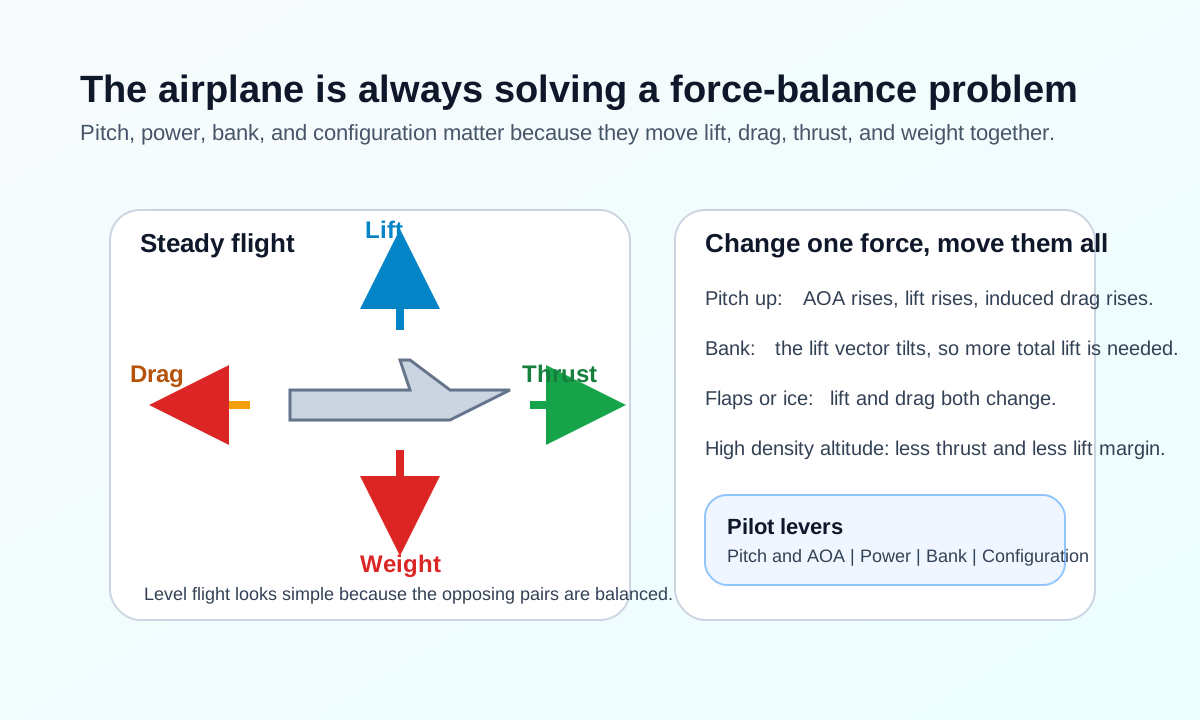
That is why pilots should think of the four forces as a system. A pitch change alters angle of attack, which changes lift and induced drag. A power change alters thrust, which changes acceleration and often trim demand. Configuration changes alter both lift and drag. Understanding the force system makes climbs, descents, turns, stalls, and performance problems easier to explain without memorizing isolated rules.
Force Balance and Equilibrium
In straight-and-level unaccelerated flight, lift balances weight and thrust balances drag. That does not mean the forces disappear. It means the opposing pairs are equal, so there is no net acceleration vertically or horizontally.
- Lift = Weight keeps the airplane from accelerating up or down.
- Thrust = Drag keeps the airplane from accelerating forward or slowing down.
As soon as the pilot changes power, pitch, bank, or configuration, the balance shifts. The airplane then accelerates, decelerates, climbs, descends, or turns until a new equilibrium is found. That is the practical meaning of trim and stabilization: the pilot is trying to establish a new balanced force picture that matches the intended maneuver.
Operational shortcut
If the airplane feels like it is taking more effort to hold the desired path, the force balance has changed even if the attitude picture looks familiar at first glance.
Lift
Lift is the aerodynamic force acting roughly perpendicular to the relative wind. It is produced when the wing changes the airflow and creates a pressure difference plus downward momentum in the wake. For a pilot, the most useful control fact is that lift depends strongly on angle of attack, airspeed, air density, wing shape, and wing area.
- More angle of attack: usually increases lift up to the critical angle, then stall occurs.
- More airspeed: increases lift for a given angle of attack.
- Higher density: increases lift potential for the same wing and speed.
- Flaps or configuration changes: may increase lift at lower speeds, but usually with a drag cost.
Lift is not a fixed upward arrow. In a bank, the lift vector tilts. Part of it still opposes weight, but part of it now turns the airplane. That is why turning flight often needs more total lift than straight flight, which is one reason stalls arrive at higher speeds in steeper turns.
Weight
Weight is the force of gravity acting toward the center of the earth. It is always present, always acts downward, and changes the whole performance picture because the airplane must create enough lift to oppose it. More weight means more lift required, which usually means higher angle of attack, higher stall speed, longer takeoff distance, and reduced climb performance.
Weight is also tied to loading and center of gravity. A more forward CG often requires more tail-down force and therefore more effective wing lift to maintain the same flight path, which increases drag and trim demand. Aft CG reduces that demand but may make the airplane less stable and harder to recover from stalls or unusual attitudes.
Thrust
Thrust is the forward force produced by the propulsion system. In piston airplanes, that usually means a propeller accelerating air backward. In turbine aircraft, it is the engine and exhaust flow producing forward reaction. Operationally, thrust is the force that gives the airplane acceleration margin and helps overcome drag.
Thrust is not only about speed. It also changes climb capability, go-around margin, and whether the pilot can trade energy between altitude and airspeed. High density altitude, engine issues, propeller efficiency loss, or icing contamination can all reduce useful thrust even when the power lever position looks normal.
Drag
Drag is the aerodynamic force acting parallel and opposite to the relative wind. It resists forward motion, and it is one of the most operationally misunderstood forces because it is not one thing. Pilots usually work with two large categories:
- Parasite drag: drag from form, skin friction, and interference. It increases rapidly with speed.
- Induced drag: drag created as a by-product of lift. It is highest at lower airspeeds and higher angles of attack.
This tradeoff creates the classic drag curve. At low speed, induced drag is high because the wing must work hard to produce enough lift. At high speed, parasite drag dominates because the airplane is pushing through the air faster. Somewhere between those extremes is the region of minimum total drag, which matters for endurance, best glide, and some performance planning.
Configuration changes matter because flaps, gear, ice, sideslip, and rough surfaces all increase drag. In practical terms, if the airplane suddenly needs much more power to hold a familiar airspeed or descent path, the drag picture has changed.
How the Forces Shift in Flight
The four-force picture changes with the maneuver:
- Climb: thrust must exceed drag enough to support the climb, and the lift vector is no longer directly opposite total weight because part of the energy is being used to gain altitude.
- Descent: weight contributes to forward motion along the flight path, reducing the thrust needed to sustain speed.
- Turn: the lift vector tilts, so more total lift is needed to keep altitude while also turning the airplane.
- Acceleration or deceleration: thrust and drag are out of balance until a new speed is reached.
This is the bridge from aerodynamics to practical flying. The pilot is not just moving controls. The pilot is changing the force balance so the airplane adopts a new performance state.
What the Pilot Actually Controls
Pilots do not directly command lift, drag, thrust, and weight as separate quantities. In normal operations they mainly control:
- Pitch and angle of attack, which change lift and induced drag.
- Power, which changes thrust and therefore the energy picture.
- Configuration, which changes both lift and drag.
- Bank, which redirects the lift vector and changes load factor.
That is why instrument flying is built around pitch, power, trim, and configuration awareness. Those are the cockpit levers that move the force system. If a maneuver is not working, the solution is usually not mystery. It is that one of those levers changed the force balance in a way the pilot has not yet recognized.
Use this page with Principles of Flight and Theories of Lift if you want the deeper explanation of why the airplane responds the way it does when those controls are moved.
References
- Pilot's Handbook of Aeronautical Knowledge — foundational FAA discussion of lift, weight, thrust, drag, and the drag curve.
- FAA Instrument Flying Handbook — practical use of force balance through pitch, power, and trim in instrument flight.
- Principles of Flight — how these force relationships explain stalls, stability, and turning behavior.
- Aerodynamic Factors — the applied performance side of force changes in real operations.