Departures
How SIDs, ODPs, transitions, and climb restrictions organize IFR departure and handoff into the en route phase.
Quick Reference
Key points
Short-answer refresher for returning pilots before diving into the full page.
Quick Reference
Key points
Short-answer refresher for returning pilots before diving into the full page.
- Know whether the departure is solving an obstacle problem, a traffic-flow problem, or both before you accept the procedural workload it creates.
- Climb gradients are performance requirements, not briefing trivia; if the airplane cannot make the published gradient in current conditions, the plan is wrong.
- Brief the first protected segment and the first transition into en route structure before takeoff so post-liftoff changes do not start from zero.
Standards & References
FAA doctrinal and ACS cross-reference
Use this box to line the topic up with the FAA’s primary instrument handbooks, the most relevant ACS task areas, and the knowledge, skill, and risk elements that usually drive checkride evaluation.
- IFH Ch. 8, Flight Planning: departure preparation, route review, and obstacle-awareness planning.
- IFH Ch. 9, IFR Flight: clearance review, departure briefing, and post-takeoff task management.
- IPH Ch. 1, Departure Procedures: ODPs, SIDs, takeoff minima, textual notes, and climb-gradient interpretation.
- III.B Compliance with Departure, En Route, and Arrival Procedures and Clearances.
Checkride Focus
How this topic is typically evaluated
Use this block as the ACS-ready summary: what task areas this page supports, what the applicant should know, what the applicant should be able to do, and what risks must be managed without prompting.
Checkride Summary
Departure tasks are judged on preparation and first-segment execution: the pilot should already know the first lateral path, first altitude, first fix, and first expected change before the wheels leave the runway.
Knowledge
- Explain the difference between an ODP, a SID, radar vectors, and the climb-gradient requirements tied to each.
- Know the first fix, first altitude, active source, and first mode or heading logic the departure will use.
- Understand how departure notes, obstacle concerns, and initial en route join logic affect the briefing.
Skills
- Brief and load the departure or opening clearance correctly before takeoff.
- Track the correct first segment after liftoff while maintaining climb performance and aircraft control.
- Absorb the first clearance change or mode change without losing the departure picture.
Risk Management
- Launching without a clear first-segment plan for course, altitude, and nav source.
- Going heads-down to repair the box during the highest-workload part of the takeoff and initial climb.
- Using the wrong source, wrong heading logic, or wrong climb expectation immediately after departure.
On This Page
Overview
Instrument departures sit between takeoff and the en route phase. Their purpose is to get the aircraft away from the airport safely, protect obstacle clearance, and organize traffic flow leaving terminal airspace. In practical terms, a departure answers the question: how do I get from the runway into the route structure safely and predictably under IFR? The AIM frames that job in terms of DPs that either provide obstacle clearance, traffic-flow structure, or both; see AIM 5-2-9.
Some IFR departures are simple radar vectors after takeoff. Others require published procedures with specific turns, altitude restrictions, or waypoint sequences. The main distinction is whether the departure is solving an obstacle problem, a traffic-flow problem, or both.
What a Departure Does
A departure procedure provides a structured path from the airport environment into the en route system. It may define an initial climb path, a sequence of fixes, altitude restrictions, speed limitations, and transitions toward airways or RNAV routes. The key value is predictability: ATC knows where the aircraft should be going, and the pilot has a defined plan rather than improvising immediately after takeoff.
Conceptually, the sequence is takeoff to departure to en route. That is why departures belong as a separate IFR topic rather than being treated as just a line in the flight plan.
SIDs
A Standard Instrument Departure (SID) is a published IFR departure used to simplify clearance delivery, increase efficiency, and organize outbound traffic. At busier airports, a SID allows many aircraft to depart along predictable routes while meeting airspace and terrain requirements.
When ATC clears an aircraft via a SID, the pilot is expected to fly the charted route and comply with published altitude and speed restrictions unless specifically amended. The AIM ties those expectations to SID clearance phraseology such as maintain altitude versus climb via, and to the rule that published speed restrictions remain in effect unless canceled; see AIM 5-2-9h. A SID may include both RNAV and conventional path definitions depending on airport design and traffic needs.
Transitions
Many SIDs include transitions from the common departure segment to different airways, fixes, or RNAV route entry points. These transitions matter because they determine where the aircraft leaves the shared terminal path and joins its assigned route structure.
A proper briefing should identify the specific transition cleared, not just the SID name. One SID can have multiple exit paths, and the transition is what connects the departure to the filed route.
Obstacle Departure Procedures
An Obstacle Departure Procedure (ODP) is a published IFR departure designed primarily to provide obstacle clearance. Unlike a SID, an ODP is not a traffic-flow tool first. Its purpose is terrain and obstacle protection during the initial climb out from the airport.
ODPs may be textual or graphical. They are available to the pilot even if ATC does not specifically assign them, because AIM 5-2-9 places obstacle-clearance responsibility on the pilot unless ATC issues an alternate departure path or vectors that assume that responsibility; see AIM 5-2-9f and 5-2-9h.
This is one of the most important practical distinctions in IFR departures: a SID may help with traffic sequencing, but an ODP exists because simply climbing straight out may not be safe.
Departure Chart Anatomy
A departure chart should be read as a sequence of required actions rather than just a route drawing. Key items include:
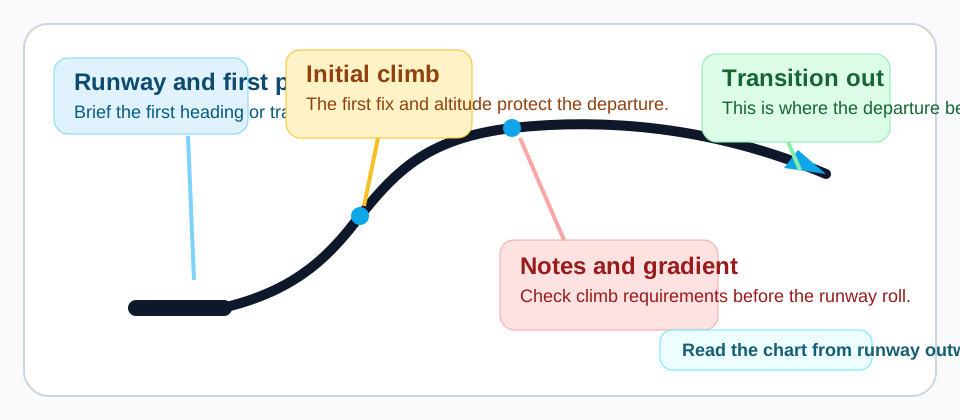
- Procedure name and revision: confirms the exact departure in use.
- Runway applicability: which runways the procedure may be used from.
- Initial climb segment: the immediate post-takeoff heading, fix, or track to be flown.
- Altitude restrictions: minimum or maximum altitudes at key points.
- Speed restrictions: charted speeds used for traffic management.
- Transitions: paths from the common departure into the en route structure.
- Notes: climb gradient requirements, required equipment, lost-communications expectations, or special operating cautions.
The callout flow should match the briefing flow: top strip and notes first, runway-specific path second, then the transition that determines how the departure stops being a terminal procedure and starts being an en route clearance.
A strong departure brief answers three questions: what do I do immediately after takeoff, what restrictions must I meet, and where does this procedure hand me off to the en route environment?
Climb Gradients and Restrictions
Climb performance is one of the central issues in IFR departure planning. A procedure may assume the standard IFR climb gradient of 200 feet per nautical mile, or it may require more. AIM 5-2-9e makes that baseline explicit and also explains that higher published climb gradients are mandatory when the procedure requires them. If the published procedure demands a steeper climb and the aircraft cannot meet it under actual conditions, then that procedure is not an acceptable departure plan.
Altitude restrictions also matter operationally because they often determine when turns begin, when ATC can hand the aircraft off, and whether terrain clearance remains protected. The same AIM section is explicit that ODP altitude restrictions cannot be canceled by ATC when they protect obstacle clearance, while SID altitude restrictions may be reissued through climb-via or amended clearances. A departure that looks simple on paper can become demanding if the aircraft is heavy, hot-and-high, or climbing poorly.
This is why departures begin before the takeoff roll: the pilot needs to know whether the aircraft can satisfy the required climb gradient in the expected conditions, not just whether the route is easy to understand.
Vectors and Amendments
ATC may clear the aircraft via a SID and then change it with radar vectors, heading assignments, altitude changes, or route amendments. That means the pilot should treat the published departure as the baseline plan, while staying ready to adapt once airborne. AIM 5-2-9h also matters here: once ATC vectors an aircraft off a SID, the SID restrictions are considered canceled unless ATC says to expect or resume the SID.
The critical point is that the first segment of departure usually carries the highest workload and the least excess time. If ATC amends the procedure after takeoff, the pilot must understand whether obstacle clearance is still being provided by the published procedure, by the new clearance, or by radar vectors. On ODPs, a vector or lower assigned altitude is the point where ATC assumes terrain and obstacle responsibility for the amended path under AIM 5-2-9h.
A revised departure is still part of the departure phase. Good technique is to maintain the initial safe climb picture first, then absorb the amended routing without losing aircraft control or vertical performance awareness.
RNAV vs. Conventional Departures
Many modern departures are RNAV-based and rely on waypoint sequencing rather than radials and intersections. These procedures often allow more efficient routing and cleaner traffic separation. Conventional departures may use headings, VOR radials, DME distances, or fixes based on ground navigation aids.
RNAV departures can be easier to fly precisely, but only if database currency and avionics setup are correct before takeoff. Conventional departures demand stronger mental geometry and raw navigation awareness, especially when the initial climb must be flown accurately before joining a radial or intercepting a route.
The practical difference is what the pilot must monitor. RNAV emphasizes avionics mode awareness and leg sequencing. Conventional departures emphasize heading control, navigation source setup, and when the aircraft is actually established on the required path.
Transition to En Route
The departure phase is complete when the aircraft is handed from the immediate terminal departure structure into the en route system. Sometimes that is a transition on the SID. Sometimes it is radar vectors to join the filed route. Sometimes it is a clearance direct to a later fix.
This is why the departure and en route portions of an IFR flight should be thought of together. If the pilot understands where the departure procedure is trying to deliver the airplane, the clearance becomes more coherent and less reactive once airborne.
Good departure management reduces en route workload and lowers the chance of a rushed reprogramming or heading error during the climb. Poor departure preparation creates confusion at the exact time the pilot has the least spare capacity.
Next Concept
Once the runway escape and SID or ODP are stable, the next workload shift is route ownership: minimum altitudes, reroutes, and airway or RNAV leg management.
Real-Chart Example
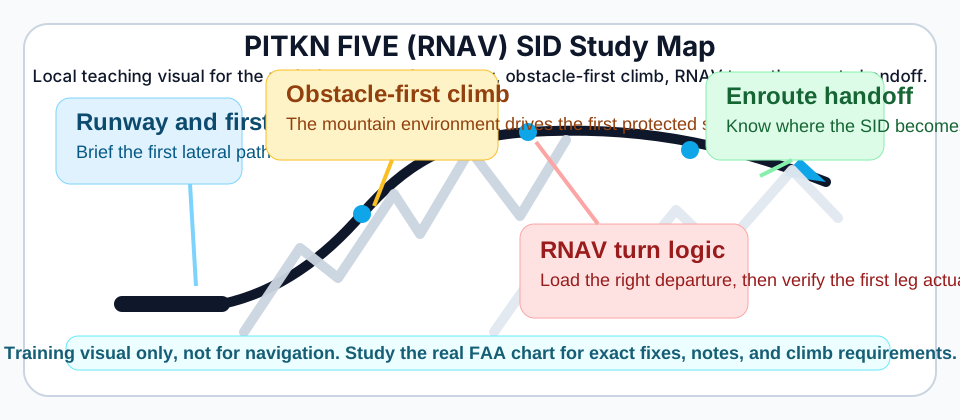
Use the current FAA search results for Aspen (KASE) as a departure study set. That page currently shows both the SARDD THREE (OBSTACLE) ODP and charted departures such as ASPEN SEVEN, LINDZ ONE, and PITKN FIVE (RNAV), which makes it a useful place to compare obstacle-first and traffic-flow-first departures at the same airport. For the visual study example here, use PITKN FIVE (RNAV) as the named SID reference.
What to look for on the real chart
- ODP versus SID purpose: the ODP exists because terrain or obstacles drive the first segment; the DP or SID adds the traffic-flow layer.
- Top-strip notes: identify any special climb gradient, runway applicability, or required navigation capability before looking at the route drawing.
- First segment discipline: isolate the first runway path, first altitude, and first event that changes the procedure from runway escape to route join.
- Transition out: brief the fix or transition that actually hands the airplane off to the enroute structure so the departure does not end as a surprise.
This is the right kind of chart study because it forces the pilot to answer the departure questions in order: what do I fly first, what protects me, what restriction matters now, and where does the procedure stop being a departure and start being the route?
Practical Briefing
A useful departure brief is short but disciplined. It should include the runway, initial heading or course, first altitude, navigation source, any special climb gradient, the cleared SID or ODP, and the transition or route handoff expected afterward.
For practical use, the pilot should be able to answer:
- What do I fly immediately after takeoff?
- What climb gradient or altitude restriction must I meet?
- Which navigation source and mode should be active?
- What is the first fix or transition that connects me to the route?
- What will I do if ATC amends the procedure or if I lose situational awareness during the climb?
If those answers are clear before takeoff, the departure becomes a prepared procedure rather than a cockpit surprise.
References
- FAA Instrument Procedures Handbook: primary FAA reference for SID and ODP interpretation, chart reading, and departure procedure structure.
- FAA Instrument Flying Handbook: operational IFR guidance on departure briefings, climb management, and cockpit technique.
- FAA Aeronautical Information Manual (AIM), 5-2-9: official FAA discussion of DPs, ODPs, SIDs, climb gradients, DVA use, and pilot versus ATC obstacle-clearance responsibility.
- FAA Aeronautical Information Manual (AIM), 5-2-8: departure control expectations, vectors, and heading or RNAV-advisory use after takeoff.
- Terminal Procedures Publication: the controlling source for any specific SID, ODP, charted note, and published restriction being flown.
Go Deeper
- ATC System: ATC in the IFR Flight Flow — where the departure clearance, first handoff, and amendments fit into the broader system picture.
- Automation and Avionics Management: Departure Example — source, mode, and FMA traps in the first minutes after takeoff.
- GPS and RNAV Systems: Waypoint and Leg Management — the RNAV sequencing side of flying modern departures cleanly.
- En Route Operations — the phase that begins when the departure stops protecting the first segment and hands the flight to the route.