Integrated IFR Procedures
Scenario-based IFR procedural flying from clearance to missed approach, including course intercepts, ILS and RNAV execution, and common IFR contingencies.
Quick Reference
Key points
Short-answer refresher for returning pilots before diving into the full page.
Quick Reference
Key points
Short-answer refresher for returning pilots before diving into the full page.
- IFR procedure workload spikes at phase seams, so brief the next phase before the current one is saturated.
- Treat clearance, departure, arrival, approach, and missed approach as one connected chain instead of separate memory items.
- If the chain breaks, stabilize the airplane, recover the active segment, and then rebuild the next one deliberately.
Standards & References
FAA doctrinal and ACS cross-reference
Use this box to line the topic up with the FAA’s primary instrument handbooks, the most relevant ACS task areas, and the knowledge, skill, and risk elements that usually drive checkride evaluation.
- IFH Ch. 8, Flight Planning: preloading the route, weather, and alternate decisions before workload spikes.
- IFH Ch. 9, IFR Flight: clearance, departure, en route flow, arrival, approach, and missed approach as one connected workflow.
- IFH Ch. 10, Emergency Operations: abnormal transitions when the plan changes late or a miss becomes a system-management event.
- IPH Ch. 1, Departure Procedures through Ch. 4, Approaches: the published departure, en route, arrival, and approach structure as one linked workflow.
- IPH Appendix A, Emergency Procedures: continuity when equipment, communications, or guidance failures interrupt that workflow.
- III.B Compliance with Departure, En Route, and Arrival Procedures and Clearances.
- VI.A through VI.C Instrument Approaches and Missed Approach.
- VII.A Emergency Operations.
Checkride Focus
How this topic is typically evaluated
Use this block as the ACS-ready summary: what task areas this page supports, what the applicant should know, what the applicant should be able to do, and what risks must be managed without prompting.
Checkride Summary
Integrated IFR procedure work is checkride-ready when the applicant can connect clearance, departure, en route, arrival, approach, and missed approach into one continuous and organized cockpit workflow.
Knowledge
- Know the phase-change triggers that shift the flight from departure to en route, arrival, approach, and missed logic.
- Understand what each phase briefing must cover before the airplane arrives there.
- Know how abnormal changes, reroutes, and downgrades alter the next segment of the flow.
Skills
- Stay ahead of the next segment by briefing and configuring before workload spikes.
- Comply with clearances, transitions, and approach setup without losing the bigger route picture.
- Carry the flight cleanly into the missed or alternate plan when the approach does not end in a landing.
Risk Management
- Expectation bias that makes the pilot fly what was anticipated instead of what was actually cleared.
- Late reprogramming, shallow briefing, or task saturation at phase changes.
- Treating the missed or abnormal event as separate from the rest of the workflow instead of as the next segment.
On This Page
Overview
IFR training is easiest to fragment into separate subjects: flight planning, departures, arrivals, approaches, holds, and missed approaches. Real instrument flying does not happen that way. In the airplane, those pieces run together as one continuous procedural sequence from the initial clearance to landing or missed approach.
This page is meant to bridge that gap. It connects the reference material elsewhere in Flying Worx into a practical workflow: receive the clearance, brief the departure, intercept the route, manage the arrival, brief and fly the approach, and execute the missed approach if needed. The FAA Instrument Flying Handbook, Instrument Procedures Handbook, and AIM all support that integrated view.
Integrated Training Flow
A useful IFR procedural flow is:
- Receive, copy, and verify the clearance.
- Brief the departure and immediate post-takeoff actions.
- Stabilize the climb and join the route structure.
- Intercept and track courses or RNAV legs accurately.
- Prepare early for arrival, descent, and likely approach.
- Brief the plate thoroughly enough that no major decision is deferred to short final.
- Fly the final segment to DA or MDA with a clear missed approach plan.
- If needed, transition immediately to the missed approach and next clearance.
The point of this sequence is workload management. Most procedural IFR errors are not caused by ignorance of one isolated rule. They come from task saturation at the seams between phases, such as runway change to arrival, arrival to approach, or approach to missed approach.
Clearance to Initial Climb
The procedural chain begins before takeoff. When the pilot receives the clearance, the job is not merely to read it back correctly. The job is to convert it into an immediate-action plan. That means identifying the departure runway, SID or ODP if any, first heading or course, first altitude, first fix, and what navigation source must be alive before the airplane starts moving. AIM 5-2-9 is the official background for that workload: it is where departure procedure structure, climb-gradient assumptions, and pilot versus ATC obstacle-clearance responsibility are spelled out.
The first two minutes after takeoff are not the place to discover that the wrong transition is loaded, the wrong CDI source is active, or the pilot never truly understood the departure path. The Instrument Flying Handbook treats departure briefing as a control-and-workload problem as much as a navigation problem.
A practical departure brief should answer:
- What do I fly immediately after liftoff?
- What altitude and climb gradient protect me?
- What course, heading, or lateral mode should be active first?
- What is the first event that changes the procedure: a fix, an altitude, or an ATC vector?
That is the start of procedural flying: turning a clearance into an immediate cockpit plan.
Course Intercepts and En Route Flow
Once airborne, IFR flying becomes a series of intercepts and transitions. The airplane intercepts the departure path, the assigned route, the arrival, the approach course, and sometimes the missed approach hold. That is why intercept technique is central to procedural flying even when the airplane uses RNAV for much of the route.
For conventional navigation, course intercepts should be deliberate rather than aggressive. The pilot should choose an intercept angle that is large enough to join efficiently but small enough to avoid overshooting in wind or at high groundspeed. For RNAV procedures, “intercept” often becomes a question of leg sequencing and mode awareness rather than needle geometry, but the principle is the same: the pilot must know what path the airplane is trying to capture next.
The important procedural question is always: what am I established on now, and what am I about to be established on next? If that answer is unclear, the airplane is already behind the procedure.
Arrival and Approach Setup
Well before reaching terminal airspace, the pilot should begin converting the en route phase into the likely arrival and approach plan. This is where descent planning, runway expectation, arrival constraints, and approach choice come together. A late runway change or late plate review usually means the briefing has been delayed too long.
The arrival setup should include the likely approach family, expected navigation source, the high-priority altitude and speed restrictions, whether a course reversal or HILPT is possible, and how the arrival likely feeds the final approach. AIM 5-4-6 and 5-4-9 are the key official references behind that logic because they govern how an approach clearance connects from an arrival or feeder route and when a procedure turn or HILPT is still required. The Instrument Procedures Handbook supports reading the approach from top strip to plan view to profile to minima block. Procedural flying means doing that soon enough that ATC changes can be absorbed without panic.
A strong setup habit is to build a five-part approach card before the last vector or transition fix: brief the chart, set the avionics, say the expected ATC readback and missed call, expect the next segment change, and identify the one or two traps most likely to hurt this specific procedure. That same flow works on an ILS, a WAAS approach, a VOR, or a circling procedure.
Scenario: Briefing and Flying an ILS
Use the FAA ILS OR LOC RWY 36 chart at KOSH as a model vector-to-final case. The pilot has been told to expect the ILS, has briefed the localizer frequency, inbound course, glideslope intercept altitude, DA, missed approach instructions, lighting, and runway environment requirements. When vectors are issued, the pilot still has to manage the intercept actively rather than passively waiting for the localizer to center.
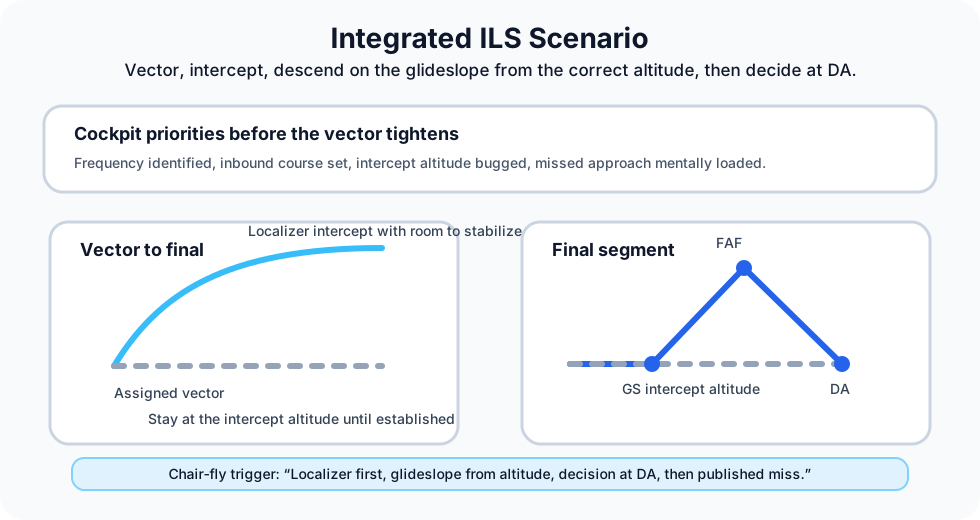
In practical cockpit sequence:
- Confirm the correct navigation source and frequency are active and identified.
- Set the inbound course and verify the glideslope intercept altitude from the plate.
- Join the localizer cleanly with enough time to stabilize before glideslope intercept.
- Do not descend on the glideslope until established and at the correct intercept altitude; AIM 5-4-5 and 5-4-6 both assume the pilot remains at the last assigned altitude until established on the published segment that authorizes descent.
- Track localizer and glideslope with small corrections while monitoring airspeed and configuration.
- At DA, either continue with required visual references or execute the missed approach immediately.
The procedural value of an ILS is that it gives both lateral and vertical guidance to a decision altitude. That makes it a strong example of guided descent to DA. The pilot is not waiting level at minimums. The pilot is descending on a path to a fixed decision point. That is why the miss decision and initial missed approach actions should already be mentally loaded before intercepting the glideslope.
- Brief: localizer frequency and ident, inbound course, FAF, glideslope intercept altitude, DA, missed approach, approach-lighting notes, and localizer-only fallback.
- Set: NAV source, course selector, vectors-to-final or full approach as appropriate, altitude bugs for intercept and missed, and any autopilot mode needed for localizer capture.
- Say: read back “Cleared ILS runway 36 approach,” and if the approach breaks down, be ready with “missed approach, published.”
- Expect: altitude restriction until established, localizer capture before glideslope descent, and a decision at DA without drifting below while searching.
- Trap focus: late descent to glideslope intercept, overshooting the localizer on a tight vector, and forgetting to transition mentally if the glideslope fails.
Audio-style ILS transcript
Approach: “Skylane Three Four X-ray, three miles from JENKS, turn right heading three three zero, maintain two thousand five hundred until established, cleared ILS runway three six approach.”
Pilot: “Right three three zero, two thousand five hundred until established, cleared ILS runway three six, Three Four X-ray.”
Pilot, cockpit callout: “Localizer alive, glideslope from altitude only, DA set, missed loaded.”
Tower: “Three Four X-ray, runway three six cleared to land.”
Chair-Fly This Aloud
- “Nav source identified, inbound course set, intercept altitude held.”
- “Localizer first, glideslope from the published altitude only.”
- “At DA: land with the runway, otherwise published miss immediately.”
Scenario: Briefing and Flying an RNAV Approach
Now consider the FAA RNAV (GPS) RWY 35R chart at KAPA. The first difference is that the pilot must identify not only the approach title but also the actual minima line likely to be used: LPV, LNAV/VNAV, LP, or LNAV. The same chart may support several different procedural outcomes depending on what service and equipment are available.
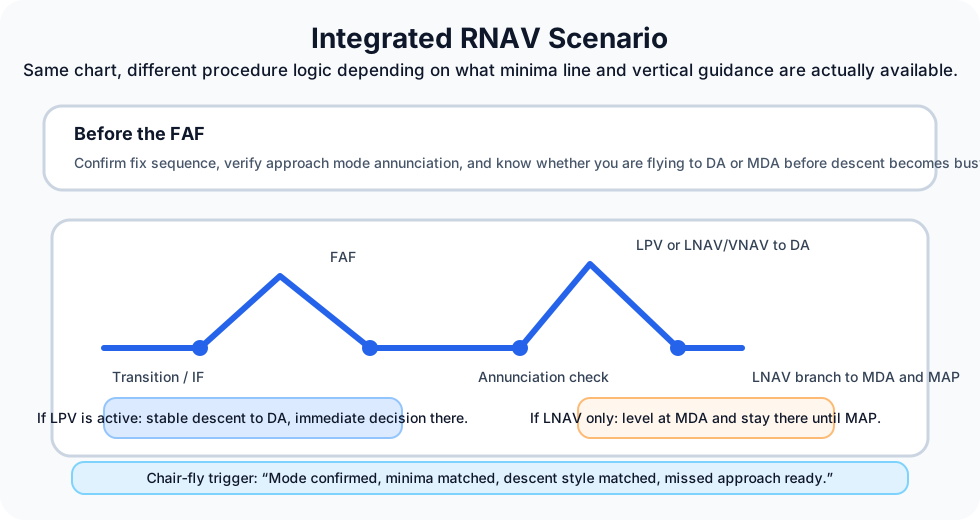
In an LPV or LNAV/VNAV scenario, the flow resembles an ILS operationally: brief the initial and final fixes, confirm glidepath or vertical guidance availability, verify the correct minima line, and descend to a DA. In an LNAV-only scenario, the flow is different because the pilot must manage descent to MDA and often remain level at that altitude until the MAP if visual references are not acquired sooner.
This is where RNAV procedural discipline matters most. The pilot should brief what happens if the approach downgrades. If vertical guidance is lost and only LNAV remains valid, the descent plan, decision point, and missed approach timing all change. The chart may look the same, but the way it is flown does not.
- Brief: approach title, transition or vector join, FAF altitude, missed approach, and the exact minima line to be used if LPV annunciates and if it does not.
- Set: load the approach early, confirm the fix sequence, activate the correct leg or vectors-to-final only when appropriate, verify GPS is the active source, and confirm final approach mode annunciation before relying on vertical guidance.
- Say: read back “Cleared RNAV runway 35R approach.” If a runway or procedure amendment comes late, ask for delaying vectors instead of rebuilding the box while already descending.
- Expect: a workload shift at the FAF because the same chart may either continue as a DA-based glidepath approach or as an MDA-based nonprecision approach depending on annunciation and available minima.
- Trap focus: assuming advisory glidepath authorizes descent, missing the downgrade from LPV to LNAV, and failing to redefine the MAP/MDA strategy when the approach no longer behaves like an ILS.
Audio-style RNAV transcript
Approach: “Bonanza Eight Two Sierra, cross WIPOR at or above eight thousand, cleared RNAV runway three five right approach.”
Pilot: “Cross WIPOR at or above eight thousand, cleared RNAV runway three five right, Eight Two Sierra.”
Pilot, cockpit callout: “Approach mode checked, LPV active unless downgraded, LNAV plan ready if it changes.”
Tower: “Eight Two Sierra, runway three five right cleared to land. Advise immediately if you go missed.”
Chair-Fly This Aloud
- “Fix sequence right, approach mode right, minima line right.”
- “If LPV stays active: descend to DA. If not: reset to LNAV and MDA.”
- “MAP and missed approach are briefed before the FAF, not after the downgrade.”
Stepdowns, DA, and MDA
A major procedural difference between instrument approaches is whether the final segment leads to a DA or an MDA. On an ILS, LPV, or LNAV/VNAV procedure, the pilot descends on a vertical path to a decision altitude. At that point the decision is immediate: continue visually or go missed.
On many nonprecision procedures, especially LNAV or localizer-only procedures, the pilot may descend to the MDA and then remain level until the missed approach point if the runway environment is not yet visible. Step-down fixes become especially important here because descent is not continuously guided all the way to decision altitude. The pilot must know exactly where descent is authorized and what altitude cannot be left before the next segment.
That distinction is one of the most important procedural differences in IFR flying. A DA-based approach is flown as a stabilized descent to a decision point. An MDA-based approach demands stronger altitude discipline, MAP awareness, and step-down compliance. Treating one like the other is a common procedural error.
Two practical examples make the difference obvious. On the KAPA RNAV chart flown as LPV, the pilot descends continuously to DA and decides there. On the same chart flown as LNAV, or on the KOSH VOR RWY 36 chart, the pilot must be ready to level at MDA and continue to the actual MAP without creeping lower. On a circling plate such as KASE LOC/DME-E, the pilot must also separate the instrument segment from the later visual maneuver instead of blending them into one improvised descent.
Missed Approach Flow
A missed approach is part of the procedure, not the failure of the procedure. If the runway environment is not in sight at DA or MAP, or if the approach becomes unstable, the pilot transitions immediately to the missed approach. AIM 5-4-21 is the core FAA reference here: obstacle protection assumes the miss starts at DA or at the MAP, not from an improvised point lower or farther along the approach. The first actions should already be memorized from the briefing: power, pitch, source or mode confirmation, and the initial routing.
Procedurally, the miss connects the approach back to the broader IFR system. It may lead to a published hold, vectors, a return for another approach, or a diversion. That is why the first missed approach instruction is more important than the later hold details. The critical question is: what do I do in the first five seconds after deciding not to land? AIM 5-4-21 also makes the point that an early or below-minimum miss may not carry the same obstacle protection, which is exactly why the first routing and climb actions matter more than reprogramming the hold.
A useful cockpit script is: power up, pitch up, clean up on schedule, verify the navigation source, fly the first published routing, then talk. The radio call can be short: “missed approach, published.” The mistake to avoid is trying to brief the hold, reprogram the box, and talk to ATC before the airplane is climbing on the correct initial path.
If that answer is not clear before the final segment begins, the approach briefing is incomplete.
IFR Contingencies and Emergencies
Integrated IFR training should also include abnormal situations because real procedural skill shows up when the plan changes suddenly. The important contingencies are not limited to dramatic emergencies. They include unstable intercepts, navigation source confusion, loss of vertical guidance, runway changes late in the arrival, lost communications, and partial-panel situations.
A practical IFR contingency mindset is:
- Unstable approach: stop trying to salvage it and go missed early.
- Lost guidance or equipment downgrade: immediately determine which minima line or backup procedure remains legal and flyable.
- Late amendment: aviate first, then rebuild the procedure sequence from the current clearance.
- Lost communications: fall back on cleared route, expected routing, assigned altitude logic, and published procedures as supported by regulation, AIM 6-4-1 through 6-4-3, and 14 CFR 91.185.
The common thread is that procedural IFR flying depends on staying ahead of the next segment, not merely surviving the current one. That is why integrated training matters. It teaches how the phases connect, and that connection is what keeps workload manageable when something changes.
References
- FAA Instrument Flying Handbook: procedural cockpit technique, control priorities, departure and approach execution, and missed approach management.
- FAA Instrument Procedures Handbook: chart reading, procedure design, SIDs, STARs, approach structure, procedure turns, and missed approach procedures.
- FAA Aeronautical Information Manual (AIM), 5-2-9: departure-procedure structure, climb-gradient assumptions, and obstacle-clearance responsibility.
- FAA Aeronautical Information Manual (AIM), 5-4-6, 5-4-9, and 5-4-21: approach entry, course-reversal expectations, and missed-approach execution.
- FAA Aeronautical Information Manual (AIM), 6-4-1 through 6-4-3: lost-communications procedures, transponder use, and reestablishing contact.
- Terminal Procedures Publication: the controlling source for the actual departure, arrival, approach, and missed approach procedures being flown.