IFR Emergencies and Abnormals
Compact abnormal flows for the moments where IFR workload rises fastest: equipment failures, lost comms, and unstable approaches.
Quick Reference
Key points
Short-answer refresher for returning pilots before diving into the full page.
Quick Reference
Key points
Short-answer refresher for returning pilots before diving into the full page.
- Abnormal IFR recovery still starts with aviate, navigate, communicate, because a stable airplane buys back decision time.
- Partial-panel and lost-comms situations are easier if the route, altitude, and backup scan were mentally organized before the failure.
- If the approach or system becomes unstable, a clean missed approach is usually the best first abnormal procedure.
Standards & References
FAA doctrinal and ACS cross-reference
Use this box to line the topic up with the FAA’s primary instrument handbooks, the most relevant ACS task areas, and the knowledge, skill, and risk elements that usually drive checkride evaluation.
- IFH Ch. 10, Emergency Operations: partial-panel control, lost communications, system failures, and abnormal instrument situations.
- IPH Appendix A, Emergency Procedures: missed-approach and holding continuity when equipment, guidance, or communications fail.
- IPH Ch. 4, Approaches: missed-approach continuity when final guidance changes or is lost.
- VII.A Emergency Operations.
- VII.B Emergency Equipment Malfunctions.
- VII.C Loss of Communications.
Checkride Focus
How this topic is typically evaluated
Use this block as the ACS-ready summary: what task areas this page supports, what the applicant should know, what the applicant should be able to do, and what risks must be managed without prompting.
Checkride Summary
In the checkride and in real IFR, abnormals are judged on order of operations: stabilize the airplane, simplify the navigation picture, then communicate clearly and accept only the next simplest task.
Knowledge
- Know the aviate-navigate-communicate priority for partial panel, lost communications, and downgraded or unstable approaches.
- Understand the route and altitude logic for lost communications and what guidance still applies after a failure.
- Know what ATC help actually reduces workload, such as no-gyro vectors, delaying vectors, or a simpler clearance.
Skills
- Rebuild the scan around the remaining instruments when the normal panel picture is no longer trustworthy.
- Decide early whether a downgraded or unstable approach still supports safe continuation or requires a missed approach.
- Tell ATC what failed, what assistance is needed, and what the airplane can still accept.
Risk Management
- Trying to solve equipment, navigation, and communication problems simultaneously before basic aircraft control is stable.
- Pretending the original scan or approach still exists after a failure or downgrade.
- Letting workload or surprise delay the decision to go missed, simplify, or ask for help.
On This Page
Overview
IFR abnormals become dangerous when the pilot tries to solve everything at once. The working rule is still aviate, navigate, communicate, but under instrument conditions that means simplifying the aircraft state first, then rebuilding the plan with the equipment and procedure that remain.
Aviate, Navigate, Communicate
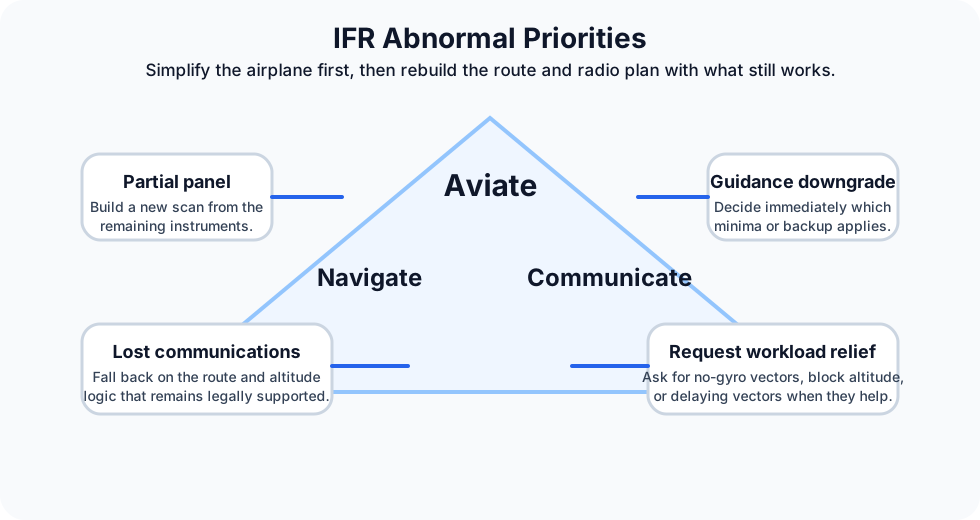
- Aviate: stabilize attitude, power, and configuration.
- Navigate: determine what guidance, route, altitude, and terrain protection still apply.
- Communicate: tell ATC what failed, what you can still accept, and what help you need.
Partial Panel
Partial-panel work is a scan problem before it is anything else. If the attitude or heading information is unreliable, stop pretending the original scan still exists. Build a new scan around the remaining instruments and request the easiest workload reduction available.
- Level the airplane and set a known power setting.
- Shift the scan to turn coordinator, altimeter, airspeed, VSI, compass, and power cues as appropriate.
- Ask for no-gyro vectors, block altitude, or delaying vectors if they reduce workload.
Lost Communications
Lost communications is not guesswork. The pilot falls back on the regulation-supported route and altitude logic, then flies the procedure predictably. In short form, use the appropriate route logic from assigned, vectored, expected, or filed, and the highest applicable altitude logic from assigned, minimum, or expected. AIM 6-4-1, Two-way Radio Communications Failure lays out that operational sequence directly, and AIM 6-4-2 adds the standard 7600 transponder response when the aircraft is equipped.
The operational point is to decide early what you will fly if the radio goes silent, especially during arrivals, approaches, and missed approaches where ambiguity grows quickly.
Unstable or Downgraded Approach
Two common IFR abnormals are an unstable approach and a guidance downgrade. Both demand an early decision, not an improvised salvage.
Unstable approach
If lateral guidance, vertical path, airspeed, or workload are not stabilized, go missed early and cleanly.
Guidance downgrade
If glidepath, GPS integrity, or another required element is lost, immediately decide which minima or backup procedure still applies.
If weather or icing is driving the abnormal, zoom out one step further: ask whether the flight should continue in that phase at all, or whether the safest decision is a hold, diversion, or cancellation. AIM 5-4-21, Missed Approach is a useful reminder that the protected missed-approach assumptions depend on going missed when the procedure expects, not after a low-altitude salvage attempt has already started to unravel.
Cockpit Phrases
What to say and do
- Partial panel: "Approach, N12345 partial panel, request no-gyro vectors."
- Guidance failure: "Approach, N12345 lost glidepath, unable LPV, request alternate clearance."
- Missed approach: "Tower, N12345 missed approach, climbing 3,000."
- Workload reduction: "Center, N12345 request vectors and lower workload due equipment issue."
Phraseology matters because it tells ATC what kind of help you need. Be direct, say what failed, and say what support will actually reduce workload.
Scenario Walkthroughs
Scenario 1
Partial panel on vectors in cloud
The attitude indicator fails while you are being vectored for an approach and workload rises immediately.
- Level the airplane with the remaining instruments and set a known power setting.
- Build the new scan around turn coordinator, altimeter, airspeed, VSI, and compass information.
- Tell ATC exactly what you need: "Approach, N12345 partial panel, request no-gyro vectors."
- Accept only the next simplest task. Stability matters more than pace.
Scenario 2
LPV downgrade near final, then missed to hold
Vertical guidance drops out late, the approach is no longer what you briefed, and the missed procedure includes a hold.
- Decide immediately whether the downgraded minima and current setup are still legal and stable.
- If not, go missed early rather than trying to rebuild the approach inside the final segment.
- Fly the first missed approach segment completely before shifting attention to the hold entry or rebrief.
- Once stable, tell ATC what changed and what clearance you need next.
References
- 14 CFR 91.185: IFR operations under lost communications.
- AIM 6-4-1 through 6-4-3: route, altitude, transponder, and reestablishment guidance for IFR communications failure.
- AIM 5-4-21, Missed Approach: obstacle-protection assumptions and practical missed-approach execution limits.
- FAA Instrument Flying Handbook: partial panel, unusual attitudes, and practical IFR abnormal handling.
- FlyingWorx IFR human factors and risk management
- FlyingWorx ATC system reference