Instrument Scan Patterns and Cross-Check
How to use scan patterns, return to attitude often, and catch drift before it becomes a correction problem.
Quick Reference
Key points
Short-answer refresher for returning pilots before diving into the full page.
Quick Reference
Key points
Short-answer refresher for returning pilots before diving into the full page.
- A good scan is organized, not frantic; return to attitude often enough that no supporting instrument gets promoted into fixation.
- Use training patterns like radial or rectangular scans to build discipline, then shift emphasis as the maneuver changes.
- Catch drift while it is still a trend problem, because late corrections are what make the scan feel busy.
Standards & References
FAA doctrinal and ACS cross-reference
Use this box to line the topic up with the FAA’s primary instrument handbooks, the most relevant ACS task areas, and the knowledge, skill, and risk elements that usually drive checkride evaluation.
- IFH Ch. 4, Flight Instruments: instrument interpretation and limitations that shape a good cross-check.
- IFH Ch. 5, Attitude Instrument Flying: scan, supporting instruments, and selective emphasis needed to catch trend errors early.
- Supporting only: scan discipline is applied while flying the procedures in IPH Chs. 1 through 4 rather than taught in a dedicated procedural chapter.
- IV.A Instrument Cockpit Check.
- IV.B Basic Instrument Maneuvers.
Checkride Focus
How this topic is typically evaluated
Use this block as the ACS-ready summary: what task areas this page supports, what the applicant should know, what the applicant should be able to do, and what risks must be managed without prompting.
Checkride Summary
For the checkride, scan is not a recital about named patterns. It is the demonstrated ability to catch trend early, shift emphasis intelligently, and avoid fixation while the airplane stays stable.
Knowledge
- Know the purpose of cross-check, the attitude-centered hub concept, and the common named scan patterns.
- Understand selective emphasis and how scan priorities change in level flight, climbs, descents, turns, and approaches.
- Recognize fixation, omission, and emphasis errors before they become large control problems.
Skills
- Maintain an organized scan that returns to attitude frequently and samples supporting instruments deliberately.
- Shift the scan emphasis when the maneuver or procedure changes without abandoning the hub.
- Use a fast reset to rebuild the scan when workload or distraction starts to collapse it.
Risk Management
- Collapsing the scan onto one instrument, especially during radio work or approach guidance changes.
- Correcting too late because one instrument was omitted long enough for the error to grow.
- Letting one task, such as localizer intercept or radio tuning, own the entire panel.
On This Page
Overview
Cross-check is the disciplined movement of attention across the panel. It exists to prevent fixation. A good scan is not fast for its own sake. It is organized enough to notice trend early and flexible enough to shift emphasis when the maneuver changes.
The attitude indicator is usually the hub. The supporting instruments answer whether the selected attitude is producing the result you want.
Scan Picture
A practical scan keeps returning to attitude, then samples the instruments that confirm performance. Think hub-and-spoke rather than random wandering.
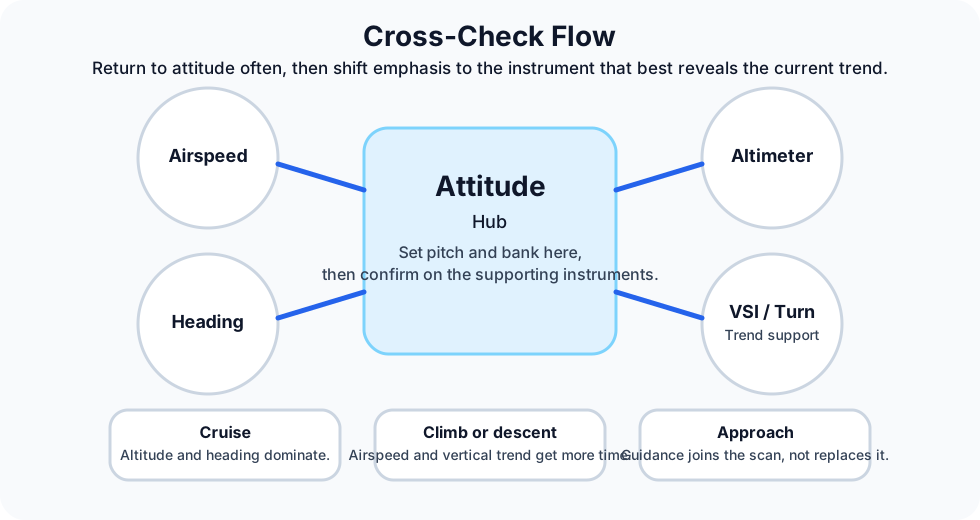
- Start at attitude.
- Check the instrument that matters most for the current maneuver.
- Return to attitude before sampling the next supporting instrument.
- Increase attention where the airplane is starting to drift.
Named Patterns
The FAA names several scan patterns because they solve different cockpit problems. The best one is the pattern you can sustain under workload without breaking the link back to attitude.
Radial
Move out from the attitude indicator to one supporting instrument at a time, then return to center.
Inverted V
Drop from attitude to the lower supporting instruments and back, keeping the scan compact and rhythmic.
Rectangular
Use a box-like pattern when you need to sample a wider set of instruments without skipping one repeatedly.
Hub and spoke
Treat the attitude indicator as the hub and every other instrument as a spoke. This is usually the most durable real-world pattern.
Selective Emphasis
The scan should change with the task. In straight-and-level flight, altitude and heading may dominate. In a constant-airspeed climb, airspeed trend and pitch picture deserve more attention. On an approach, localizer or course guidance joins the scan without replacing basic attitude control.
Level flight
Attitude, altimeter, heading, airspeed, back to attitude.
Climb or descent
Attitude, airspeed, VSI or altimeter trend, power, back to attitude.
Approach
Attitude, lateral guidance, vertical path or altitude, airspeed, back to attitude.
Trap Recovery
The classic scan traps are fixation, omission, and emphasis. The recovery is usually the same: widen the scan, level the workload, and use smaller corrections.
- Fixation: staring at one instrument long enough for another variable to drift.
- Omission: skipping an instrument until the correction becomes large.
- Emphasis: solving one problem so aggressively that another axis starts to unravel.
If the panel feels chaotic, go back to the center of the scan. Reestablish a known attitude, verify power, then rebuild the cross-check one instrument at a time.
Cockpit Cues
Say and do
- "Back to attitude": use this when you catch yourself staring.
- "Trend, not chase": correct the first hint of drift rather than waiting for a big miss.
- "One correction": do not solve altitude and heading with one large movement.
- "Rescan after every change": never hold your eyes on the instrument you just corrected.
Those cues sound simple because they are meant to interrupt bad habits quickly. Under workload, short verbal rules are easier to execute than perfect theory.
Scenario Walkthroughs
Scenario 1
Altitude drift while tuning radios
You look down to retune the next frequency and the airplane starts a slow descent before the altimeter shows a large error.
- Return to attitude first instead of staring at the altimeter.
- Confirm the vertical trend with VSI or altimeter, then make one small pitch correction.
- Resume the radio task only after the scan is stable again.
- Say: "Back to attitude, then task."
Scenario 2
Localizer intercept in light chop
The CDI starts moving and your scan wants to collapse onto lateral guidance alone.
- Keep the attitude indicator as the hub even while the localizer joins the scan.
- Check attitude, localizer, airspeed, then vertical path or altitude, and return to attitude again.
- If you start overcontrolling, slow the scan down slightly and reduce correction size.
- Say: "Guidance joins the scan, it does not own it."
References
- FAA Instrument Flying Handbook: scan technique, cross-check methods, and common errors.
- Primary and Supporting Instruments
- Deeper FlyingWorx reference on attitude instrument flying